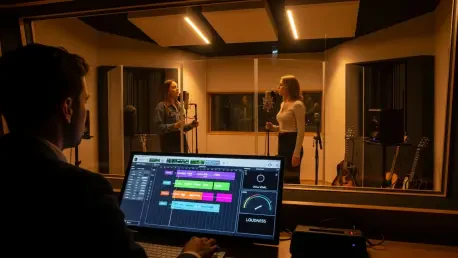

Consumers typed a few stray lines about sushi, showtimes, and rewatching a favorite film, and a minute later a full-bodied pop duet arrived—sectioned, harmonized, and loudness-matched—signaling a shift from tinkering with tools to treating text itself as the studio. That jump matters: the friction of traditional songwriting has long been time, talent, and gear, while the new constraint is simply describing intent in plain language. As AI systems cross from novelty to utility, the central question becomes whether they translate vague prompts into songs that feel deliberate rather than stitched together.
Context and Stakes
Text-to-song systems moved from research curiosities to consumer products once diffusion and transformer models could align language with musical form. The appeal is not only speed but comprehension: turning legible inputs—casual chats, captions, scene descriptions—into cohesive, shareable audio. TikTok’s preference for recognizable transformations magnifies this effect; a before-and-after that starts with visible text and ends as a hooky chorus is primed to travel. Chart success by AI-led tracks did more than grab headlines; it reset listener expectations around polish, proving that provenance does not preclude repeat plays.
Moreover, the creator economy rewards credible output on short timelines. For marketers, fans, and hobbyists, “good enough” now means radio-like loudness, clean arrangement, and memorable motifs. The winner is the system that converts the messiness of human language into form, not just style transfer.
How Suno Works
Suno’s pipeline turns loose phrases into structure before it turns structure into sound. A language-to-structure stage parses prompts, detecting repeated lines that can anchor a chorus, expanding sparse text into singable meter, and carving sections—intro, verses, choruses, and bridges—with implied dynamics. This is more than slotting words over a beat; it is probabilistic form inference, aligning natural language rhythm with lyric scansion and rhyme pressure.
Voice and performance rendering then assigns distinct vocal timbres, enabling duets and call-and-response passages. Stylistic phrasing and precise pitch treatment mimic modern pop’s tight autotune without collapsing into robotic flatness. Finally, arrangement and mixdown select instrumentation and groove from prompt cues, thread motifs across sections, and output mastered audio at consistent loudness, reducing the gap between first render and playlist-ready track.
Hands-On Test: Dinner Chat to Duet
Feeding Suno a raw exchange about ordering sushi and catching a movie—no line breaks, no lyric edits, just the tag “make it a duet”—produced multiple takes with clear verse–chorus contrast. Across regenerations, the system promoted repeated phrases into a catchy hook, balanced two vocalists with responsive phrasing, and kept transitions tight. The chorus landed predictably early and returned often, which is exactly where mainstream pop bets its attention.
Close listening revealed synthetic edges: consonants softened at times, vowels smeared under heavy pitch correction. Yet the overall impression skewed radio-friendly rather than demo-like. Regenerations changed vibe meaningfully—playful, then sentimental—without rewriting text, which proved useful for tone exploration when time was short.
Performance and Differentiation
Compared with other consumer tools, Suno’s strength lies in form discipline and vocal interplay. Many systems mimic genre but struggle with sectional logic; Suno tends to lock a sturdy chorus early and sustain momentum with builds and drops. Duet execution is another edge: assigning contrasting timbres and trading lines creates narrative shape that single-voice models rarely match.
Control is intentionally lightweight—compact prompts, explicit format cues, and iterative regen—favoring speed over granular knobs. That choice differentiates Suno for casual creators, agencies on deadlines, and social teams seeking volume. However, it also limits expert users who want melody handles, rhyme schemes, or section-level editing inside the generator rather than post-processing in a DAW.
Risks and Trade-Offs
The convenience masks thorny questions. Training data provenance and licensing remain unsettled, and voice likeness poses brand and consent risks if models drift too close to identifiable timbres. Platforms are shifting policies around AI labeling and monetization, which could affect distribution economics overnight. On craft, repetition and style homogeneity emerge under vague prompts, and once a generation lands, the model often “locks” the aesthetic, making micro-adjustments harder than a full regen.
Operationally, inference at scale trades latency against cost; fast, high-fidelity vocals are compute-hungry. If demand spikes, queues grow or audio fidelity dips—neither ideal for creators on publishing schedules.
Verdict and What to Watch
Suno compressed the path from loose idea to finished audio and made everyday language a viable songwriting substrate. The system excelled at turning repetition into hooks, staging duets with convincing call-and-response, and delivering loud, coherent mixes with minimal guidance. Its lighter control surface favored momentum but constrained fine-tuning once a take settled. For most social-first and rapid-production scenarios, that balance worked; for meticulous writers, deeper handles on melody, rhyme, and section edits would have elevated outcomes.
Looking ahead, the decisive upgrades would have been section-level editing, real-time jamming, and consented voice timbres, all wrapped in rights-aware pipelines with watermarking and revenue attribution. In short, Suno proved that text could become a song worth sharing and that AI’s role in music hinged less on replacing writers and more on collapsing distance between intent and impact.