
The enduring vision of replacing a lost limb with a seamlessly integrated bionic extension has often been overshadowed by the cumbersome reality of controlling these advanced devices, creating a significant gap between technological promise and user experience. AI-powered prosthetics represent a pivotal advancement in assistive technology, aiming to bridge this divide by fundamentally reshaping the interaction between amputees and their bionic limbs. This review explores a groundbreaking development in this field, examining its key features, performance in real-world scenarios, and profound impact on users. The purpose is to provide a thorough understanding of this new approach, its current capabilities, and its potential to restore intuitive, effortless function for individuals with limb loss.
This new wave of innovation is driven by a deep understanding of the persistent challenges that have long plagued prosthetic technology. By leveraging artificial intelligence, engineers are developing intelligent robotic prostheses designed to enhance manual dexterity while significantly reducing the cognitive burden that often leads users to abandon their devices. At its core, this research tackles one of the most persistent hurdles in prosthetics: the absence of the subconscious control that characterizes natural human movement. A new shared human-machine control system promises to make everyday tasks simple and intuitive once again, heralding a new era for assistive limbs.
The Core Challenge Overcoming Cognitive Burden in Prosthetics
The primary hurdle in prosthetic technology has long been the immense cognitive load placed upon the user. For a non-amputee, simple actions like grasping a cup or shaking a hand are executed almost reflexively, governed by subconscious neural pathways honed over a lifetime. The intricate coordination of each finger and the constant adjustment of grip strength occur without conscious thought. In stark contrast, a person using a conventional prosthesis must deliberately command every aspect of the device’s movement, transforming a simple activity into a mentally taxing exercise in fine motor control.
This lack of intuitive operation, compounded by the absence of sensory feedback, is a primary contributor to user frustration. The constant mental effort required to perform daily tasks can be exhausting, leading to a high rate of device abandonment. Research indicates that nearly half of all users eventually stop using their advanced prostheses, citing their clumsy controls and the significant cognitive burden as key reasons. Addressing this issue requires a paradigm shift—moving from devices that are merely user-operated to ones that are user-partners. The integration of artificial intelligence is proving to be the most promising path toward creating this partnership and achieving the subconscious control that mimics natural limb function.
Anatomy of an Intelligent Prosthesis
Advanced Sensory Integration A Hand That Sees
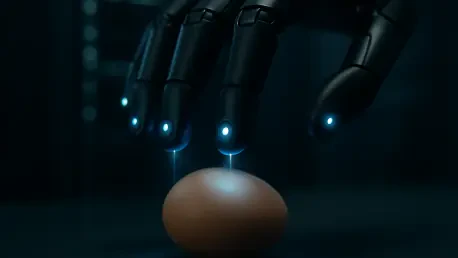
The foundation of this new intelligent prosthesis is its custom-designed sensory hardware, which grants the device a form of situational awareness previously unseen in commercial products. Engineers began with a state-of-the-art bionic hand and augmented it with bespoke fingertips embedded with a sophisticated dual-sensor system. This system combines traditional pressure sensors, which detect the force of a grip, with advanced optical proximity sensors. This latter technology represents a critical innovation, fundamentally changing how the prosthesis interacts with the world around it.
The integration of these optical sensors allows the hand to effectively “see” and interpret an object’s distance, shape, and orientation before physical contact is even made. This pre-contact awareness enables the prosthesis to anticipate the required grasp, mimicking a key aspect of natural human dexterity that relies on visual and proprioceptive cues. Each finger is equipped with its own sensor, allowing them to work in parallel and synergistically adjust to conform to an object’s unique geometry. The sensitivity of this system is so refined that it can detect an object as light as a cotton ball being dropped onto it, showcasing a level of perception that moves far beyond simple force detection.
The AI Brain Autonomous Grasping via Neural Networks
With this advanced sensory hardware in place, the next step was to develop the “brains” of the operation: a sophisticated artificial neural network. This AI model was trained extensively on vast datasets collected by the optical proximity sensors, learning to correlate specific sensor readings with the physical properties of countless objects. Through this process, the neural network developed the ability to interpret incoming sensor data in real-time and autonomously calculate the precise positioning required for each individual finger to achieve a perfect, stable grasp.
This AI-driven approach effectively offloads the most mentally demanding aspect of prosthetic control—the continuous fine-tuning of finger movements—from the user to the device itself. Instead of having to consciously micromanage the grip, the user can simply initiate the action, and the AI handles the complex calculations required to secure the object. This autonomous adjustment not only enhances the precision and stability of the grasp but also dramatically reduces the cognitive load, freeing the user to focus on the overall goal of their task rather than the mechanics of its execution.
A New Paradigm The Bioinspired Shared Control System
While a fully autonomous system is powerful, it also presents a potential conflict: the machine’s calculated decision might not always align with the user’s true intention. To resolve this, researchers developed an innovative bioinspired “shared control” paradigm. This approach creates a cooperative partnership between the human user and the AI agent, ensuring a seamless and intuitive interaction. It was carefully designed to strike the optimal balance between user command and machine assistance, preventing a scenario where the user feels they are fighting the prosthesis for control.
In this shared-control model, the user remains in ultimate command, providing the high-level intent, such as the desire to pick up an object and bring it to their mouth. The AI, in turn, acts as an intelligent co-pilot, taking that intent and executing the low-level motor details with superhuman precision. It autonomously handles the minute, subconscious adjustments of finger placement and pressure modulation, augmenting the user’s control signals without overriding them. The result is a system where the machine enhances the user’s precision while simultaneously making tasks easier and more natural to perform.
Real World Performance and User Impact
The efficacy of this AI-powered, shared-control system was validated in a study involving transradial amputees, who used the intelligent prosthesis to perform a series of standardized tests and common everyday activities. The results were overwhelmingly positive, demonstrating significant and measurable improvements in several key performance metrics. Participants exhibited far greater grip security, confidently holding objects without the persistent fear of dropping them. They also showed enhanced grip precision, allowing for the delicate handling of fragile items that would be challenging with a conventional device.
A powerful illustration of the system’s benefit was observed in a task as simple as drinking from a plastic cup—an activity fraught with difficulty for many amputees. A grip that is too weak will cause the cup to fall, while a grip that is too strong will crush it. The AI-assisted hand, however, was able to modulate the pressure perfectly, allowing the user to perform the task with confidence and ease. Critically, these substantial performance gains were achieved with measurably less mental effort and without the need for the extensive training or practice typically required to master a new prosthesis, underscoring the truly intuitive nature of the design.
Addressing a Legacy of Limitations
This new technology successfully mitigates long-standing challenges that have defined the prosthetic experience for decades. The most significant of these is the lack of tactile feedback, which in a natural hand provides the reflexive cues needed to adjust grip force automatically. The other is the absence of the brain’s subconscious predictive models, which anticipate how the hand should be shaped to interact with an object before it is even touched. These biological systems are fundamental to effortless dexterity.
The AI-powered shared-control system directly confronts these core issues by providing an effective technological substitute. The optical sensors that allow the hand to “see” and the neural network that autonomously calculates grasp patterns collectively function as an artificial replacement for the brain’s missing predictive models. By embedding this intelligence directly into the prosthesis, the system addresses the root causes of user frustration and device abandonment. It demonstrates that by making the prosthesis smarter, the interaction becomes simpler and more natural for the user.
The Future Horizon Merging AI with Neural Interfaces
This work represents a significant milestone, yet it is also a stepping stone toward an even more integrated future. The next phase of development aims to blend this advanced sensor and AI technology with ongoing research into implanted neural interfaces. These interfaces are designed to create a direct communication pathway between the user’s brain and their bionic limb, moving beyond the current reliance on muscle signals to interpret user intent.
The ultimate vision is to create a fully integrated, bidirectional system. A neural interface would not only allow individuals to control the prosthetic device directly with their thoughts but would also, crucially, transmit sensory information from the prosthesis back to the brain. This would allow a user to feel the texture of an object or the warmth of a coffee cup through their bionic hand. The fusion of an intelligent, self-adjusting prosthesis with a direct neural link promises to culminate in a bionic limb that is not just a tool, but a true, sentient extension of the user’s body.
Conclusion A Leap Toward Intuitive Bionic Limbs
The development of this AI-powered prosthesis represented a major leap forward in the field of assistive technology. By successfully integrating advanced sensors, an autonomous neural network, and a cooperative shared-control system, this approach demonstrated that the profound cognitive burden associated with prosthetic use could be dramatically reduced. It proved that complex fine motor control tasks could be effectively offloaded from the user to the device itself, resulting in a more intuitive, dexterous, and satisfying user experience.
Ultimately, the success of this technology established more than just a better prosthesis; it forged a new design philosophy centered on intelligent human-machine collaboration. The project’s lasting impact was its role in charting a clear path toward a future where a bionic limb could feel and function not as a foreign attachment, but as a genuine part of the self. The work provided a critical proof of concept, showing that by adding artificial intelligence to prosthetics, the goal of making simple tasks simple again was finally within reach.