
The seamless illusion of an actor in a dubbed film speaking a foreign language with perfect enunciation and flawlessly synchronized lip movements has quietly moved from the realm of cinematic fantasy to a tangible reality, prompting a profound question about the state of digital human creation. This technological feat, now appearing in major motion pictures, is more than just clever editing; it represents a culmination of years of research aimed at solving one of computer graphics’ most enduring challenges. As these digital alterations become indistinguishable from reality, it signals that the era of truly lifelike digital avatars—once a staple of science fiction—may have finally arrived, poised to reshape industries from entertainment to communication. These advancements, spearheaded by researchers in Germany, are not merely incremental improvements but fundamental breakthroughs in how digital humans are generated, animated, and perceived.
Have You Ever Noticed How Actors in a Dubbed Film Seem to Speak Perfect English
The technology making this cinematic magic possible is a direct result of solving deep-seated issues in digital avatar generation. For years, the creation of convincing digital humans has been a formidable task, with even the most advanced models falling short of true believability. This recent leap in visual dubbing, where an actor’s facial performance is digitally recreated to match a new audio track, serves as a powerful public demonstration of progress. It showcases an unprecedented level of realism in facial animation, one that maintains the original actor’s identity and emotional nuance while seamlessly adapting their speech.
This development naturally leads to a broader inquiry: if technology can convincingly alter a real actor’s performance on screen, does this mean we have conquered the obstacles that have long prevented the creation of fully autonomous, photorealistic digital beings? The ability to generate such high-fidelity results suggests a mastery over the subtle complexities of human expression that were previously unattainable. This transition from a theoretical goal to a practical application in a high-stakes industry like Hollywood indicates that the underlying science has reached a critical stage of maturity, moving from the laboratory into the real world.
The Uncanny Valley Why Creating Believable Digital Humans Has Been So Hard
The journey toward realistic digital humans has been a long and arduous climb out of the so-called “uncanny valley,” a term describing the unsettling feeling experienced when a digital creation appears almost, but not exactly, human. Researchers at Germany’s esteemed Max Planck Institute (MPI) for Informatics have focused on dismantling the specific barriers that cause this effect. One of the most significant challenges has been what could be termed the “puppet string problem,” where an avatar’s facial expressions are unnaturally tethered to its body posture, causing an awkward, non-human-like link between thought and motion. An attempt to make an avatar smile might inadvertently cause its shoulders to shrug, instantly shattering the illusion of life.
Further compounding the issue has been the rendering of clothing and the fragility of an avatar’s realism. Garments on digital figures have often appeared stiff and artificial, failing to fold, stretch, or interact with the body’s movements in a natural way. Moreover, many digital humans suffered from a fragile photorealism; they might look convincing from a specific, carefully chosen camera angle but would fall apart when viewed from a different perspective, revealing their synthetic nature. Perhaps the most persistent and difficult problem to solve, however, has been the “dead eyes” effect. Avatars frequently lacked the subtle, involuntary micro-expressions—the minute twitches of an eyebrow, the slight shifts in gaze, the tiny movements around the cheeks—that are essential for conveying genuine emotion and inner life, leaving them feeling vacant and robotic.
Two Breakthroughs from The Max Planck Institute A Tale of a Head and a Body
In response to these long-standing challenges, researchers at MPI have introduced two distinct yet complementary solutions that represent a paradigm shift in avatar creation. The first, titled “Audio-Driven Universal Gaussian Head Avatars,” is a system capable of animating a photorealistic 3D head using only a voice recording as input. This technology is powered by a sophisticated foundational model known as the Universal Head Avatar Prior (UHAP), which was pre-trained on a vast dataset of videos featuring diverse individuals. The core innovation of UHAP is its ability to separate a person’s static “identity,” or unique facial structure, from their dynamic “expression,” which includes all the movements associated with speech and emotion.
This separation allows the system to go far beyond simple lip-syncing. An advanced audio-encoder analyzes a voice recording and translates it into a comprehensive facial performance for the 3D model. It captures not just the movement of the lips and jaw but also the incredibly nuanced motions of the tongue within the mouth, the natural accompanying shifts in gaze, and the subtle flex of cheek muscles that occur during speech. The result is a digital head that appears to be genuinely listening and responding, bringing an unprecedented level of life to the animation. A key advantage of this pre-trained model is its efficiency, allowing it to generate highly realistic renderings from far less input data than previously required.
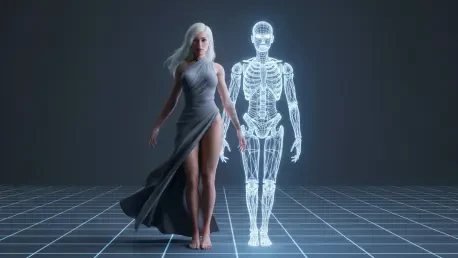
The second breakthrough, known as EVA for “Expressive Virtual Avatars,” tackles the creation of complete, photorealistic full-body avatars from multi-view video. This method introduces an innovative two-layer architecture that effectively decouples an avatar’s underlying motion from its external appearance. The foundational layer is a highly detailed digital “puppet” that captures the subject’s entire body structure, including complex hand movements and the full spectrum of facial expressions. This motion model serves as the dynamic skeleton for the avatar. The second layer then drapes the “skin” over this framework, adding photorealistic textures, intricately rendered hair, and dynamic clothing that moves realistically with the body. This separation provides two critical advantages: it allows for independent control over facial expressions and body movements, and it enables the final avatar to be rendered convincingly from entirely new viewpoints not captured in the original video.
Voices from The Vanguard What The Researchers Are Saying
The scientists behind these innovations emphasize that their goals extend beyond mere technical prowess. For them, the objective is to imbue these digital creations with a sense of genuine life. Kartik Teotia, a doctoral student on the audio-driven head project, articulated this vision clearly, stating the aim is “to create digital heads that not only synchronize with speech, but also behave lifelike.” This pursuit of authentic behavior, rather than just accurate mechanics, is a guiding principle of the research. It reflects an understanding that believability is rooted in the subtle, often unconscious, cues that define human interaction.
This sentiment is echoed by research group head Marc Habermann, who highlighted the practical breakthrough achieved with the full-body system. “With EVA, we can realistically generate movements and facial expressions independently of one another,” he explained. This solves a core animation problem that has plagued the industry for decades, finally severing the unnatural “puppet strings” that tied the face to the body. Looking at the bigger picture, MPI Director Professor Christian Theobalt sees these technologies as transformative for society. He envisions a future where such realistic avatars “could fundamentally change how we communicate, collaborate, or acquire new skills,” pointing toward applications like highly interactive and personalized virtual tutors that can engage with students on a deeply human level.
From The Research Lab to The Red Carpet The Real World Impact
The rapid transition of this research from academic papers to commercial products is fueled by a powerful innovation ecosystem. Much of this work is fostered at the Saarbrücken Research Center for Visual Computing, Interaction and Artificial Intelligence (VIA), a strategic partnership between the local university and Google. This close collaboration with industry giants ensures that foundational research is developed with real-world applications in mind, dramatically shortening the path to market. The EVA project, for instance, was developed in direct partnership with Google, while the audio-driven head avatar project involved a scientific collaboration with Flawless AI.
Flawless AI, a London-based film technology company, serves as a prime example of this synergy. Recognized as one of TIME Magazine’s 100 Most Influential Companies of 2025, the company has built its groundbreaking “Visual Dubbing” technology upon the foundational research pioneered in Professor Theobalt’s department. This technology allows filmmakers to alter an actor’s lip movements to perfectly match dialogue dubbed in another language, preserving the integrity of the original performance. This is no longer a theoretical concept; the technology made its major cinematic debut in May 2025 with the Hollywood film “Watch the Skies,” which was reworked using Visual Dubbing for its U.S. theatrical release. This concrete case study demonstrates a clear and accelerated pipeline from a university research lab directly to the red carpet.
The breakthroughs from the Max Planck Institute did more than just advance the field of computer graphics; they provided a tangible answer to a long-standing creative and technical pursuit. The development of audio-driven heads and independently controlled full-body avatars marked a definitive step across the uncanny valley. These technologies demonstrated that the key to digital realism lay not just in visual fidelity but in capturing the subtle, desynchronized complexities of human behavior. By separating identity from expression and motion from appearance, the researchers offered the world a new set of tools that have already begun to reshape global entertainment and hold the promise of transforming how we interact, learn, and connect in an increasingly digital world. The line between the real and the rendered had become irrevocably blurred.