
The intricate process of scientific discovery has often been hampered by the tedious, time-consuming task of creating publication-quality visuals, a final hurdle where researchers manually translate complex data and methodologies into clear, concise diagrams. While artificial intelligence has revolutionized text generation and data analysis, the creation of professional figures—from intricate methodology diagrams to precise statistical plots—has stubbornly remained a manual craft. This bottleneck not only consumes valuable hours but also introduces a barrier for researchers who may lack advanced graphic design skills. A new agentic AI system, developed from a collaboration between Google Cloud AI Research and Peking University, is set to dismantle this obstacle. This tool automates the entire illustration process, allowing scientists and students to generate polished, accurate visuals simply by providing text from their paper and a descriptive caption, potentially liberating them to focus more on the core ideas that drive innovation. This advancement signals a significant move toward a future where AI manages the full lifecycle of a research paper, from initial concept to final, illustrated publication.
The Architecture of Automated Illustration
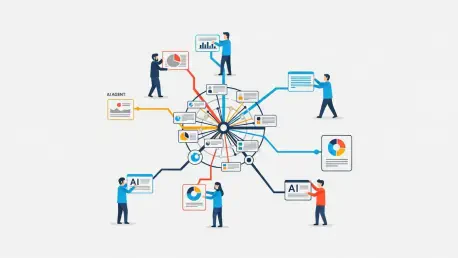
The system’s innovative approach relies on a sophisticated framework where multiple specialized AI agents collaborate to interpret, plan, and generate visuals. This multi-agent architecture is designed to mimic the workflow of a human design team, with each agent assigned a distinct role to ensure the final output is not only visually appealing but also scientifically rigorous and faithful to the source material. By breaking down the complex task of figure creation into manageable sub-tasks, the system can address the nuances of academic illustration, from adhering to specific journal formatting to ensuring the precise representation of data. This collaborative process, powered by advanced vision-language models and image generation technology, operates in an iterative, reference-driven loop, moving from conceptualization to a polished, final product that meets the high standards of academic publishing. The synergy between these agents is what allows the technology to overcome the limitations of single-model generative AI, which often struggles with the accuracy and structural logic required for scientific diagrams.
A Symphony of Specialized Agents
The first critical component in this collaborative framework is the Retriever, an agent tasked with grounding the entire creative process in established scientific precedent. When provided with a user’s text and caption, the Retriever scours a vast database of existing academic papers to identify relevant visual references. This step is crucial for preventing the generation of nonsensical or unconventional diagrams that would be out of place in a formal research paper. By analyzing successful examples of similar concepts, the Retriever provides the system with a stylistic and structural foundation, ensuring that the output aligns with the visual language of the specific academic field. Following this, the Planner agent takes over, acting as the project’s strategist. It meticulously analyzes the input text to deconstruct the core concepts and relationships, creating a detailed structural blueprint for the illustration. This plan outlines the layout, flow, and interconnection of all visual elements, effectively translating the paper’s narrative into a logical visual schematic before any pixels are generated.
The creative and technical execution is then handled by the remaining agents, each contributing a specialized skill set to refine the illustration. The Stylist acts as the team’s graphic designer, focusing entirely on the visual appeal and professional standards of the figure. This agent ensures the use of appropriate and aesthetically pleasing color schemes, selects academically compliant fonts suitable for platforms like arXiv, and applies professional design principles to enhance clarity and impact. Concurrently, the Visualizer serves as the primary “artist,” translating the Planner’s blueprint and the Stylist’s design choices into the final image. A key feature of the Visualizer is its ability to generate and execute Python code using libraries like Matplotlib for data-centric visuals. This approach ensures numerical precision in graphs and plots, effectively avoiding the “hallucinations” or factual inaccuracies that are a common pitfall for purely generative image models. This code-based method for data visualization marks a significant leap in the reliability of AI-generated scientific figures, ensuring that the beauty of the illustration does not compromise its empirical accuracy.
The Iterative Refinement Process
A generated figure is only as valuable as its accuracy, and to that end, the system incorporates a rigorous quality control mechanism embodied by the Critic agent. Once the Visualizer produces an initial draft of the illustration, the Critic meticulously reviews it, acting as a tireless proofreader with an exacting eye for detail. This agent cross-references the generated image against the original source text and caption, checking for any inaccuracies, inconsistencies, or deviations from the Planner’s structural blueprint. It assesses everything from the correct labeling of components to the logical flow of the diagram, ensuring that the visual representation is a faithful and unambiguous translation of the research concepts. If any discrepancies are found, the Critic rejects the draft and provides specific, targeted feedback, demanding revisions from the other agents. This initiates a continuous feedback loop where the illustration is iteratively refined until it meets the Critic’s stringent quality standards. This process ensures a high-quality, error-free result that is ready for publication.
The performance of this multi-agent system has been validated through rigorous testing on a newly introduced benchmark, PaperBananaBench, which comprises a challenging set of diagrams sourced from publications at the prestigious NeurIPS 2025 conference. In head-to-head evaluations, the automated system consistently outperformed baseline models across a range of key metrics, including faithfulness to the source text, conciseness of the visual representation, overall readability, and aesthetic quality. The results demonstrated that the AI-generated illustrations could match, and in some cases even surpass, the clarity and professional appearance of human-created diagrams. Beyond creating entirely new visuals from scratch, the technology also proved its utility as a powerful enhancement tool. Researchers can use the system to refine and professionalize existing human-drawn diagrams by applying consistent, high-quality style guides, instantly elevating the visual standard of their work. This dual capability makes it a versatile asset for researchers at all stages of the publication process.
A New Paradigm in Scientific Communication
The introduction of this automated illustration system represented more than just an incremental improvement in AI capabilities; it signaled a fundamental shift in the research workflow. By successfully automating one of the most labor-intensive parts of academic publishing, the technology enabled researchers to redirect their efforts from the mechanics of graphic design toward the core of their scientific inquiry. The ability to rapidly generate and iterate on high-quality visuals directly from manuscript text streamlined the entire process of paper preparation, reducing the time from discovery to dissemination. This development was not merely about convenience but about empowering a more efficient and focused scientific community, where the clarity and impact of a researcher’s work were no longer constrained by their artistic skill or access to design resources. The system ultimately stood as a critical milestone on the path toward the “AI scientist”—an integrated system capable of managing the complete research lifecycle, from ideation and experimentation to writing, formatting, and illustration.