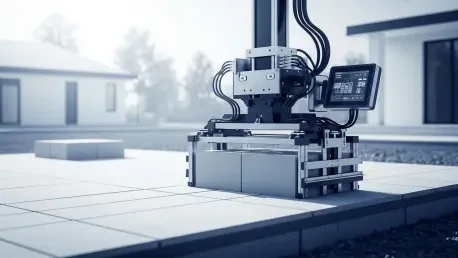

The global construction industry currently faces an unprecedented convergence of rising material costs, chronic labor shortages, and an urgent demand for affordable housing that traditional building methods struggle to satisfy. While the sector has historically been slow to adopt digital transformation, the emergence of sophisticated mobile robotic systems suggests a fundamental shift in how urban environments are developed. FBR Limited, a technology firm listed on the Australian Securities Exchange, is currently spearheading this change through its Hybrid Robotic Housing Strategy. At the forefront of this movement is the Hadrian X, a high-precision block-laying machine designed to operate in complex outdoor environments where manual labor often falters. This robotic system does not merely mimic human movement but optimizes the entire masonry process by utilizing advanced sensors and software to ensure structural integrity. By addressing the critical bottleneck of bricklaying, the technology offers a scalable solution for developers seeking to accelerate project timelines while maintaining strict quality standards across diverse residential landscapes.
Transitioning to Commercial Robotic Masonry
The movement of construction robotics from experimental laboratory settings to full-scale commercial applications represents a significant milestone in the evolution of modern building infrastructure. Central to the success of the Hadrian X is its proprietary dynamic stabilization technology, which allows the machine to maintain extreme precision despite wind, vibration, or uneven terrain. This capability is vital for outdoor construction, where environmental variables typically hinder the accuracy of automated systems. Recent deployments have demonstrated that this robotic approach can lay blocks significantly faster than traditional crews, while also virtually eliminating the human error that leads to costly structural adjustments later in the build. Furthermore, the integration of 3D modeling allows the robot to cut blocks to exact specifications before they are placed, which drastically reduces on-site waste. As investors within the All Ordinaries index observe these advancements, the transition from pilot programs to live residential projects signals a growing confidence in the reliability of automated masonry for high-volume housing developments between 2026 and 2028.
Redefining Value: The Wall as a Service Model
Adopting a “Wall as a Service” business model transformed the way developers approached the financial and logistical hurdles of large-scale masonry projects. Instead of purchasing expensive hardware, construction firms outsourced the structural assembly to specialized robotic fleets, allowing for predictable costs and streamlined project management. This shift encouraged industry leaders to prioritize data-driven planning and sustainability, as the automated systems provided granular insights into material usage and efficiency. To capitalize on these advancements, stakeholders began integrating robotic workflows into the early design phases, ensuring that architectural plans were optimized for machine precision from the outset. Educational institutions also adjusted their curricula to prepare a new generation of technicians capable of overseeing automated sites rather than performing manual labor. By focusing on these integrated solutions, the industry moved toward a more resilient housing supply chain that balanced rapid growth with environmental responsibility. This strategic pivot ensured that technological innovation translated directly into tangible community benefits through the faster delivery of high-quality homes.