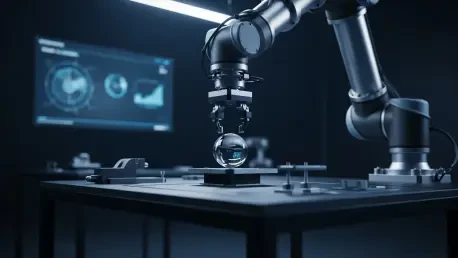

The long-promised future of household robots assisting with daily chores has been consistently stalled by a deceptively simple challenge: the ability to skillfully and adaptively handle everyday objects. Industrial robots can weld a car frame with flawless repetition, but they lack the innate sense of touch that allows a person to grasp a delicate wine glass or a heavy book with the appropriate force. This critical gap between rigid programming and fluid intuition has largely confined automation to the predictable world of the factory floor. However, a significant breakthrough in machine learning is finally teaching robots not just to copy human movements, but to understand and generalize the subtle intentions behind them, heralding a new era of dexterous, adaptable machines. This novel system achieves human-like precision by requiring only a minimal amount of training data, a development poised to reshape our interaction with automated systems in homes, hospitals, and beyond.
The Rigidity of Modern Automation
The core limitation preventing robots from entering our dynamic world is their fundamental inflexibility, a problem often termed the “dexterity gap.” Most robotic systems operate on pre-programmed trajectories, executing movements with incredible precision as long as the environment remains perfectly controlled and unchanged. This is ideal for an assembly line, where every component is identical and arrives in a predictable orientation. However, when faced with the unpredictability of a real-world setting—an object of a slightly different size, weight, or material—these systems falter. They cannot intuitively adapt their grip or motion based on sensory feedback in real time. This inability to adjust to physical interaction is the primary obstacle that stops robots from performing complex, interactive tasks such as assisting the elderly, preparing a meal, or navigating and manipulating objects in an unfamiliar environment, tasks that humans perform effortlessly every day.
Historically, attempts to bridge this gap have relied on motion reproduction systems (MRSs), which have consistently proven to be too brittle for practical application. The methodology behind MRSs is straightforward: a human operator performs a task using a teleoperated robotic arm, and the system records the precise sequence of movements. The robot is then programmed to replicate this exact sequence. While effective for a single, specific object, the weakness of this approach is its profound lack of generalization. The system’s performance deteriorates dramatically if a new object does not perfectly conform to the physical properties of the one used during the initial recording. This fragility severely restricts the versatility and utility of such robots, as the real world is inherently variable. A robot trained to pick up a specific can of soup would struggle or fail entirely if presented with a carton of milk, rendering the technology impractical for the very dynamic service roles it is intended to fill.
A Leap Forward in Adaptive Learning
Seeking to overcome these long-standing challenges, a research team from Japan’s Keio University and Tokyo University of Science has pioneered a novel approach that fundamentally rethinks how robots learn. At the heart of their innovation is the strategic use of a sophisticated machine learning technique known as Gaussian process regression (GPR). Unlike many common deep learning models that demand vast, often prohibitively large datasets for training, GPR is a non-linear regression method that excels at identifying complex, underlying relationships between variables from a remarkably small amount of data. This exceptional efficiency is a crucial advantage, as it dramatically reduces the time, computational power, and financial investment required to train a capable robotic system, making advanced automation more accessible. The team’s system moves beyond rote memorization of actions and instead aims to instill a deeper, more generalized understanding of physical interaction.
The mechanism behind this new system is both elegant and highly effective in its design. The learning process begins by having the GPR model observe a human operator manipulating just a few objects with varying physical properties, such as different levels of stiffness. Instead of merely logging the movements, the model meticulously analyzes the intricate relationship between an object’s inherent characteristics, which the researchers term “environmental stiffness,” and the corresponding position and force commands executed by the human. Through this analytical process, the model achieves something far more profound than simple mimicry: it learns to infer the human’s underlying “motion intention.” This abstracted understanding allows the robot to build a generalized concept of how to apply force and adjust its grip based on an object’s perceived feedback. Consequently, when the robot encounters a completely new object, it can generate a novel, appropriate set of commands by predicting how a human would intuitively handle it.
Putting Intuition to the Test
To validate the performance of their groundbreaking system, the researchers conducted a series of rigorous tests, benchmarking their GPR-based approach against three alternative methods: a conventional motion reproduction system, a linear interpolation model, and a typical imitation learning model. The results unequivocally demonstrated the superiority of their design. In tests involving interpolation—tasks where the robot had to manipulate objects whose stiffness fell within the range of the items used during the training phase—the new system showcased a dramatic increase in accuracy. It successfully reduced the average root-mean-square error (RMSE) by at least 40% for position commands and 34% for force commands compared to the next-best method. This marked a significant enhancement in the robot’s ability to precisely reproduce nuanced motions for objects that were similar, but not identical, to its training experience, proving its fine-tuned learning capabilities.
The system’s true potential, however, was most compellingly revealed during the more challenging extrapolation tests. In these scenarios, the robot was tasked with handling objects that were either significantly harder or softer than any it had encountered during its minimal training. This is a critical benchmark for true adaptability, as it measures the ability to generalize knowledge to entirely new situations rather than just interpolating between known data points. The results were nothing short of remarkable. The GPR-based system exhibited a staggering 74% reduction in position RMSE, showcasing a robust and powerful capacity to reason about unfamiliar physical properties. This demonstrates that the robot was not merely replaying learned movements but was applying a deeper, more abstract understanding of human-object interaction to solve novel problems, a crucial leap toward creating truly intelligent and versatile machines.
The Dawn of Dexterous Machines
The far-reaching implications of this work signaled a pivotal moment in robotics. By successfully modeling the complex nuances of human interaction with minimal training data, this new paradigm for motion reproduction systems has created a viable path for generating highly dexterous commands applicable to a wide variety of objects. This breakthrough was a critical step in moving robots from the structured confines of industrial settings into more sophisticated and dynamic service roles. The low data requirement proved to be a particularly significant advantage, as it drastically lowered the financial and computational barriers that have often hindered the adoption of advanced machine learning. As lead researcher Mr. Akira Takakura noted, this accessibility could empower companies previously unable to invest in machine learning due to data acquisition costs. This opened a vast landscape of potential applications, from advanced life-support robots that must adapt to assist different individuals to versatile assistants in homes and hospitals. Ultimately, this research provided a powerful and efficient pathway to capturing and recreating complex human skills, paving the way for a new generation of more adaptable, intuitive, and capable robots.