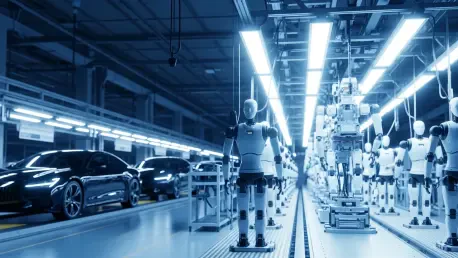

In a move that sent reverberations through both the automotive and tech industries, Tesla has announced it will cease production of its foundational Model S and Model X vehicles next quarter, marking a definitive pivot away from its luxury electric vehicle roots. The company, which arguably created the modern EV market, is now betting its future not on four-wheeled vehicles, but on two-legged robots and a network of autonomous taxis. This strategic realignment involves repurposing its Fremont, California, factory to manufacture the Optimus humanoid robot, a clear signal that the company’s leadership sees its destiny in artificial intelligence rather than just on the highway. This decision arrives at a critical juncture, forcing investors and consumers alike to question whether this is a visionary leap into the future or a desperate gamble driven by mounting pressures in its core business.
A Response to Market Headwinds
The decision to abandon two of its flagship models is not occurring in a vacuum, as it coincides with a notably challenging financial period for Tesla’s automotive division. The company’s most recent quarterly report painted a concerning picture, revealing an 11% year-over-year decline in total automotive revenues and a 3% drop in overall company revenue. Vehicle deliveries, a key metric for the automaker, plunged by 16% in the fourth quarter, a downturn that even the much-hyped Cybertruck could not escape, as its sales also experienced a significant decline. While the company managed to surpass Wall Street’s earnings and revenue expectations for the quarter, the underlying trend points toward a business facing significant headwinds. The report itself frames this period as a deliberate transition, recasting Tesla’s identity from a hardware-centric automaker to what it terms a “physical AI company,” suggesting the pivot is a calculated response to these market realities.
Further complicating Tesla’s position is the rapidly intensifying competition within the electric vehicle space, a market it once dominated with little opposition. The automotive landscape has transformed, with rivals like BYD emerging as formidable challengers. In fact, BYD recently surpassed Tesla to become the world’s largest electric car manufacturer, achieving this milestone largely by offering a range of more affordable alternatives that appeal to a broader consumer base. This increasing pressure from both established automakers and new EV-focused companies has eroded Tesla’s market share and put its premium pricing strategy to the test. The shift away from the high-end Model S and Model X, therefore, can be interpreted as a strategic retreat from a segment where competition is fierce and margins are under threat, allowing the company to redirect its focus toward a new, and potentially uncontested, technological frontier.
Betting the Company on an AI Future
In place of its established automotive lines, Tesla is channeling immense resources into highly ambitious, AI-driven initiatives that are still in their nascent stages. CEO Elon Musk is vigorously promoting the Optimus robot and a fleet of self-driving Robotaxis as the true future of the company, projecting a level of growth that dwarfs anything its car business could achieve. Despite these technologies not yet being commercially viable or widely deployed, the vision is one of transformative potential. Musk has publicly declared that he envisions Optimus becoming the “biggest product of all time,” with initial production slated to begin by the end of this year. This is not a tentative exploration but a full-throated commitment to a future where Tesla’s primary products are autonomous machines designed for labor and transportation, fundamentally altering the company’s business model and its role in the global economy.
To fuel this monumental shift, the company is undertaking a significant capital reallocation, underscoring the seriousness of its new direction. Tesla has committed to a capital expenditure of $20 billion to build out the infrastructure required for its AI and robotics ambitions. Furthermore, the company has directly invested $2 billion in Musk’s separate xAI venture, a move that solidifies the symbiotic relationship between its hardware development and cutting-edge artificial intelligence research. This massive financial deployment represents a clear and unequivocal bet on a future dominated by AI. By consciously moving capital away from proven vehicle production lines and into speculative, long-term technology projects, Tesla is signaling to the market that it is no longer content to be just a car company, but aims to be the definitive leader in the age of physical artificial intelligence.
A New Chapter’s Uncertainties
The company’s strategic overhaul from an electric vehicle pioneer into a robotics and AI powerhouse marked a pivotal moment in its history. This decision was presented not as a reaction to market difficulties but as a proactive leap toward a new technological paradigm. The discontinuation of the Model S and Model X was framed as a necessary step to free up critical resources for what leadership believed would be a far more lucrative future. The substantial financial commitments to both the Optimus project and associated AI ventures demonstrated a firm belief in this new path. Ultimately, this profound transformation concluded one chapter of the company’s story and began another, leaving the final judgment of its success or failure to the years that followed.