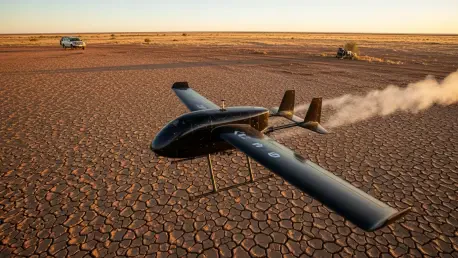

We are joined by Oscar Vail, a Technology expert with a keen interest in emerging fields such as quantum computing, robotics, and open-source projects. He is consistently at the forefront of advancements in the industry, and today he offers his insights on the incredible world of high-speed, custom-built drones. This conversation explores the engineering feats behind the ‘Blackbird’ drone, which recently clocked an unofficial speed of 430 mph, the innovative design choices that make such speeds possible on a budget, and the logistical challenges of chasing world records in the remote Australian outback. We’ll delve into the technical trade-offs of its minimalist design, the high-risk, high-reward power system, and what it will take to officially break the 700kmh barrier.
Your Blackbird drone was built for around $3,000, not much more than a high-end consumer model. Can you walk me through the key design decisions you made to achieve such extreme performance on a modest budget, detailing the most challenging components to source or create from scratch?
It’s truly a testament to clever engineering over lavish spending. The core philosophy was to push existing, accessible components to their absolute limits rather than sourcing exotic, multi-million-dollar parts. The most critical decision revolved around the powertrain, specifically selecting those AAX 2826 Competition motors. The challenge wasn’t necessarily sourcing them, but in the integration. Creating a frame from scratch that could handle the immense stress and vibration at over 400 mph while remaining lightweight was the real hurdle. Every gram matters, so building a custom chassis that perfectly complements off-the-shelf performance parts is where the magic, and the difficulty, really lies.
You chose to solder the motors directly to the speed controllers, a method that reduces weight by eliminating wiring. Could you explain the performance trade-offs of this design? Please share some specifics on how this streamlined setup impacts the drone’s aerodynamics and stability at over 400 mph.
That direct-solder method is a high-stakes choice, but it’s essential for this level of performance. The immediate benefit is, as you said, the weight reduction from eliminating connectors and excess wiring. But the aerodynamic advantage is just as crucial. This approach allows the drone’s arms to be incredibly thin and light. When you’re punching through the air at nearly 700 kilometers per hour, any bit of surface area creates immense drag. By keeping the arms sleek, you minimize turbulence, which is absolutely critical for maintaining stable flight. The trade-off, of course, is a lack of modularity; a blown motor or controller becomes a much more intensive repair job, but for a pure speed-run vehicle, you gladly sacrifice convenience for raw efficiency.
Unlike many competitors, your design uses a dual-battery system that is slightly overcharged. Could you detail the specific risks and rewards of this high-voltage approach? Please elaborate on how it helps manage heat and deliver the necessary power during a peak throttle speed run.
The dual-battery setup is our secret weapon, but it’s also the most dangerous part of the design. The primary reward is delivering an enormous amount of power to the motors exactly when needed for that peak throttle run. By slightly overcharging them, we push the voltage ceiling higher, which allows the drone to run not only faster but also cooler, as higher voltage reduces the current draw and thus the heat generated. The risks, however, are significant. Overcharging lithium polymer batteries is inherently unstable and drastically shortens their lifespan; we’re talking about a very limited number of flight cycles. There’s always a danger of catastrophic failure, but for that brief, record-breaking window, it provides an unparalleled power-to-weight ratio that a single, standard-voltage battery just can’t match.
The recent 690kmh run in the Australian outback was an incredible achievement, though it remains unofficial. Could you share an anecdote from that day and describe the logistical hurdles, such as finding a professional observer, you face when organizing these attempts in such a remote location?
The feeling of seeing that 690kmh number flash on the screen was pure adrenaline, but it was immediately followed by the frustrating realization that it wouldn’t count. The biggest hurdle is simply geography. We’re operating in the vast, empty Australian outback for safety, but that makes logistics a nightmare. The most challenging part is coordinating a professional observer. You’re asking a certified expert to venture into the middle of nowhere on short notice, often with unpredictable weather conditions. For this last run, we simply couldn’t get an official in place in time. It’s a constant battle between finding the perfect, safe location for a 400 mph flight and being close enough to the resources and people needed to make it all official in the record books.
You’ve held the official record before and are now poised to reclaim it. Beyond just securing an official observer for your next attempt, what specific technical refinements are you planning for the Blackbird to definitively break the 700kmh barrier and what is the biggest engineering challenge?
Securing an observer is priority one, but technically, we’re always pushing forward. The next evolution of the Blackbird will focus on further aerodynamic refinement and even more aggressive weight reduction. We’re looking at tweaking the shape of the arms and body to achieve a lower drag coefficient, which becomes exponentially more important as you approach these speeds. The biggest engineering challenge remains power management. We need to extract even more performance from the batteries and motors without causing them to fail under the extreme load. Pushing past 700kmh is a game of marginal gains, and ensuring the entire system can survive that final, most powerful throttle punch is the ultimate test.
What is your forecast for high-speed drone development?
I believe we are on the cusp of some truly staggering advancements. The 700kmh barrier is just the next milestone; it won’t be long before we see garage-built drones pushing even faster speeds. The real evolution, however, will be in applying these high-speed principles to more practical applications. While record-chasing is a fantastic driver of innovation, the materials, motor technologies, and aerodynamic efficiencies we’re learning about here will eventually trickle down. Imagine search and rescue drones that can cover vast distances in minutes or rapid-response delivery systems. The hobbyist and pro-sumer scenes will continue to lead the charge, consistently out-innovating the big-budget corporate labs because they are driven by pure passion and a willingness to take risks.