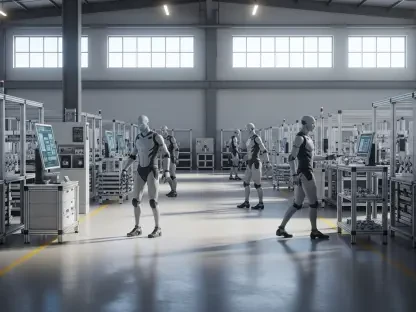
In Las Vegas, a new kind of combat is emerging, where human-piloted robots fight not with saws and hammers, but with fists and kicks. This is the world of humanoid robot fighting, a field that blends athletic competition with advanced robotics. We spoke with technology expert Oscar Vail to understand the challenges and the incredible potential behind this burgeoning sport, from the intricacies of pilot control and the crucial role of data collection to what it will take to bridge the gap between today’s tech and the spectacles we’ve seen in science fiction.
Your events feature human-piloted humanoid robots, a shift from the typical demolition-style bots. What unique challenges does the humanoid form present for pilots, and how does this focus on human movement create a more compelling story for the audience? Please provide a specific example from a match.
The shift to a humanoid form completely changes the game. With the older, wheeled demolition bots, it was really a contest of engineering brute force—who could build the toughest wedge or the most destructive spinner. Here, the challenge is one of finesse and human expression. The pilots are contending with gravity, balance, and the complex dynamics of a two-legged machine. You see it in the ring when the combatants, about the size of schoolchildren, stumble a bit as they throw a punch. In one match, I watched a robot wind up for a massive kick, only for the pilot’s ambition to outstrip the machine’s balance, causing it to flail wildly. The crowd laughed, but they were also cheering, because they weren’t just watching a machine fail; they were feeling the pilot’s struggle and intent. That’s the compelling story—the human drama playing out through a robotic avatar, transforming it from a demolition derby into something with a real human narrative at its core.
Pilots use motion-sensing controllers to have robots mirror their actions in real time. Can you describe the main technical hurdles in achieving perfect replication of a pilot’s movements? What specific steps are you taking to improve the robot’s accuracy and reduce the lag between command and action?
The biggest hurdle is the gap between human intention and robotic execution. A pilot using motion-sensing controllers is performing fluid, complex actions, but the robot is trying to replicate them “more or less accurately,” which is a huge technical challenge. There’s an inherent latency, a slight delay between the pilot’s punch and the robot’s swing, that can make the machines look like “blindfolded boxers” at times. Furthermore, the controllers and cameras have to translate subtle shifts in a pilot’s body into commands for dozens of motors simultaneously. To tighten this up, the focus is on refining the software that interprets the motion data. By analyzing every movement, we can create predictive algorithms that anticipate the end of a motion, starting the robot’s action a fraction of a second sooner. It’s a constant process of improving the data pipeline to make the robot a true, real-time extension of its pilot.
Beyond sheer entertainment, these bouts serve as research by collecting body movement data. Could you walk us through how data from one match is used to train robot software? Please share a key insight this research has revealed about improving a robot’s balance or reflexes during combat.
Absolutely. Every single fight is a massive data-gathering exercise. Think of a single three-minute round: we’re collecting thousands of data points on every punch, kick, block, and stumble. This data is then fed into machine learning models. For example, when a robot takes a heavy blow and staggers, we capture the exact forces, angles, and the pilot’s corrective movements. By analyzing hundreds of these events, the software learns to recognize the precursors to instability. A key insight we’ve gained is in proactive balancing. Instead of just reacting to a loss of balance, the software can now predict it based on an incoming attack’s trajectory and the robot’s current stance, allowing it to automatically make micro-adjustments to its footing. This is how we move from robots that simply mirror actions to robots that possess their own refined reflexes.
The spectacle has been compared to the movie ‘Real Steel’, though the current technology is less advanced. What are the top two or three technical advancements—in either hardware or software—that are needed to bridge this gap? Describe your plan for implementing these over the next five years.
That ‘Real Steel’ comparison is both a benchmark and a constant reminder of the road ahead. To get there, the first major advancement we need is in hardware, specifically actuator technology. The robots in the film are incredibly fast and powerful, while our current models are more measured. We need motors that are stronger, faster, and more energy-efficient to deliver knockout blows without compromising stability. The second leap has to be in software, achieving near-zero latency in the control system. This means moving beyond current-generation motion controllers to more integrated systems that capture a pilot’s full-body kinematics. Over the next five years, our plan is an aggressive, iterative cycle. We will introduce new generations of hardware annually, funded by the growing success of events in places like San Francisco, while our software team continuously deploys updates trained on the data collected from every single bout.
What is your forecast for the sport of humanoid robot fighting over the next decade?
I believe this is truly the sport of the future. Over the next decade, we’re going to see an exponential curve in technological advancement and audience engagement. Right now, it’s a thrilling spectacle drawing in young tech professionals and curious crowds, but as the technology matures, the “human stories” of the pilots will come to the forefront. The robots will become more agile and responsive, allowing for a higher level of skill and strategy to be displayed. I envision it evolving into a global league, much like e-sports, but with a visceral, physical component that no video game can replicate. The clumsy, stumbling bots of today will be seen as the charming pioneers of a major international sport where the connection between pilot and machine is as celebrated as the athleticism in any other arena.