
Achieving sub-micrometer precision across expansive workspaces has long remained the elusive goal for engineers who found themselves trapped between the rigid limitations of stationary stages and the inherent inaccuracy of mobile robotic platforms. The emergence of the Holonomic Beetle (HB) signifies a departure from these traditional constraints, offering a sophisticated synthesis of microscopic accuracy and macroscopic mobility. This technology, pioneered by researchers at Yokohama National University, introduces a paradigm where miniature robots no longer require fixed tracks to perform high-stakes operations. By reimagining the structural interplay between the actuator and the environment, the HB provides a versatile solution to the “range versus resolution” dilemma that has hindered progress in micro-assembly for years.
At its core, the technology leverages the unique properties of piezoelectric materials to bridge the gap between static precision and mobile versatility. Unlike conventional electromagnetic motors that suffer from backlash and frictional energy loss, the HB utilizes a series of rapid, microscopic mechanical pulses to generate motion. This approach allows the device to operate with the finesse of a laboratory-grade precision stage while maintaining the freedom to navigate a standard workbench. The context of its evolution is defined by the growing demand for “on-the-fly” manufacturing, where components must be assembled with atomic-level accuracy over surfaces that span several centimeters or even meters.
Evolution of Precision and Mobility in Microrobotics
The historical trajectory of microrobotics has been defined by a frustrating binary: a system could either move several meters with centimeter-level error or move several micrometers with nanometer-level error. This conflict created a bottleneck in industries where small parts need to be transported across large cleanroom facilities. The Holonomic Beetle emerged as a direct response to this limitation, utilizing a design that functions as a mobile precision stage. By eliminating the heavy, anchored frames of traditional positioning equipment, this technology allows for a more flexible and decentralized approach to micro-engineering.
Furthermore, the relevance of this evolution lies in the shifting needs of modern fabrication. As electronic components shrink and biological manipulation becomes more complex, the tools used for assembly must become more agile. The HB represents the transition from “passive” precision—where the environment is moved to the tool—to “active” precision, where the tool autonomously finds the work. This shift is critical for the next generation of smart factories, where modularity and space efficiency are prioritized over massive, single-purpose machinery.
Technical Foundations of the Holonomic Beetle
Piezoelectric Actuation and Motion Resolution
The primary driver behind the Holonomic Beetle’s success is its reliance on piezoelectric ceramics, which transform electrical energy into physical displacement with remarkable efficiency. When an electrical field is applied, these materials undergo minute expansions or contractions, creating a “walking” motion at a frequency high enough to be perceived as fluid movement. This method is fundamentally superior to geared systems because it eliminates the mechanical play and friction that typically degrade resolution at the sub-micrometer scale. Each step taken by the HB can be controlled at a level of granularity that exceeds the visual capabilities of standard microscopes.
Moreover, the high-resolution displacement offered by piezoelectric actuation ensures that the robot can maintain its position even when faced with minor environmental disturbances. Because the movement is linked directly to the crystal lattice of the ceramic material, there is a one-to-one relationship between the electrical signal and the physical output. This level of control allows for a resolution that remains consistent whether the robot is performing a high-speed transit or a delicate final positioning task. The technical significance of this implementation is its ability to deliver repeatable, predictable results without the need for the bulky dampening systems required by traditional stages.
Holonomic Kinematics and Multi-Axis Maneuverability
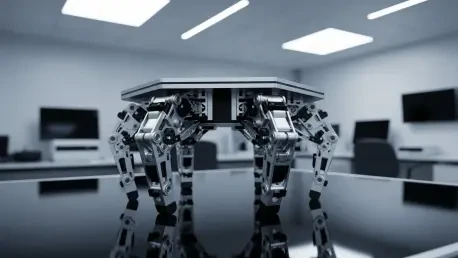
A defining characteristic of the HB is its holonomic movement, which refers to the ability to control all degrees of freedom independently. Specifically, the robot can move in the X and Y horizontal planes while simultaneously rotating (Theta) without needing to change its primary orientation. This is achieved through a specialized arrangement of actuators that allows for omnidirectional travel. In practical terms, this means the beetle can strafe sideways or spin in place, a capability that is invaluable when navigating the cramped, obstacle-rich environments common in micro-electronic assembly lines.
The kinematic design allows for a level of maneuverability that non-holonomic robots—such as those with standard wheels—simply cannot match. In the context of micro-manipulation, the ability to make lateral adjustments without a turning radius reduces the complexity of path-planning algorithms and minimizes the risk of collisions. This technical advantage ensures that the HB can approach a workpiece from any angle, facilitating the assembly of multi-faceted MEMS devices that require precise alignment from various perspectives. The integration of such high-level maneuverability into a palm-sized platform marks a major milestone in mechanical engineering.
Latest Developments in Micro-Positioning Control
Recent progress in the field has focused heavily on refining the feedback loops that govern the robot’s movement. By integrating Proportional-Integral-Derivative (PID) control with high-resolution optical encoders, developers have successfully minimized the trajectory errors that previously plagued mobile microrobots. These encoders provide real-time data on the robot’s actual position, allowing the control system to make instantaneous adjustments. This development is crucial because it compensates for surface irregularities or minor slippage that could otherwise lead to a loss of accuracy over long distances.
In addition to control algorithms, there is a clear trend toward the total autonomy of these platforms. Modern iterations of the HB are increasingly capable of executing complex, pre-programmed paths with Root Mean Square Error (RMSE) values consistently below one micrometer. This transition from a stationary laboratory tool to a mobile, autonomous unit is reshaping industrial manufacturing. It allows for a “swarm” approach to assembly, where multiple robots work in concert on a single large-scale project, each maintaining sub-micrometer precision while traversing the shared workspace.
Real-World Applications and Implementation
The practical utility of the Holonomic Beetle is most evident in the fabrication of semiconductors and the assembly of micro-electro-mechanical systems (MEMS). In these sectors, the ability to move small silicon wafers or sensors with extreme accuracy is paramount. The HB serves as a bridge, allowing these components to be moved between different processing stations without losing their alignment. This capability reduces the reliance on large, expensive conveyor systems and allows for a more compact and efficient cleanroom layout.
Beyond industrial manufacturing, the HB is finding a niche in biological research and materials science. It is particularly useful for tasks such as cell manipulation or the placement of microscopic sensors on specialized surfaces. In these scenarios, researchers often need to work across expansive areas while requiring the precision to interact with single-micrometer structures. The HB provides a scalable solution, offering the flexibility to work on large glass slides or petri dishes while maintaining a level of accuracy that was previously only available through the use of stationary, high-cost micromanipulators.
Technical Hurdles and Market Obstacles
Despite its impressive capabilities, the technology faces several persistent challenges, most notably regarding mechanical rigidity. Because the robot is lightweight and mobile, it is more susceptible to external vibrations and structural flexing than a heavy, granite-mounted precision stage. These factors can introduce noise into the positioning data, potentially compromising accuracy during high-speed operations. Furthermore, the speed of piezoelectric motors is currently lower than that of their electromagnetic counterparts, which can limit the overall throughput of a manufacturing line.
To address these limitations, ongoing research is focused on optimizing the structural design of the beetle to enhance stiffness without significantly increasing weight. Engineers are also exploring more sophisticated control algorithms that can predict and suppress environmental vibrations in real-time. Market adoption is another hurdle, as many industries are hesitant to replace proven, stationary equipment with relatively new mobile technology. Overcoming this resistance will require continued demonstrations of long-term reliability and the development of more user-friendly interfaces for robot programming.
Future Trajectory and Technological Breakthroughs
The trajectory of this technology is moving toward more advanced model-based control systems that can account for complex environmental variables. By shifting away from simple PID loops to systems that “understand” the physics of the robot’s interaction with the floor, developers hope to push precision limits even further. There is also a significant push toward scalability, with the goal of producing low-cost, mass-manufactured versions of the HB. This would allow smaller laboratories and startup manufacturers to access the kind of precision that is currently reserved for large-scale industrial players.
Potential breakthroughs in material science may also lead to the development of new piezoelectric compounds that offer faster response times and higher displacement. Such advancements would resolve the current speed limitations, making the HB a viable replacement for high-speed pick-and-place machines. The long-term vision includes the creation of a modular ecosystem where various “beetles” with different specialized tools can collaborate on complex, multi-stage assembly tasks. This evolution would effectively turn any flat surface into a high-precision factory floor.
Final Assessment of the Holonomic Beetle
The Holonomic Beetle succeeded in demonstrating that mobility and sub-micrometer precision are no longer mutually exclusive properties. The research proved that a compact, piezoelectric-driven platform could navigate complex trajectories while maintaining an error margin of only a few micrometers. This achievement successfully bridged a long-standing gap in engineering, providing a blueprint for a new generation of micro-positioning tools. By moving beyond the physical constraints of stationary stages, the project opened new avenues for flexibility in high-tech manufacturing and research.
Ultimately, the development team provided a compelling case for the transition toward autonomous, mobile precision equipment. The performance metrics achieved in recent tests indicated that the technology reached a level of maturity suitable for more demanding industrial environments. As future iterations focus on increasing motor speed and structural rigidity, the long-term impact on the precision engineering industry was established as profound. The Holonomic Beetle stood as a pivotal advancement, marking the moment when high-precision work finally broke free from its fixed anchors.