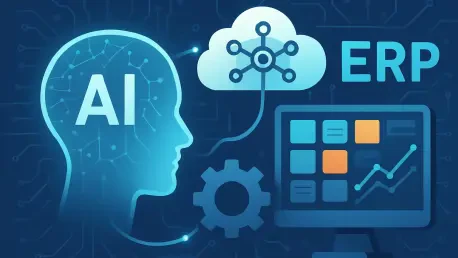

The global corporate landscape is currently experiencing a monumental shift as traditional Enterprise Resource Planning systems evolve from static repositories of historical data into dynamic, intelligent ecosystems. This transformation is primarily driven by the deep integration of Artificial Intelligence, which allows modern businesses to transcend simple record-keeping in favor of proactive, real-time organizational management. In this current environment, companies are no longer satisfied with merely tracking what occurred in previous fiscal quarters; instead, they are leveraging sophisticated algorithms to dictate future actions across critical departments such as finance, supply chain logistics, and human resources. The necessity for this evolution stems from the increasing complexity of global trade, where the margin for error has narrowed significantly, requiring software that acts as a strategic partner rather than a passive digital filing cabinet. By adopting these advanced computational models, enterprises are achieving a state of digital maturity that enables them to navigate market volatility with unprecedented precision and confidence.
Defining the Technological Pillars of Modern ERP
Machine Learning serves as the primary engine behind this evolution by allowing enterprise systems to identify intricate patterns and detect subtle anomalies without explicit manual programming. In the current operational climate, these systems are capable of flagging potential fraud or identifying brewing supply chain disruptions long before they manifest as critical failures. This capability shifts the burden of monitoring from human analysts to autonomous software, ensuring that the organization remains protected around the clock. Furthermore, the integration of Natural Language Processing has democratized access to complex corporate databases, enabling staff members across all levels of technical proficiency to interact with the system using plain English commands. By removing the need to navigate convoluted technical menus or master specialized query languages, companies have effectively lowered the barrier to data-driven decision-making, allowing insights to flow more freely through the corporate hierarchy and enhancing overall organizational agility.
Robotic Process Automation and Generative AI represent the second tier of this technological foundation by automating the repetitive “heavy lifting” associated with administrative maintenance. These tools are currently being utilized to manage everything from routine data entry to the generation of complex procurement contracts and intelligent responses to customer inquiries. By delegating these high-volume, low-variability tasks to AI agents, businesses have seen a drastic reduction in human error, which is often the most significant source of financial leakage in legacy systems. Moreover, the predictive analytics embedded within these platforms allow for high-precision forecasting of market fluctuations and internal resource needs. This synergy between automation and intelligence creates a feedback loop where the ERP system constantly optimizes itself based on new data points, transforming the platform into a self-improving asset that grows more valuable as the volume of processed information increases over time.
The Nusaker Model as a Benchmark for Success
The implementation of the Nusaker model provides a definitive blueprint for organizations seeking to modernize their infrastructure without risking the stability of their current operations. Central to this approach is a phased, additive strategy that introduces artificial intelligence capabilities into existing frameworks in stages rather than attempting a total, high-risk overhaul. This methodology ensures that business continuity is maintained while the organization gradually absorbs more sophisticated automated processes into its daily workflow. By focusing on modular integration, companies can target specific departments—such as finance or inventory management—where the immediate impact of AI is most profound, before scaling the technology across the entire enterprise. This tactical deployment has proven highly effective in maintaining employee buy-in, as staff members have the opportunity to adapt to new tools incrementally, reducing the friction often associated with massive technological transitions in large-scale corporate environments.
A remarkable achievement of this specific model is the realization of an 80% automation rate, particularly within the sectors of financial reporting and inventory control. By moving away from rigid, rule-based systems toward those that learn from massive datasets, the Nusaker approach demonstrates how to optimize content workflows and generate highly personalized recommendations for resource allocation. This level of integration proves that artificial intelligence should be viewed as a vital complement to human expertise, creating a form of “collective intelligence” that elevates the entire enterprise’s performance. The system’s ability to handle complex financial forecasts and adjust stock levels autonomously allows management to focus on high-level strategy rather than getting bogged down in transactional details. This transition from reactive troubleshooting to predictive management represents the new standard for operational excellence, proving that a well-executed digital transformation can turn internal data into a primary driver of competitive advantage.
Strategic Advantages and Operational Impact
Transitioning to an intelligent ERP environment provides a clear competitive edge by fundamentally reshaping how leadership teams approach the decision-making process. In the current market, the ability to pivot corporate strategies based on real-time, hard data is a vital necessity rather than a luxury, especially when dealing with rapid global shifts. By moving away from a reliance on intuition or outdated month-end reports, executives can now make informed choices that are backed by live metrics and predictive modeling. This shift toward data-centricity allows for much faster responses to emerging opportunities and threats, ensuring that the organization remains resilient in the face of unexpected economic challenges. Furthermore, the transparency provided by an integrated AI system ensures that every department is operating from a single version of the truth, eliminating the silos that frequently lead to conflicting reports and misaligned goals within large organizations.
Beyond strategic agility, the operational benefits of these systems translate into substantial cost savings and a significant boost in overall employee productivity. Automating complex processes like inventory reconciliation and multi-currency financial settlements eliminates the persistent drain on resources caused by manual processing errors. This redirection of human capital allows employees to abandon mundane tasks in favor of high-value initiatives, such as long-term market analysis or customer relationship enhancement. Industry data indicates that predictive models currently improve demand forecasting accuracy by up to 50%, which directly correlates to optimized stock levels and reduced overhead costs. When the back-end ERP functions with this level of intelligence, the front-end customer experience becomes more seamless, reliable, and personalized, ultimately leading to higher retention rates and a stronger market position for the company in an increasingly crowded global commercial landscape.
Core Technical Features Driving Innovation
Specific technical innovations, such as the integration of the Internet of Things and conversational digital “Copilots,” are the primary drivers behind the success of modern enterprise management models. By connecting the central ERP system to a vast network of IoT sensors located in warehouses, production lines, and shipping containers, businesses have created a sensory nervous system that feeds live data directly into an AI engine. This connection allows the system to trigger maintenance requests or purchase orders automatically when it detects a machine component nearing failure or a shelf reaching a specific depletion threshold. This level of autonomy removes the latency inherent in manual reporting, ensuring that the supply chain remains fluid and responsive to real-world conditions without requiring constant human oversight. The result is a highly efficient operational loop where information moves from the physical world to the digital platform and back into actionable tasks in a matter of seconds.
Simultaneously, the rise of specialized AI Copilots has fundamentally lowered the barrier to entry for managing complex enterprise software suites. These digital assistants act as persistent guides, helping users navigate intricate workflows and providing contextual assistance that significantly reduces the time and expense associated with traditional employee training. These assistants are not merely passive help menus; they are active participants that can suggest the next best action or highlight potential errors before they are finalized. When these interactive features work in tandem with the sensory data from IoT devices, they create a synchronized environment where every department stays aligned with current operational realities. This technological synergy ensures that the organization can scale its operations rapidly without a corresponding increase in administrative overhead, providing a robust framework for sustained growth and innovation across all sectors of the business.
Navigating the Challenges of Digital Transition
Despite the overwhelming evidence in favor of modernization, achieving a high level of digital efficiency requires organizations to navigate several critical hurdles, with data integrity being the most significant prerequisite. An artificial intelligence system is only as reliable as the information it processes, meaning that rigorous “data hygiene” is an absolute necessity for any successful implementation. Companies must invest in cleaning and organizing their legacy data before feeding it into an AI-driven ERP, as poor-quality input will inevitably lead to flawed forecasts and unreliable automated decisions. Additionally, the technical complexity of merging cutting-edge AI tools with aging legacy infrastructure poses a significant risk for many enterprises. Navigating this transition requires a specialized workforce and a clear strategic roadmap to avoid creating disconnected data silos that could hamper the very efficiency the organization is trying to achieve.
Cultural resistance and cybersecurity also remain primary concerns that management must address during the transition to an intelligent enterprise model. Employees often harbor fears that increasing automation will lead to job displacement, making it essential for companies to invest in comprehensive retraining programs that emphasize how AI serves as a tool for human empowerment. By demonstrating that technology handles the drudgery, allowing staff to focus on more creative and impactful work, organizations can foster a more positive attitude toward digital change. Meanwhile, as these systems become more autonomous and store more sensitive corporate information, the necessity for robust encryption and strict adherence to global privacy regulations has never been higher. Protecting the integrity of the ERP system is synonymous with protecting the business itself, requiring a proactive approach to cybersecurity that evolves as quickly as the threats it is designed to counter.
The Future of Hyperautomation and Agentic AI
The current trajectory of enterprise software development is leading toward a state of hyperautomation, where AI manages multi-step business processes that previously required sophisticated human judgment. This shift is giving rise to Agentic AI, featuring autonomous agents that can handle entire end-to-end cycles—such as the full procurement process—from inception to completion without human intervention. This represents a fundamental move away from viewing AI as a simple add-on feature toward a reality where it serves as the core foundation of the entire architectural stack. As these systems become more prevalent, they will enable a level of operational speed that was previously unattainable, allowing businesses to execute complex transactions and logistical adjustments in real time. This evolution marks the beginning of a new era where the enterprise is defined by its ability to process information and act upon it with near-instantaneous efficiency.
Emerging trends such as Explainable AI and Composable ERP are also gaining significant traction as businesses demand more transparency and flexibility from their digital tools. There is an increasing requirement for “transparency reports” that allow human supervisors to understand exactly why an automated system made a specific recommendation, ensuring that accountability remains central to corporate governance. At the same time, the move toward a composable or modular architecture allows companies to “plug in” specific AI capabilities as needed, creating a customizable solution that can evolve alongside the changing requirements of the business. Organizations that prioritized high-quality data and focused on human-centric change management effectively positioned themselves to thrive in this new environment. By treating internal data as a primary strategic asset, these enterprises moved beyond traditional management styles to become fully predictive entities. The transition to these intelligent systems ensured that the gap between technological leaders and those tethered to legacy processes continued to widen, establishing a new global standard for commercial success.