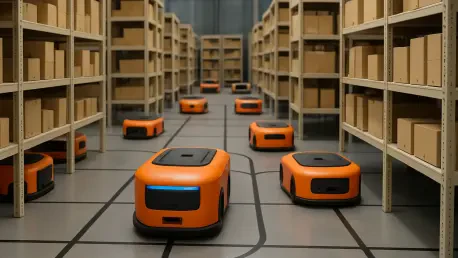

The seamless flow of global e-commerce depends increasingly on the synchronized movement of massive robotic fleets that must navigate incredibly dense and narrow aisles to fulfill thousands of customer orders every hour. As these facilities become more crowded to meet rising consumer demand, they frequently encounter a phenomenon known as the snowball effect, where a minor delay or a localized collision between two autonomous agents triggers a facility-wide gridlock. Traditional management systems often rely on hand-coded algorithms designed by human experts, but these static models struggle to account for the exponential complexity of high-density environments. When a single bottleneck occurs in these legacy systems, the resulting traffic jam can necessitate a complete manual reset of the warehouse floor, leading to hours of lost productivity. To solve this, researchers from MIT and Symbotic developed an artificial intelligence system that anticipates congestion before it happens, ensuring that goods continue to move efficiently without the need for frequent human intervention or system restarts.
The Synergy: Merging Neural Networks with Classical Logic
The core of this technological breakthrough lies in a two-tiered hybrid system that successfully balances high-level strategic decision-making with low-level execution. The first tier utilizes a sophisticated neural network trained through deep reinforcement learning to act as the primary coordinator for the entire robot fleet. By processing vast amounts of environmental data in real-time, this AI component identifies which robots are most likely to encounter obstacles or contribute to future congestion points. Unlike traditional systems that treat every robot with equal weight until a conflict occurs, this deep learning model proactively sets priorities by determining which units should take precedence at intersections. This enables the system to manage long-term constraints and the intricate, dynamic interactions between hundreds of agents. The AI learns through a trial-and-error process within high-fidelity simulations, allowing it to develop a nuanced understanding of traffic flow that far exceeds the capabilities of a set of human-written rules.
Once the high-level priorities are established by the neural network, the second tier of the system takes over to handle the specific logistics of movement. This tier employs a classical, high-speed planning algorithm that translates the AI’s priority decisions into precise, step-by-step navigational instructions for every individual robot on the floor. This division of labor is critical because it leverages the pattern recognition strengths of deep learning while maintaining the reliability and computational speed associated with traditional optimization methods. By offloading the complex “who goes first” decision to the AI and leaving the path generation to established algorithms, the system avoids the common pitfalls of pure AI models, which can sometimes struggle with the sheer mathematical scale of large-robotics problems. This hybrid approach essentially simplifies the machine learning task, making it possible to solve massive optimization challenges that were previously considered insurmountable, even with the most advanced hardware available in the current industrial landscape.
Operational Efficiency: Quantifying the Impact of Smart Routing
The practical effectiveness of this hybrid methodology was recently validated through rigorous simulations that mirrored the complex layouts of modern distribution centers. The empirical results were nothing short of transformative, demonstrating a 25 percent increase in total warehouse throughput compared to traditional management software and random search methods. In the high-stakes world of logistics, throughput is a vital metric that measures how many packages a robotic fleet can successfully deliver within a specific window of time. While standard algorithms often reach a point of diminishing returns as robot density increases, this AI-driven system maintained high efficiency by identifying potential bottlenecks several steps before they occurred. By rerouting agents in advance and optimizing intersection wait times, the system effectively eliminated the “stop-and-go” movement patterns that typically plague autonomous warehouses. This level of optimization ensures that the physical infrastructure of the warehouse is utilized to its maximum potential.
Beyond the immediate improvements in speed and volume, the system demonstrated a remarkable level of adaptability across a wide variety of operational scenarios. Older management software often requires extensive manual fine-tuning by specialized engineers whenever a warehouse floor plan is altered or a new fleet of robots is introduced. In contrast, the neural network developed by the research team showed an innate ability to generalize its learned behaviors to entirely new environments. When tested in layouts with different aisle configurations or significantly larger numbers of robots, the system continued to deliver superior performance without requiring a complete redesign of its core logic. This flexibility is particularly crucial for commercial operations where warehouse configurations are frequently updated to accommodate seasonal inventory shifts, new product lines, or changing consumer habits. The ability to deploy a single, intelligent solution that scales naturally with the growth of a business represents a major shift in how companies approach the implementation of warehouse automation.
Strategic Implementation: From Gridlock to Global Scalability
The economic implications of this technological leap are profound for the global logistics sector, particularly as the industry moves toward even higher levels of automation. Financial analysis indicates that even a minor improvement in throughput, perhaps as low as two or three percent, can translate into millions of dollars in annual savings for large-scale distribution operations. Achieving a 25 percent gain is considered a “super-human” level of performance that fundamentally changes the cost-benefit analysis of building massive, robot-heavy facilities. By automating the resolution of traffic conflicts and reducing the risk of catastrophic system shutdowns, companies can create more resilient supply chains that are less dependent on manual troubleshooting. This research suggests that while human-designed logic served the industry well during the early stages of automation, the future of the field belongs to AI systems capable of navigating the chaos of high-density environments with a level of precision that human programmers simply cannot replicate.
Moving forward, the focus of the research team shifted toward integrating task assignment directly into the overarching optimization model to further streamline warehouse workflows. While the current system excels at managing how robots move once they have an objective, the next logical step involved deciding which specific robot is best suited for a particular pick based on current traffic patterns and proximity. By combining task distribution with real-time traffic management, the researchers aimed to reduce unnecessary travel distances and further minimize the friction that occurs when thousands of agents operate in a shared space. These insights provided a clear blueprint for the next generation of industrial automation, offering a scalable solution that addressed both local movements and facility-wide coordination. The successful deployment of this hybrid AI methodology proved that the key to unlocking the full potential of autonomous warehouses was not just faster hardware, but a more intelligent and adaptable way to manage the complex dance of digital and physical logistics.