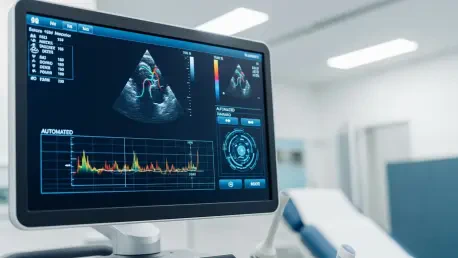

The traditional boundaries of medical diagnostics are being redrawn as artificial intelligence transitions from an experimental novelty to a fundamental pillar of modern sonography. This shift represents a sophisticated intersection of acoustic engineering and computational intelligence, where deep learning algorithms now actively participate in the acquisition and interpretation of clinical data. In 2026, the global market for AI in ultrasound imaging is valued at approximately USD 3.43 billion, reflecting a sharp increase from previous years and setting the stage for a trajectory that is expected to reach USD 22.62 billion by 2034. This expansion is characterized by a compound annual growth rate of 26.61% from 2026 to 2034, underscoring the indispensable role of automated systems in modern clinical workflows. The core objective of these technological advancements is to minimize the historical reliance on operator skill while simultaneously enhancing image quality and providing rapid, quantitative data that was previously susceptible to human error or interpretation bias.
Addressing the Global Crisis in Healthcare Personnel and Imaging Volume
The global healthcare ecosystem is currently struggling to keep pace with an unprecedented surge in patient volumes, driven largely by aging populations that require more frequent and detailed diagnostic screenings. This increased demand coincides with a critical shortage of trained sonographers and radiologists, creating a bottleneck that threatens the quality of patient care and extends wait times for vital diagnoses. Artificial intelligence serves as a crucial force multiplier in this high-pressure environment, allowing medical facilities to manage larger workloads without sacrificing accuracy. By automating routine and time-consuming tasks—such as the manual labeling of organs, initial lesion detection, and complex workflow documentation—AI-enabled ultrasound systems liberate clinicians from the drudgery of repetitive data entry. This transition allows medical professionals to dedicate their expertise to the analysis of complex diagnostic cases, ensuring that their specialized knowledge is applied where it is most needed.
Beyond simply increasing the speed of examinations, the integration of automation into the clinical setting addresses the pervasive issue of clinician burnout, which has reached alarming levels in recent years. AI tools act as a second pair of digital eyes, providing real-time feedback during the scanning process to ensure that all necessary anatomical views are captured correctly on the first attempt. This capability reduces the need for patient callbacks and repeated scans, which are often the result of suboptimal image quality or incomplete data sets. As these intelligent systems become more deeply embedded in hospital infrastructures, they provide a much-needed buffer for overstretched staff, streamlining the path from initial scan to final report. The result is a more resilient healthcare system that can maintain high standards of diagnostic precision even as the global demand for medical imaging continues to escalate at a rapid pace across diverse clinical environments.
Mitigating Operator Dependency through Real-Time Algorithmic Guidance
Ultrasound has long been considered one of the most user-dependent modalities in the diagnostic imaging suite, meaning the accuracy of a diagnosis is often tied to the specific physical skills and experience of the operator. This variability has historically led to inconsistencies in care, particularly when comparing scans performed at specialized urban centers with those conducted in smaller, rural clinics. Artificial intelligence is actively neutralizing this “skill gap” by providing real-time guidance that assists even less-experienced operators in achieving professional-grade results. For example, AI algorithms can now monitor the live feed from an ultrasound probe and provide on-screen visual cues to ensure the operator is positioned correctly to capture difficult views, such as the intricate four-chamber view of a fetal heart. This standardized approach ensures that the quality of diagnostic information remains consistent regardless of who is holding the transducer.
This movement toward standardization is particularly impactful in high-stakes environments like emergency medicine and intensive care units, where quick decisions are paramount. In these settings, clinicians who may not be ultrasound specialists often use point-of-care devices to assess critical conditions such as internal bleeding or heart failure. AI-driven guidance software provides these non-specialist users with the confidence to perform scans that would otherwise require a dedicated sonographer. By offering automated anatomical recognition and automatic measurement capabilities, the software ensures that the data captured is accurate and clinically actionable. This evolution effectively transforms the ultrasound machine from a passive imaging tool into an active diagnostic partner, democratizing access to high-quality imaging and ensuring that patients receive a uniform standard of care regardless of the institutional setting or the time of day.
Technological Innovation: The Rise of Intelligent Imaging Platforms
The current landscape of ultrasound technology is defined by a state of continuous innovation, as major industry leaders pivot away from hardware-centric designs toward software-defined, intelligent platforms. Notable recent developments include the introduction of systems like the GE HealthCare Vivid Pioneer and the Philips Transcend Plus, which represent a departure from iterative hardware updates. These platforms are built with specialized processing units capable of executing complex deep learning models in milliseconds, allowing for the real-time processing of massive amounts of acoustic data. Instead of merely displaying an image, these machines can simultaneously perform edge detection, flow analysis, and tissue characterization. This level of computational power enables the system to provide immediate clinical insights, such as calculating the ejection fraction of a heart or grading the stiffness of a liver, with a single button press.
This shift toward intelligent platforms also facilitates a more flexible and future-proof approach to medical equipment procurement for hospital administrators. Modern ultrasound systems are now frequently designed with a modular software architecture that allows for over-the-air updates, much like a smartphone or a modern electric vehicle. This means that as new AI algorithms are developed and cleared by regulatory bodies, they can be deployed directly to existing machines in the field without requiring the purchase of entirely new physical units. This capability ensures that healthcare providers can keep their diagnostic tools at the cutting edge of technology for longer periods, maximizing their return on investment. The focus has moved from the physical transducer and console to the underlying intelligence that powers the entire imaging chain, creating a paradigm where the value of the equipment increases over time as the software becomes more sophisticated.
Navigating the Complexities of Reimbursement and Global Infrastructure
Despite the undeniable clinical benefits and rapid technological advancements, the universal adoption of AI in ultrasound faces significant hurdles related to financial and structural frameworks. One of the most prominent obstacles is the persistent lag in reimbursement policies, as many insurance providers and government health programs have been slow to create specific billing codes for AI-assisted analysis. Currently, most healthcare systems reimburse for the ultrasound procedure itself but do not offer additional compensation for the use of advanced AI software that improves accuracy and efficiency. This creates a financial dilemma for hospital administrators who must justify the initial licensing and implementation costs of these sophisticated tools without a clear path to direct revenue generation. Without a standardized reimbursement model that recognizes the value of AI, the pace of adoption may remain uneven across different healthcare systems and regions.
Furthermore, the deployment of advanced AI solutions is often contingent on a robust digital infrastructure that is not universally available, particularly in emerging markets. Many deep learning algorithms require high-speed internet connectivity for cloud-based processing or high-performance local computing hardware to function effectively. In low-and-middle-income countries, these requirements can pose a significant barrier to entry, as clinics may lack the stable power or digital bandwidth necessary to support an enterprise-grade AI system. Additionally, there is a global shortage of technical personnel trained to maintain and troubleshoot these complex computational platforms in a clinical setting. Addressing these infrastructure and implementation gaps is essential for ensuring that the benefits of AI-enhanced ultrasound are not limited to wealthy, technologically advanced nations but are instead distributed equitably to improve global health outcomes and diagnostic accessibility.
The Democratization of Care: Handheld Devices and POCUS Integration
The transition toward decentralized healthcare is being accelerated by the democratization of ultrasound through portable, handheld devices that integrate powerful artificial intelligence directly onto the handset. This segment of the market is currently experiencing some of the most dynamic growth, as companies like Butterfly Network and others work to put diagnostic tools into the hands of primary care physicians, paramedics, and home-health providers. By embedding AI into point-of-care ultrasound devices, these manufacturers are effectively turning the transducer into a “digital tutor” that guides non-expert users through the scanning process. This guidance is crucial for making ultrasound a standard tool for bedside examinations, where it can provide immediate answers to diagnostic questions that would otherwise require a trip to the radiology department or a formal referral.
The impact of AI-guided POCUS extends into remote and underserved areas where specialized medical imaging is often entirely unavailable. In these contexts, a handheld device equipped with AI can serve as a lifeline, enabling local clinicians to perform screening for prenatal health, cardiac function, and traumatic injuries with high confidence. The software can automatically identify anatomical structures and alert the user if an abnormality is detected, even if the user lacks formal training in sonography. This capability significantly lowers the barrier to entry for high-quality medical imaging, moving diagnostics from the centralized hospital hub to the point of patient contact. As these devices become more affordable and their AI algorithms more robust, they are expected to become as ubiquitous as the stethoscope, fundamentally changing the nature of the physical examination and the speed of clinical decision-making.
Scaling Diagnostics through Cloud-Based Enterprise Ecosystems
Modern healthcare networks are increasingly turning to cloud-based deployment models to manage the vast amounts of data generated by AI-enhanced ultrasound systems across multiple locations. This shift toward cloud integration allows for a centralized approach to data management, ensuring that imaging protocols and AI-driven analysis tools are standardized throughout an entire hospital system. For instance, enterprise platforms like Butterfly’s Compass AI enable administrators to monitor device usage, ensure compliance with diagnostic standards, and aggregate data for large-scale clinical analytics. By moving the heavy computational burden of AI analysis from the local hardware to the cloud, health systems can implement sophisticated diagnostic tools without the need for expensive, high-end servers at every individual clinic or department.
This scalability is particularly beneficial for large, multi-site healthcare organizations that require a high degree of operational efficiency and data security. Cloud-based ecosystems facilitate seamless collaboration between clinicians, allowing a scan performed at a small satellite clinic to be instantly reviewed and analyzed by a specialist at a central teaching hospital. Furthermore, the centralized nature of these platforms simplifies the process of regulatory compliance and auditing, as all imaging data and AI-generated reports are stored in a secure, unified environment. As the volume of diagnostic data continues to grow, these cloud architectures will be essential for managing the lifecycle of medical images and for training the next generation of AI models using diverse, real-world data sets. This transition toward enterprise-wide digital health solutions is a key driver in the modernization of the ultrasound market, offering a path to sustainable and scalable diagnostic excellence.
Optimizing Specialty Care: The Impact on OB/GYN and Radiology
The clinical application of AI in ultrasound is perhaps most visible in the field of obstetrics and gynecology, which remains the largest segment for ultrasound utilization globally. Because ultrasound is the gold standard for prenatal care, the sheer volume of routine fetal screenings makes it an ideal candidate for automation. AI tools are now capable of automatically measuring fetal biometry, such as head circumference, abdominal circumference, and femur length, with a precision that often exceeds manual measurements. This automation not only reduces the time required for each scan—allowing clinics to see more patients—but also minimizes the risk of human oversight during critical developmental assessments. By providing a consistent baseline for fetal growth monitoring, AI helps clinicians identify potential complications earlier and with greater certainty, leading to improved outcomes for both mothers and infants.
In the broader radiology department, the most tangible benefit of AI lies in the automation of measurement and quantification for various organs and lesions. Traditionally, measuring the volume of a tumor or the velocity of blood flow through a vessel required the meticulous manual placement of calipers on a screen, a process that is both time-consuming and subject to inter-operator variability. AI algorithms can now perform these tasks instantaneously, using automated labeling and segmentation to provide objective data that is directly integrated into the patient’s electronic health record. This leap in efficiency significantly boosts the throughput of imaging centers, helping to clear the diagnostic backlogs that often plague large public and private health systems. By transforming raw acoustic data into clear, quantifiable metrics, AI allows radiologists to transition from being technicians who gather data to consultants who provide high-level diagnostic interpretation and treatment planning.
Regional Dynamics: Analyzing Growth Patterns across the Globe
The global landscape for AI in ultrasound is characterized by distinct regional trends, with North America currently maintaining its position as the dominant market force. This leadership is fueled by a high prevalence of chronic diseases, a technologically adept workforce, and a proactive regulatory environment where the FDA frequently clears new AI-enabled software as a medical device. In the United States, the integration of AI is seen as a primary strategy for managing the rising costs of healthcare while maintaining high standards of clinical excellence. The region’s well-established digital health infrastructure and the presence of major technology hubs provide a fertile ground for the continuous development and deployment of advanced imaging solutions, ensuring that North American providers remain at the vanguard of this medical revolution.
In contrast, the Asia Pacific region is emerging as the fastest-growing frontier for AI in ultrasound, driven by massive population bases and an acute shortage of specialized medical personnel in countries like China and India. In these markets, AI is not just a tool for efficiency but a vital necessity for bridging the gap between sophisticated urban medical centers and underserved rural clinics. Governments in the region are investing heavily in digital health initiatives to expand access to basic diagnostic services, viewing AI-enabled portable ultrasound as a cost-effective solution for large-scale public health screening. Meanwhile, Europe maintains a strong secondary position in the market, with a focus on integrating cloud-connected radiology systems to modernize public health infrastructures and address the needs of an aging demographic. These diverse regional drivers collectively contribute to a global market that is both highly competitive and rapidly evolving to meet local healthcare challenges.
Competitive Strategies: Consolidation and Collaboration in the Tech Sector
The market for AI in ultrasound is currently highly consolidated, with a small number of “tech giants” and specialized AI firms controlling the majority of the market share. Leaders such as GE HealthCare, Philips, and Siemens Healthineers have adopted strategies that focus on integrating artificial intelligence across the entire imaging chain, from the initial capture of the signal to the final diagnostic report. These companies are increasingly moving away from being hardware manufacturers and are repositioning themselves as providers of holistic digital health solutions. Their competitive advantage lies in their ability to bundle advanced AI software with their extensive installed base of hardware, creating a seamless experience for clinicians who are already familiar with their platforms and workflows.
To maintain their technological edge, these industry leaders are frequently entering into strategic partnerships with pure-play technology companies, such as NVIDIA, to harness the massive computational power required for real-time deep learning. Additionally, collaborations with public-sector organizations and academic institutions are common, as companies seek to validate their algorithms against large, diverse clinical data sets. This collaborative approach is essential for navigating the complex regulatory landscape and for ensuring that AI tools are effective across different patient populations and clinical scenarios. Smaller, specialized firms like Butterfly Network continue to disrupt the market by focusing on niche applications or the democratization of hardware, forcing the established giants to innovate more rapidly and adopt more flexible, software-centric business models that prioritize user experience and clinical utility.
Transforming the Standard of Care from Visualization to Precision
The integration of artificial intelligence into the global ultrasound market successfully moved the modality from a subjective imaging tool to a precise, objective diagnostic instrument. By the time the industry reached the middle of this decade, the focus had shifted entirely from simply “seeing” better to “quantifying” more accurately. This transition was marked by the widespread adoption of automated measurement tools and real-time guidance systems that ensured a uniform standard of care across diverse clinical environments. Clinical facilities that implemented these technologies reported significant improvements in workflow efficiency and a measurable reduction in diagnostic errors, proving that algorithmic assistance was a necessary component of modern radiology. The democratization of ultrasound through AI-guided handheld devices also played a pivotal role in expanding access to care in remote areas, effectively decentralizing high-quality diagnostics and bringing it closer to the patient.
As the technology continued to mature, the development of hybrid models that combined local hardware processing with cloud-based analytics became the industry standard. These systems provided clinicians with the immediate feedback required for critical care while simultaneously offering the deep, long-term data insights needed for personalized medicine. The regulatory landscape also adapted, streamlining the approval processes for software-defined medical devices and encouraging a faster pace of innovation. By the conclusion of this growth phase, AI was no longer viewed as an optional upgrade but as an essential element of every ultrasound scan performed globally. This evolution ensured that the benefits of sophisticated diagnostic imaging were accessible to all patients, regardless of their location or the experience level of their healthcare provider, cementing AI’s role as a permanent and transformative fixture in the global medical landscape.