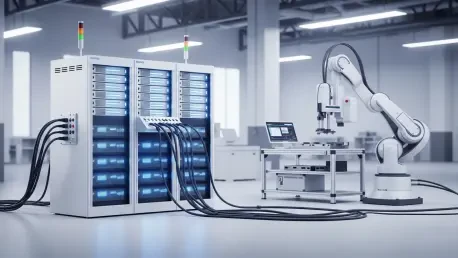

The persistent challenge of translating flawless digital simulations into reliable physical actions has long been the primary bottleneck preventing the widespread adoption of advanced autonomous systems across the global manufacturing landscape. This strategic alliance between ABB Robotics and NVIDIA represents a definitive milestone in overcoming these hurdles by introducing high-level physical AI to industrial environments. By integrating NVIDIA Omniverse libraries and accelerated computing capabilities directly into the established RobotStudio platform, these organizations are effectively bridging the sim-to-real gap that has historically plagued the sector. This collaboration provides manufacturers with a high-fidelity, virtual playground where robots can be designed, trained, and optimized with unprecedented precision before any physical hardware is deployed. The resulting ecosystem allows for the creation of smarter machines that can perceive, reason, and act within complex surroundings, fundamentally altering the trajectory of modern automation.
Closing the Sim-to-Real Gap with High-Fidelity Simulation
The centerpiece of this technological evolution is the release of RobotStudio HyperReality, a sophisticated system designed to achieve a nearly perfect correlation between virtual results and actual performance on the factory floor. In the past, the transition from a digital twin to a physical production line was frequently disrupted by subtle environmental variables such as shifting lighting conditions, material friction, or complex surface textures that simulation engines could not accurately replicate. By leveraging NVIDIA Omniverse’s physically accurate simulation tools, developers can now account for these nuances with extreme detail. This level of realism enables the generation of high-quality synthetic data, which is then used to train AI models in a risk-free environment. Consequently, robots can learn to master intricate and nuanced tasks virtually, which significantly reduces the reliance on traditional, time-consuming physical testing and iterative trial-and-error processes.
Beyond just visual accuracy, the integration of these advanced simulation tools allows for the modeling of complex physics that govern how robots interact with different objects and materials. This capability is essential for industries where precision is non-negotiable, as it ensures that the robotic path planning and force control are optimized long before the machine is bolted to the shop floor. By using synthetic data to cover a vast array of edge cases and rare scenarios that would be difficult or dangerous to replicate in real life, engineers are building more robust and resilient AI agents. This shift toward a simulation-first methodology means that when a robot finally begins its task in the physical world, it does so with a pre-existing library of knowledge that covers almost every possible operational variance. This advancement marks a departure from rigid programming, moving instead toward a more flexible, intelligent form of automation that responds dynamically to its environment.
Economic Gains and Operational Speed in Modern Production
The integration of these advanced AI and simulation tools is delivering massive improvements in operational efficiency and cost management for manufacturers across various sectors. Industry projections indicate that the ability to design and test production lines entirely within a virtual space can reduce setup and commissioning times by as much as 80 percent. Furthermore, by eliminating the need for expensive physical prototypes during the initial development phases, companies are seeing a 40 percent reduction in associated capital expenditures. For high-velocity industries like consumer electronics, where product life cycles are becoming increasingly shorter, this technology is expected to compress the time-to-market by nearly half. Such acceleration is made possible through parallel engineering, a process where software refinement and hardware planning occur simultaneously in a unified digital environment, ensuring that the physical rollout is seamless and highly efficient.
This streamlined approach to engineering not only saves money but also allows for a higher degree of customization and flexibility in manufacturing. Because the virtual models are so accurate, companies can experiment with different factory layouts or robotic configurations without pausing existing production lines or wasting physical resources. This agility is particularly valuable in the current economic climate, where market demands can shift rapidly, requiring manufacturers to pivot their production capabilities almost overnight. By reducing the financial and temporal barriers to entry for complex automation projects, these tools are making it possible for firms to pursue ambitious innovation strategies that were previously considered too risky or expensive. The result is a more resilient manufacturing sector that can adapt to global supply chain fluctuations and changing consumer preferences with much greater speed and financial predictability.
Hardware Integration and Edge Intelligence on the Factory Floor
The collaboration between these tech giants extends far beyond software simulation and into the critical realm of hardware execution and real-time data processing. The partners are actively integrating the NVIDIA Jetson edge computing platform into the latest ABB Omnicore controllers, bringing unprecedented processing power directly to the robot. This integration enables real-time AI inference at the edge, allowing robots to make split-second decisions based on live sensor data without the latency issues associated with cloud computing. By utilizing sophisticated foundation models that are continuously refined through real-world data feedback, the system creates a virtuous cycle of constant improvement. Once a robot is deployed, its performance data is analyzed and fed back into the virtual model to further sharpen the AI, which can then be redeployed across a global network of over 60,000 users, ensuring that every machine benefits from collective learning.
This decentralized intelligence model is fundamental to scaling industrial AI across diverse and geographically distributed manufacturing facilities. When robots are capable of processing complex information locally, they become more autonomous and less dependent on constant human supervision or centralized command structures. This autonomy is crucial for tasks that require high-speed reactions, such as collaborative robotics where humans and machines work in close proximity. The use of foundation models also means that robots can be easily repurposed for new tasks without the need for extensive reprogramming; they simply need to be updated with new data sets or refined models. This level of connectivity and local intelligence ensures that the entire robotic fleet remains at the cutting edge of performance, as every minor optimization discovered in one corner of the factory can be instantly scaled and applied to thousands of other machines globally.
Empowering Industry Leaders and Small Enterprises Through AI Deployment
Practical applications of this partnership are already visible through early adoption programs with major industrial players like Foxconn, the world’s leading electronics manufacturer. Foxconn utilized this high-fidelity technology to automate the highly delicate assembly processes required for modern consumer electronics, where the margin for error is nearly non-existent. By training their robotic systems with synthetic data in a virtual environment, they optimized production for multiple product variants simultaneously, ensuring a flawless transition to physical manufacturing. This demonstrated that even the most complex and precise manual tasks can be successfully automated when the digital training ground is sufficiently accurate. This success provided a roadmap for other large-scale manufacturers looking to integrate AI into their assembly lines while maintaining the highest possible quality standards and production speeds.
Furthermore, the technology democratized advanced automation for small and medium-sized manufacturers who previously lacked the resources to implement such sophisticated systems. Companies like WORKR used these AI-powered platforms to lower the barrier to entry, proving that intelligent robotics were no longer the exclusive domain of multinational corporations. These tools allowed smaller firms to deploy robots that could quickly learn and adapt to new tasks, providing them with the agility needed to compete with larger rivals. In the end, the strategic alignment between simulation and execution provided a clear path toward a more accessible and efficient industrial landscape. By shifting the heavy lifting of training and optimization into the digital realm, the partnership ensured that manufacturing became more flexible and capable of meeting complex global demands. These advancements established a new standard for precision, where the gap between virtual planning and real-world execution was finally closed for good.