
The creation of high-fidelity 3D assets has long been a labor-intensive process, demanding specialized skills and significant time investment, which has traditionally acted as a bottleneck for developers in gaming, virtual reality, and industrial design. The recent emergence of foundational AI models promises to dismantle these barriers, democratizing a field once reserved for seasoned experts. A significant architectural advancement has been officially unveiled, introducing a new-generation model for 3D Artificial Intelligence Generated Content (AIGC). This development is not merely an incremental improvement but a fundamental rethinking of how three-dimensional objects are conceived and generated by machines. By shifting from assembling disparate 2D elements to creating objects holistically within a volumetric space, this technology is set to dramatically improve the quality, efficiency, and accessibility of 3D content creation for a global community of developers and creators, heralding a new era of digital artistry.
A Fundamental Shift in Generation Methodology
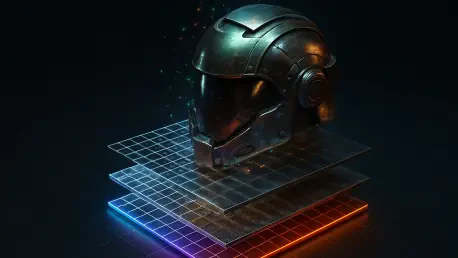
A groundbreaking paradigm known as “TEXTRIX” represents a stark departure from the conventional methods that have long defined AI-driven 3D generation. Historically, these systems often relied on projecting 2D textures onto pre-existing 3D meshes, a technique fraught with potential issues. This process could frequently lead to jarring visual inconsistencies, such as visible seams where textures meet, unnatural lighting reactions, and a general lack of cohesive detail. In stark contrast, the new “Native 3D” approach generates assets directly within a volumetric space. This is achieved through a proprietary Attribute Grid, which allows the model to cohesively generate geometry, texture, and semantic attributes simultaneously. The result is a “born-in-3D” methodology that ensures seamless, 360-degree visual consistency, effectively eliminating the artifacts that plagued earlier projection-based techniques and yielding assets that are coherent from every conceivable angle, right from the moment of their creation.
The technological backbone of this native 3D approach is a sophisticated architecture that combines a Sparse Diffusion Transformer (DiT) with an Attribute Variational Autoencoder (VAE). This powerful pairing enables the model to interpret and generate complex 3D data with unprecedented cohesiveness. The Sparse DiT is particularly adept at handling the vast, often sparsely populated data of a three-dimensional space efficiently, focusing computational resources on areas of detail while ignoring empty voids. Simultaneously, the Attribute VAE works to encode and decode the various properties of the object—from its physical shape to its surface material—into a latent space. This ensures that all attributes are generated in a unified and interconnected manner. By generating the model as a whole, rather than as a collection of separate parts, this system bypasses the integration challenges of older methods and produces a single, holistic digital object with intrinsic consistency and integrity from its very inception.
Advancing Fidelity and Practical Application
A critical feature that elevates this new generation of AI is its capacity for “Physical Disentanglement,” a process that goes far beyond creating simple color textures. The model is engineered to generate industrial-grade Physically Based Rendering (PBR) attributes, which are essential for creating realistic materials in modern digital environments. This includes distinct data maps for qualities such as roughness, which dictates how light scatters across a surface, and metallic properties, which control its reflectivity and color. Furthermore, it generates normal maps, which add fine surface detail and texture without increasing the geometric complexity of the model. By producing these PBR-ready assets natively, the technology ensures that the generated content is immediately compatible with leading game engines and professional rendering software. This integration streamlines creative workflows, allowing artists and developers to bypass the time-consuming process of manually creating or adapting texture maps, thereby accelerating production pipelines significantly.
Beyond material realism, the advanced AI model demonstrates exceptional proficiency in handling complex geometric and topological scenarios that have traditionally posed significant challenges for automated 3D generation. The system can accurately capture and render intricate details, such as the subtle nuances of exaggerated facial expressions or the complex, interwoven structures of ornate architecture. This capability is powered by its use of a Sparse 3D Representation, a data-efficient method that allows it to define objects without a continuous, solid surface. Consequently, the model can generate discontinuous topologies with ease. This opens up new creative possibilities, enabling the creation of assets with visually cohesive yet structurally independent elements, such as floating particles, separately rendered strands of hair, or other complex artistic effects that would be incredibly difficult and time-consuming to model using traditional manual or procedural methods.
From Digital Blueprints to Physical Reality
This innovative technology is meticulously engineered to be manufacturing-ready, effectively bridging the persistent gap between digital design and tangible physical production. It incorporates specialized features tailored for modern fabrication techniques like 3D printing and CNC machining, making the transition from screen to reality seamless. One such feature is an algorithm for “Manifold Thickening,” which intelligently reinforces thin or delicate parts of a model to enhance their structural integrity, preventing them from breaking during the manufacturing process. Additionally, the model excels at generating “Watertight Geometry.” This process ensures the creation of completely enclosed, solid meshes without any holes or gaps—a critical requirement for slicing software used in 3D printing. By outputting models that are robust and perfectly sealed, the system eliminates common fabrication errors and reduces the need for extensive manual mesh repair.
With a firm commitment to fostering the creator economy, the developers have made the foundational model accessible to the global community through an open API. This strategic move aims to transform sophisticated 3D generation from a niche, high-cost capability into a widely available and accessible utility. The overarching goal is to empower creators of all skill levels, from independent artists to large-scale development studios, to bring their most imaginative concepts to life with unprecedented ease and efficiency. This initiative is part of a broader, more ambitious vision to pioneer 3D and 4D AIGC technology. The long-term objective extends beyond static asset creation, aiming to facilitate seamless, real-time spatial experiences and ultimately to simulate the real world with such fidelity that it can serve as a foundational element in the ongoing pursuit of artificial general intelligence (AGI).
The New Creative Horizon
The introduction of this native 3D generation model marked a pivotal moment, fundamentally altering the landscape of digital content creation. By addressing the core limitations of previous 2D-to-3D projection methods, it established a new standard for quality, consistency, and efficiency. The ability to generate physically accurate materials and complex topologies directly within a volumetric space opened doors for artists and developers that were previously closed by technical and time constraints. Moreover, the deliberate focus on creating manufacturing-ready assets demonstrated a forward-thinking approach that recognized the convergence of the digital and physical realms. The decision to provide open access ensured that these powerful tools did not remain confined to a select few but were instead placed into the hands of a global creative community, fostering an environment ripe for innovation. This development set a clear trajectory toward a future where the boundary between imagination and creation would become increasingly blurred.