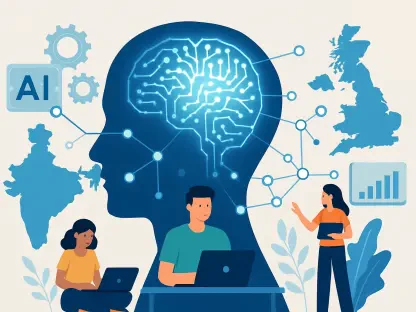

The rapid advancement of generative artificial intelligence has sparked a profound debate regarding the future of professional labor and the preservation of the human spirit. While some view AI as a threat to job security, it is more accurately described as a transformative tool that continues a long history of technological evolution. This shift represents a psychological and economic tension where the final stronghold of human output, creativity rooted in lived experience, stands as the primary differentiator between algorithmic replication and genuine insight. Recent history demonstrates that technological progress rarely destroys industries, but rather forces them into a state of creative destruction and relocation. Just as mobile banking did not eliminate finance and streaming did not kill the cinema, AI is poised to shift human roles rather than erase them entirely. By examining the evolution of the digital age since the 1990s, a consistent pattern emerges where the underlying energy of a sector is preserved even as the delivery method changes.
The Divide in Professional Vulnerability
Assessing Job Displacement and Stability
Current assessments of the labor market indicate a significant divergence in how different professional sectors respond to the integration of advanced automation and algorithmic processing. Experts often point to programming, life sciences, and complex research as the primary pillars of stability, suggesting that these fields require a level of abstract reasoning that machines have yet to master. However, a more granular analysis reveals that the risk is not distributed evenly across all white-collar professions. For instance, data-driven forecasts from 2026 to 2028 suggest that roles centered on repetitive linguistic tasks, such as basic technical editing and standard translation, face a displacement risk as high as ninety percent. This trend highlights a fundamental shift where the engines of industrial and scientific progress remain under human guidance, while the mechanical aspects of information management are increasingly handed over to specialized software.
The transition toward automated data handling necessitates a radical rethinking of professional training and career development for those in high-risk categories. If a journalist or a legal clerk spends the majority of their time on systematic data processing, the emergence of highly efficient large language models forces a move toward higher-order cognitive tasks. This does not imply the total erasure of these professions but rather a relocation of value. In the legal field, for example, while AI can scan thousands of documents for specific precedents, the human attorney provides the strategic nuance and ethical judgment required to present a case in court. This evolution mirrors the early digital transition where the arrival of spreadsheets did not eliminate accountants but instead allowed them to focus on financial strategy rather than manual arithmetic. The modern workforce is thus entering a period where technical proficiency with AI tools becomes the baseline, making unique human synthesis the new premium.
Defining the Pillars of Human Creativity
The distinction between a machine-generated response and a human innovation lies in the capacity to transcend existing datasets to create something entirely novel. True creativity is characterized by three distinct actions: the contribution of new concepts, the renewal of existing ideas with contemporary relevance, and the radical transformation of how reality is perceived. While an artificial intelligence functions as a sophisticated generative library, aggregating and predicting patterns from a massive repository of information, it lacks the independent agency to break those patterns purposefully. A machine can mimic the style of a classical composer or a modern novelist, but it cannot decide to invent a new genre that defies its training data. This limitation ensures that the most disruptive shifts in art, science, and philosophy remain a uniquely human endeavor, driven by the desire to explore the unknown.
Beyond the mere generation of content, human creativity serves as a bridge between abstract thought and societal impact, a function that algorithms are currently unable to replicate. When a human creator grants current relevance to an old idea, they are responding to the specific cultural and emotional climate of their time. This process of renewal requires an intuitive understanding of the collective human consciousness, something a mathematical model can only approximate through historical data. Transformation, the most advanced pillar of creativity, involves changing the very framework through which people view their lives or their work. Because AI is fundamentally a reactive system, it operates within the boundaries of what has already been documented. Human insight, conversely, is proactive and capable of generating the “black swan” events that redefine industries and artistic movements, ensuring that genuine innovation remains an organic process.
The Power of the Human Experience
The Connection Between Suffering and Insight
The most profound achievements of our species, ranging from classic literature to foundational philosophical treatises, are born from experiences that an algorithm cannot simulate. Works such as Viktor Frankl’s reflections on survival or the epic narratives of Miguel de Cervantes are not merely successful arrangements of words; they are the distilled essence of suffering, faith, and physical endurance. An artificial intelligence can analyze the structural components of these masterpieces and produce a technically competent imitation, but it lacks the vital and communal inspiration that comes from having lived through history. This emotional resonance is the invisible thread that connects a writer to their audience, creating a depth of meaning that goes beyond the literal definitions of the text. Consequently, storytelling and journalism remain fundamentally human endeavors because they require a witness who understands the stakes of existence.
This inherent lack of lived experience in artificial systems creates a ceiling for the quality of insight they can provide in fields that require deep empathy or moral weight. While a generative model can report the facts of a conflict or a social movement with startling speed, it cannot provide the suggestive interpretation that a seasoned war correspondent or a social critic brings to the table. The human ability to derive meaning from tragedy or triumph is what transforms raw data into a narrative that can move a population or change a policy. In the current landscape from 2026 onward, the value of content is increasingly measured by its authenticity and the perceived “soul” behind the work. As the market becomes saturated with perfect but hollow AI-generated material, the demand for human-centric perspectives—those marked by the imperfections and profound realizations of real life—is expected to see a significant resurgence.
The Critical Margin of Versatility
Even in industries that are often considered formulaic or routine, the final margin of a project’s success typically rests on a human’s ability to adapt in real-time. This “two-percent factor” represents the gap between a technically functional output and one that truly resonates with a live audience or a complex market. For example, in high-speed media production or live broadcasting, creators must often pivot their strategies minute-by-minute based on shifting audience sentiments or technical failures. An AI can manage the bulk of the logistical and structural requirements, but it lacks the intuitive spark and flexibility required to navigate the unpredictability of human social dynamics. This necessity for real-time versatility ensures that human oversight remains the essential component for managing the social and ethical nuances of modern projects, regardless of how much of the workload is automated.
Navigating the complex landscapes of ethics and social responsibility requires a level of contextual awareness that far exceeds the capabilities of even the most advanced multi-agent systems. While developers are working to integrate reasoning with learning, the ability to make a “judgment call” in a gray area is a function of human values and cultural literacy. In fields like cybersecurity or robotics, the technical execution might be handled by intelligent software, but the overarching strategy must be governed by human priorities and safety considerations. As we look toward the developments occurring between 2026 and 2030, the most successful professionals will be those who use AI as a high-efficiency engine while maintaining their role as the indispensable navigator. The future of labor is not a competition between man and machine, but a partnership where human insight provides the direction and emotional core, ensuring that technological progress serves human needs.
In light of these developments, professionals should focus on cultivating skills that emphasize emotional intelligence, ethical reasoning, and cross-disciplinary synthesis. Moving forward, the most effective strategy involves embracing AI as a sophisticated assistant that handles the weight of data processing, thereby freeing the human mind to engage in higher-level creative problem-solving. Organizations that prioritize human-in-the-loop systems will likely outperform those that rely solely on automation, as they will retain the flexibility and resonance that only human insight can provide. Investing in the uniquely human “two-percent” of any task will be the definitive factor in maintaining relevance and achieving excellence in an increasingly automated world. Ultimately, the survival of professional identity depends on the recognition that while a machine can reflect our knowledge, only a human can provide the wisdom to use it.