
Slovakia has emerged as a key regional case study where the automotive and electronics sectors drive massive demand for high-precision robotic applications. Across the globe, the manufacturing landscape is undergoing a profound transformation, moving toward an environment where automated systems are no longer a luxury reserved for elite corporations but a fundamental requirement for remaining competitive. By 2035, the integration of robotics will likely serve as the primary factor determining whether a company can withstand the pressures of an increasingly volatile global market. This shift represents a significant evolution from viewing robots as high-cost specialty tools to recognizing them as essential infrastructure that ensures operational resilience and consistent output. The recent global health crises served as a massive stress test for these systems, highlighting the inherent vulnerability of factories that depend solely on human physical presence. While traditional manual facilities faced total shutdowns due to restrictions and labor shortages, automated plants successfully maintained production through remote monitoring and tireless machine operation. This period proved that robotics can effectively decouple production cycles from biological risks, allowing for a level of continuity that conventional manufacturing simply cannot match in times of instability.
Economic Shifts and Technological Accessibility
The Drive Toward Cost Efficiency: Beyond Human Variability
One of the most compelling reasons for the rapid adoption of robotics is the significant reduction in conversion costs that these systems provide over the long term. Robotic systems effectively eliminate the variability inherent in human labor, such as physical fatigue and the natural inconsistency of manual tasks, ensuring that every cycle produces a result of identical quality. This high level of repeatability minimizes material waste and scrap, which directly improves a company’s bottom line while maintaining a constant rate of production that human teams struggle to sustain over long, repetitive shifts. In high-precision sectors like semiconductor fabrication or aerospace components, the cost of a single error can be astronomical, making the reliability of a robotic arm not just an advantage but a financial safeguard. Furthermore, the ability to run “lights-out” shifts—where production continues in total darkness without heating or cooling—allows for a level of energy efficiency that was previously unthinkable. As energy prices fluctuate and sustainability mandates become more stringent, the capacity to maximize output per square foot of factory space through automation becomes a critical economic lever for survival in a globalized economy where margins are constantly being squeezed.
The financial narrative surrounding automation has shifted from a focus on initial capital expenditure to a more comprehensive understanding of total cost of ownership and lifecycle value. Modern manufacturing requires a level of throughput that manual labor cannot achieve without significant increases in headcount and associated overhead costs like benefits, insurance, and training. When a robotic system is integrated into a production line, it provides a predictable cost structure that stabilizes the business model against the volatility of the labor market. This predictability allows for more accurate forecasting and aggressive pricing strategies that can undercut competitors who are still reliant on less efficient manual processes. Moreover, the reduction in reworked parts and the elimination of human-induced bottlenecks mean that lead times are shortened, enhancing customer satisfaction and enabling a more agile response to market demands. By prioritizing robotic precision, companies are essentially investing in a form of quality insurance that pays dividends in the form of brand reputation and operational stability, ensuring that they remain the preferred choice for clients who demand perfection and rapid delivery.
Lowering the Barrier: Accessibility for Small and Medium Enterprises
In the past, implementing automation required a massive budget and a dedicated team of specialized engineers to handle complex programming and integration. Today, the democratization of technology through modular equipment and intuitive “lead-through” programming has made these sophisticated tools accessible to small and medium-sized enterprises that were previously priced out of the market. Modern interfaces allow workers to teach a robot a specific task by simply guiding the arm through the motions or using tablet-based visual programming, enabling businesses to automate single workstations incrementally rather than committing to a risky, full-factory overhaul. This “plug-and-produce” philosophy means that a local machine shop can deploy a robotic tender for a CNC machine within a matter of days, seeing an immediate impact on productivity without the need for extensive downtime. This accessibility is fundamentally changing the competitive landscape, as smaller players can now leverage the same precision and speed as global conglomerates, allowing them to compete for higher-value contracts and specialized niche markets that require rigorous quality standards.
The rise of Robots-as-a-Service (RaaS) models further lowers the entry barrier by allowing companies to lease robotic equipment instead of purchasing it outright, shifting the cost from a capital expenditure to an operational one. This flexibility is vital for smaller manufacturers who need to manage cash flow while still upgrading their capabilities to meet modern standards. These modular systems are also designed to be redeployed easily, meaning a robot that handles palletizing one month can be reprogrammed to handle pick-and-place tasks the next, depending on the current project requirements. This versatility ensures that the investment remains relevant even as product cycles shorten and consumer preferences change. By removing the need for deep technical expertise and massive upfront investments, the industry has seen a surge in “micro-automation” projects that focus on solving specific bottlenecks. This grassroots adoption of robotics is creating a more resilient manufacturing ecosystem where even the smallest shop can harness the power of advanced technology to ensure its continued relevance in a world where speed and precision are the new baseline for entry.
Advanced Capabilities and Collaborative Workspaces
The Impact of AI: Enhancing Machine Vision and Adaptability
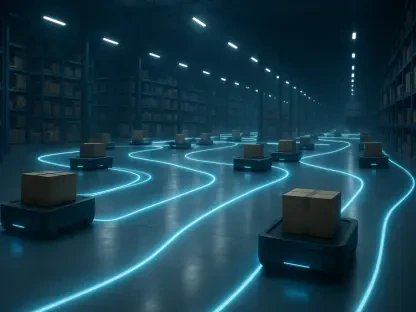
Modern industrial robots have evolved far beyond the “blind” machines of previous decades, primarily due to the deep integration of Artificial Intelligence and advanced 3D vision systems. These technologies allow robots to identify parts in random, cluttered positions, detect microscopic defects that the human eye might easily overlook, and verify complex packaging labels in real-time. This newfound flexibility is essential for high-mix, low-volume production, where the ability to interpret and adapt to a changing environment is significantly more valuable than simple repetitive motion. In the logistics sector, for instance, AI-driven robots can now navigate unpredictable warehouse environments, identifying and picking a diverse array of items without needing predefined coordinates for every single object. This capability transforms the robot from a rigid tool into an intelligent agent capable of making split-second decisions that optimize the flow of goods. As neural networks continue to improve, these machines are becoming better at “learning” from their environments, sharing data across global fleets to refine their movements and improve efficiency across entire organizations.
The convergence of machine learning and sensor technology has also enabled a new level of predictive maintenance, where the robot can diagnose its own mechanical health and alert operators before a failure occurs. This proactive approach eliminates unplanned downtime, which is often the single most expensive factor in modern manufacturing. By analyzing vibration patterns, heat signatures, and motor torque, the AI can pinpoint specific components that are wearing out, allowing for repairs to be scheduled during planned breaks. This level of self-awareness extends to the production process itself, where vision systems can monitor the quality of a weld or the placement of a component and adjust the robot’s trajectory on the fly to compensate for slight variations in the raw materials. This real-time adaptability means that the manufacturing process becomes a self-correcting system, drastically reducing the need for post-production inspections and ensuring that every item leaving the line meets the highest possible standards. This marriage of physical power and digital intelligence is what defines the current era of industrial survival, where only the most adaptable and data-driven facilities will thrive.
The Rise of Collaborative Workspaces: Synergy between Human and Machine
A significant trend in the modern factory is the deployment of collaborative robots, or “cobots,” which are designed with advanced force-sensing technology to work safely alongside people without the need for traditional protective cages. These machines are specifically engineered to take over the “dull, dirty, and dangerous” tasks—such as heavy lifting, hazardous chemical assembly, or repetitive screw driving—while human workers focus on high-level problem-solving, quality oversight, and complex assembly that requires tactile sensitivity. This synergy creates a much safer work environment and allows companies to leverage both the mechanical precision of machines and the creative adaptability of their human staff. In electronics assembly, for example, a cobot might handle the precise placement of tiny components on a circuit board, while a human technician performs the final inspection and handles the intricate wiring that requires a high degree of dexterity. This hybrid approach maximizes the strengths of both parties, leading to a more efficient and ergonomically sound workspace that reduces the risk of workplace injuries and long-term physical strain.
The integration of cobots also fosters a more dynamic and engaging work environment, as employees are transitioned away from mind-numbing repetition and into roles that involve managing and optimizing the technology. This shift helps in retaining talent, as workers are more likely to stay with a company that invests in tools that make their jobs easier and more technical. Furthermore, the compact footprint of collaborative robots allows them to be integrated into existing production lines without the need for expensive facility expansions or major reconfigurations. This makes them an ideal solution for companies looking to modernize their operations in limited space. As these systems become more intuitive, the interaction between humans and machines is becoming increasingly seamless, with gesture control and voice commands becoming more common on the factory floor. This evolution in the collaborative workspace is not just about efficiency; it is about redefining the role of the industrial worker in a way that prioritizes safety, skill development, and the intelligent application of technology to solve complex production challenges.
Labor Market Realities and Strategic Implementation
Addressing the Global Shortage: Automation as a Workforce Stabilizer
Manufacturers are currently facing a “perfect storm” of rising wages, high employee turnover, and a shrinking pool of workers willing to perform physically taxing or repetitive roles. In many regions, the demographic shift toward an aging population means that there are simply not enough new entrants into the manufacturing workforce to replace those who are retiring. Robotics addresses these systemic challenges by filling critical labor gaps in roles that are notoriously difficult to recruit for and by moving human employees into more sophisticated, technical positions that offer better career longevity. This shift does not necessarily eliminate the need for people; rather, it creates a pressing demand for a more skilled workforce capable of managing, programming, and maintaining automated fleets. By automating the most grueling tasks, companies can offer a more attractive work environment, which is essential for competing with other sectors for top-tier talent. This strategic repositioning of the workforce allows manufacturers to maintain production levels even in the face of severe labor shortages, ensuring that they do not lose market share to more automated competitors.
The transition toward an automated workforce also provides a hedge against the inflation of labor costs, which can vary wildly depending on geopolitical and economic factors. Once a robotic system is installed, its operating costs are relatively stable and predictable, allowing for better long-term financial planning. In sectors like food processing or commercial laundry, where the work is often performed in harsh environments, the use of robotics has become a necessity because it is increasingly impossible to find workers willing to endure those conditions for any length of time. By deploying automation in these areas, companies are not just saving money; they are ensuring the very continuity of their operations. Furthermore, the presence of advanced technology on the factory floor serves as a powerful recruiting tool for a younger generation of workers who are looking for roles that involve high-tech skills and digital literacy. In this context, robotics serves as a vital bridge between the traditional industrial past and a modern, technology-driven future, providing the stability and appeal necessary to sustain a robust manufacturing sector in a changing world.
Achieving Modernization: Strategic ROI and Long-Term Scalability
The financial decision to automate is increasingly supported by a clear and favorable return on investment that extends far beyond simple labor savings. Companies now account for the immense value of 24/7 uptime, reduced insurance liabilities due to fewer workplace injuries, and the ability to offer highly customized products through flexible robotic re-tooling. By starting with the most significant bottlenecks—such as welding, palletizing, or machine tending—businesses can prove the concept of automation on a small scale before expanding. This phased approach allows for the gradual accumulation of internal expertise and ensures that the technology is integrated in a way that delivers immediate, measurable benefits. As these initial projects succeed, the data generated can be used to justify further investment, creating a cycle of continuous improvement and modernization. The ability to quickly reconfigure a robotic cell to handle a new product line is a massive competitive advantage in an era where product lifecycles are measured in months rather than years.
Beyond the immediate tactical gains, the strategic implementation of robotics enables a level of scalability that is impossible to achieve through manual labor alone. An automated facility can double or triple its output by simply adding more shifts or more robots, without the logistical nightmare of hiring and training hundreds of new employees on short notice. This scalability is crucial for companies looking to expand into new markets or respond to sudden surges in demand. Moreover, the integration of robotics often leads to a more digitized and transparent supply chain, as every movement and action taken by the robot is recorded and analyzed. This wealth of data provides deep insights into the production process, allowing managers to identify inefficiencies and optimize workflows with surgical precision. By viewing robotics as a scalable platform for growth rather than a one-time purchase, manufacturers can build a future-proof foundation that is capable of adapting to whatever challenges the global economy may present next.
Strategy: Navigating the Robotic Transition
The transition toward a robotic-centric manufacturing model was successfully implemented by organizations that prioritized long-term resilience over short-term savings. These leaders recognized that the initial investment in automation provided a vital buffer against the fluctuations of the global labor market and the unpredictability of international supply chains. By focusing on specific bottlenecks first, manufacturers were able to demonstrate clear ROI, which then funded broader digital transformation efforts. This methodical approach allowed for the upskilling of the existing workforce, turning traditional laborers into high-value technicians who manage complex automated systems. The integration of AI and machine vision further solidified these gains, enabling a level of quality control and operational flexibility that was previously unattainable. Companies that embraced these technologies early found themselves better positioned to handle the high-mix, low-volume demands of the modern consumer, proving that the move toward robotics was a calculated necessity for survival rather than a speculative trend.
Moving forward, the focus must remain on the strategic integration of these tools to ensure they align with broader business goals. Manufacturers should evaluate their current production lines to identify areas where human intervention is either a safety risk or a source of chronic inconsistency. Investing in collaborative robotics and intuitive programming interfaces will continue to be a priority for those looking to maintain an agile and responsive production environment. Furthermore, the ongoing development of standardized communication protocols between different robotic platforms will make it easier to build cohesive, multi-vendor automation ecosystems. By continuing to prioritize the synergy between human creativity and machine precision, the industrial sector can navigate the complexities of the modern world with confidence. The path to long-term survival lies in the ability to embrace these technological shifts as opportunities for growth, ensuring that the factory of the future is not just automated, but intelligently integrated and human-centric in its ultimate purpose.