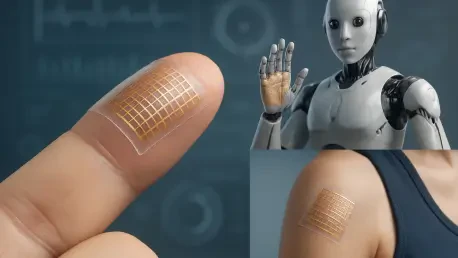

The ambitious goal of creating electronics that can perceive the physical world with the same nuance as human skin has long been hindered by the cumbersome nature of conventional sensor technology. For devices to truly interact with their environment, they must simultaneously detect multiple stimuli, such as pressure, speed of movement, and temperature. Historically, achieving this “multimodal” sensing has required complex, layered constructions of different materials, each dedicated to a single task. This approach leads to bulky, power-hungry devices with complicated signal processing and a higher potential for failure. A recent breakthrough, however, challenges this entire paradigm by demonstrating a flexible sensor that measures three distinct physical parameters—strain, strain rate, and temperature—using just a single layer of active material, potentially revolutionizing fields from robotics to wearable health monitors.
A Paradigm Shift in Sensor Architecture
Conventional multimodal sensors are often an exercise in complex integration, typically involving a stacked architecture where individual layers of specialized materials are tasked with detecting a specific physical input. One layer might be piezoelectric to measure strain, while another is thermoelectric for temperature. This design philosophy, while functional, creates a host of engineering challenges. It necessitates an intricate system for acquiring and differentiating signals from each layer, which can lead to crosstalk and interference, degrading the accuracy of the measurements. Furthermore, these composite structures often require an external power source to operate, limiting their application in self-sustaining or low-power electronics. The inherent complexity also impacts reliability and durability, particularly for flexible devices that must withstand continuous bending and stretching, making them less than ideal for long-term, continuous monitoring applications in dynamic environments.
In a remarkable departure from this established method, researchers have engineered a solution that unifies these sensing functions within a single, elegant structure. The innovation is centered on a specially designed network of tilted tellurium nanowires (Te-NWs). By meticulously controlling the material properties and physical architecture, the research team overcame a fundamental obstacle that has long stymied sensor development: the inability to collect thermoelectric signals (for temperature) and piezoelectric signals (for strain and strain rate) from the same geometric direction. In this novel design, the tilted orientation of the nanowires allows both types of signals to be generated and detected simultaneously in the out-of-plane direction. This streamlined approach not only eliminates the need for multiple material layers but also simplifies the signal acquisition process, creating a more robust, efficient, and self-powered sensor that represents a significant leap forward in flexible electronics.
Unprecedented Performance and Deeper Insights
The performance metrics of this new sensor set a new benchmark in the field of multimodal devices, significantly outperforming previously reported technologies. It exhibits an exceptionally high strain sensitivity of 0.454 V, a strain rate sensitivity of 0.0154 V·s, and a temperature sensitivity of 225.1 μV·K⁻¹. These figures represent a substantial improvement in the ability to detect and quantify subtle environmental changes. The inclusion of strain rate sensing is a particularly crucial advancement. While strain measures the amount of deformation, strain rate measures how quickly that deformation occurs. This capability is vital for dynamic scenarios, allowing a device to distinguish between a gentle, prolonged press and a sharp, sudden impact. This added dimension of data is invaluable for applications such as advanced prosthetics that need to react to rapid movements or smart textiles designed to monitor athletic performance and potential injuries in real time.
The success of the sensor is underpinned by a deep theoretical understanding of its operational mechanism, which was validated through sophisticated first-principles calculations. These computational models provided critical insights into the multi-physics coupling effects at the atomic level. The calculations revealed how the unique arrangement of tellurium atoms facilitates a redistribution of electrical charge under physical stress, generating the powerful piezoelectric effect responsible for strain and strain rate detection. Furthermore, the study elucidated how external fields, such as the thermoelectric potential created by temperature gradients, actively modulate these piezoelectric signals. This foundational work does more than just explain how the sensor works; it establishes a new design principle for creating coupled “nanogenerator” systems where multiple forms of energy can be harvested and converted into distinct, measurable electronic signals, paving the way for the next generation of intelligent, self-powered materials.
Envisioning a New Generation of Smart Devices
The development of this unified, single-material sensor opened up a vast new landscape for advanced electronics. This innovation moved beyond the incremental improvements of the past and established a foundational technology that could redefine the capabilities of smart devices. In the realm of artificial intelligence and robotics, this technology provided the means to create more sophisticated electronic skins that could give machines a far more nuanced sense of touch, allowing for safer and more intuitive human-robot interaction. For biomedical monitoring, the breakthrough enabled the design of ultra-thin, flexible patches that could conform to the skin and continuously track vital signs and subtle physiological changes without the need for cumbersome wires or frequent battery replacements. The work laid the groundwork for a future where flexible electronics were not just a novelty but a seamless and powerful interface between the digital and physical worlds.