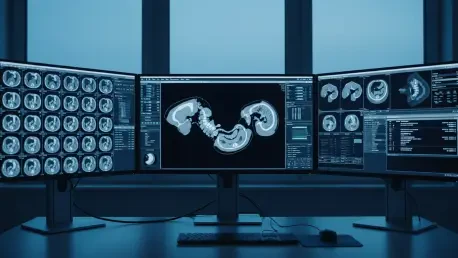

The unprecedented expansion of diagnostic imaging technology has created a profound disparity between the massive volume of clinical data generated and the cognitive bandwidth available to radiology experts worldwide. As abdominal computed tomography remains a cornerstone of modern diagnostic medicine, the sheer density of information within these volumetric scans often leads to a significant bottleneck in clinical workflows, delaying critical interventions. To address this mounting pressure, researchers have introduced Merlin, a groundbreaking three-dimensional vision-language foundation model specifically engineered to automate and refine the interpretation of complex abdominal imaging. Unlike earlier generations of artificial intelligence that relied on isolated two-dimensional analysis, this new model perceives the human body as a continuous spatial entity. By integrating diverse clinical narratives with high-resolution visual data, Merlin represents a fundamental shift toward generalist medical AI capable of understanding the nuances of patient history.
Revolutionizing Model Training with Massive Datasets
The foundational strength of Merlin lies in its exposure to an immense and diverse repository of clinical information, comprising over six million individual CT images derived from more than fifteen thousand unique scans. This scale of data is supplemented by nearly two million diagnostic codes and an extensive collection of textual tokens extracted from authentic radiology reports, allowing the model to bridge the gap between visual patterns and medical terminology. By utilizing such a vast multimodal dataset, the developers have successfully moved beyond the limitations of traditional supervised learning, which often requires slow and expensive manual annotation by human experts. Instead, Merlin learns directly from the existing wealth of institutional knowledge, internalizing the complex relationship between the physical appearance of an organ and the specific linguistic descriptors used by seasoned radiologists to document findings.
This sophisticated training regimen is powered by a multistage pretraining strategy that preserves the critical three-dimensional spatial context inherent in volumetric CT data. While traditional 2D models often lose vital information when processing a scan slice by slice, Merlin maintains a holistic view of the abdominal cavity, allowing it to track the continuity of blood vessels, the boundaries of adjacent organs, and the subtle margins of pathological lesions. This architectural decision ensures that the model does not just recognize isolated shapes but understands the structural integrity of the entire abdominal region. Furthermore, by aligning visual features with dense textual reports, the system gains a nuanced understanding of medical anatomy that transcends simple object detection. This approach has effectively cleared the path for a new era of medical intelligence where models possess a functional understanding of the clinical context in which they operate.
A Comprehensive Framework for Diagnostic Excellence
To confirm its readiness for high-stakes clinical environments, Merlin underwent an exhaustive evaluation process involving 752 distinct subtasks designed to mirror the daily challenges faced by medical professionals. One of the most significant achievements observed during these tests was the model’s proficiency in zero-shot classification, which refers to the ability to identify dozens of clinically significant findings without ever being explicitly trained on those specific labels. This capability indicates a deep, generalized understanding of pathology that allows the model to adapt to rare or unexpected medical conditions. Additionally, the system demonstrated remarkable granularity in phenotype classification, successfully identifying hundreds of different disease presentations and subtle variations in organ morphology that might be overlooked during a standard manual review of a complex case.
Beyond the immediate identification of current ailments, Merlin serves as a proactive instrument by calculating the five-year risk for several chronic diseases based on subtle visual biomarkers. This capability transforms the traditional CT scan from a reactive diagnostic tool into a predictive asset, allowing healthcare providers to implement preventative strategies long before a condition becomes symptomatic. The model also excels in the precise three-dimensional segmentation of twenty different abdominal organs, providing essential data for surgical planning and radiation therapy. By automating the generation of detailed radiology reports, Merlin significantly reduces the administrative burden on clinicians while maintaining a high standard of descriptive accuracy. This multifaceted performance ensures that the AI acts as a comprehensive assistant, supporting everything from routine screening to the management of highly complex chronic cases.
Validation Across Diverse Healthcare Environments
The true utility of any medical AI is measured by its performance in real-world settings where equipment, protocols, and patient demographics vary significantly. To test this generalizability, Merlin was subjected to rigorous validation against an external dataset containing over 44,000 scans sourced from multiple healthcare systems and public databases. The results were definitive, showing that the model consistently outperformed existing 2D vision-language systems and even specialized models designed specifically for CT analysis. Its 3D architecture allows it to scroll through a scan much like a human radiologist, maintaining anatomical continuity across hundreds of slices. This ability to synthesize information across the entire volume of the abdomen ensures that the model remains resilient against common imaging artifacts and variations in scan quality that often confuse less sophisticated AI systems.
Maintaining accuracy across different institutions is a notorious challenge in medical technology, yet Merlin demonstrated a remarkable ability to adapt to varying clinical practices. Whether analyzing scans from a high-volume urban hospital or a specialized research center, the model provided consistent and reliable outputs that aligned with expert human judgment. This robustness is attributed to the diversity of its initial training set, which prepared the model for the wide range of imaging parameters encountered in modern medicine. By proving its efficacy across tens of thousands of external cases, Merlin has established itself as a reliable foundation for automated diagnostics. This successful validation provides the necessary evidence for clinicians to trust the model’s findings, paving the way for its integration into standard hospital workflows where it can serve as a dependable second set of eyes for overloaded departments.
Scaling Laws and the Commitment to Open Science
The development of Merlin has provided the scientific community with invaluable insights into the technical requirements for building next-generation medical foundation models. Through the application of scaling laws, the research team identified a direct correlation between the volume of the training dataset, the duration of the computational process, and the eventual diagnostic accuracy of the system. They introduced innovative methods for aligning volumetric data with technical terminology, ensuring that the model’s linguistic outputs are semantically meaningful and clinically relevant. These technical advancements have established new benchmarks for how large-scale vision-language models should be constructed, particularly in fields where precision and spatial reasoning are paramount. This research confirms that as datasets grow more comprehensive, the potential for AI to mirror human-level clinical reasoning increases.
In a significant contribution to the broader medical and technical community, the creators of Merlin have released the source code and a substantial portion of the curated training data for public study. This commitment to open science ensures that the technology can be scrutinized, refined, and expanded upon by researchers around the globe, fostering a collaborative atmosphere in the fight against chronic disease. By sharing these resources, the developers have lowered the barrier to entry for other institutions looking to build specialized imaging tools, potentially accelerating the pace of innovation in the field of automated diagnostics. This transparency not only aids in the technical improvement of the model but also helps in establishing the safety standards and ethical guidelines necessary for the responsible deployment of artificial intelligence in sensitive healthcare environments.
Transforming Patient Care and Professional Workflows
The integration of Merlin into the clinical landscape has the potential to fundamentally alter the trajectory of patient care by identifying high-risk individuals years before their conditions reach a critical stage. By automating routine classification tasks and the generation of preliminary reports, the model provides immediate relief to radiology departments struggling with high turnover and burnout. This efficiency allows medical professionals to focus their attention on the most complex cases, where human intuition and bedside manner remain irreplaceable. Furthermore, the model’s ability to perform longitudinal analysis means that it can track subtle changes in a patient’s anatomy over several years, providing a level of consistency that is difficult to achieve with manual reviews. This shift toward personalized, data-driven medicine ensures that every patient receives a comprehensive and highly accurate assessment.
The implementation of such advanced technology required a careful balance of innovation and ethical responsibility during the initial rollout phases. Researchers focused on addressing concerns regarding data privacy and the interpretability of the model’s decision-making process to ensure that clinicians felt confident in the system’s recommendations. Future efforts were directed toward conducting prospective clinical trials to further refine the model’s response to rare pathologies and technical anomalies. By maintaining a focus on transparency and clinical validation, the team successfully demonstrated that Merlin could function as a cornerstone of modern diagnostic strategy. Ultimately, the project proved that merging 3D volumetric data with rich linguistic context was the key to unlocking the full potential of medical imaging, offering a scalable solution to the global demands of contemporary healthcare systems.