
The long-theorized dream of creating intelligent, microscopic machines capable of navigating complex environments independently has now transitioned from the realm of science fiction into tangible reality, heralding a new chapter in robotics. Researchers have successfully developed and demonstrated sub-millimeter-sized robots that possess the unprecedented ability to sense their surroundings, process information, and act on their own decisions without any direct human intervention. This monumental leap forward represents a fundamental paradigm shift in the field, moving beyond simple remote control to achieve true autonomy at a scale previously thought impossible.
This breakthrough is not merely an incremental improvement; it is a foundational technology that overcomes decades of limitations that have confined microrobotics to the laboratory. The development of self-sufficient, thinking microrobots paves the way for applications that could redefine industries, from targeted drug delivery and non-invasive surgery within the human body to environmental cleanup and high-precision manufacturing. The ability to mass-produce these intelligent agents opens the door to deploying swarms of programmable machines to tackle problems at the microscopic level, transforming our approach to some of the world’s most complex challenges.
A New Era of Miniaturization an Entire Fleet on a Fingertip
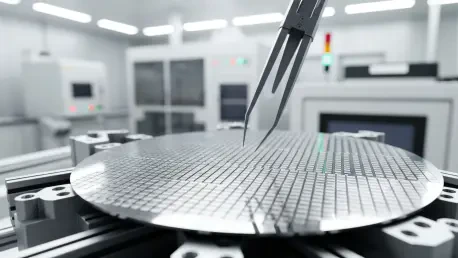
The sheer scale of this achievement is difficult to comprehend. Collaborative research between the University of Pennsylvania and the University of Michigan has yielded a platform where an entire fleet of approximately one hundred fully programmable, autonomous robots can be fabricated simultaneously on a single silicon wafer the size of a fingertip. Each individual robot measures between 210 and 270 micrometers in width, making them virtually invisible to the naked eye. This mass-production capability, borrowed from the semiconductor industry, drastically lowers the barrier to entry for utilizing this technology, suggesting a future where vast numbers of these agents can be deployed for complex, coordinated tasks.
However, the innovation extends far beyond simple miniaturization. What sets this new generation of microrobots apart is the integration of onboard intelligence. For the first time, these microscopic devices are not just passive specks of matter manipulated by external forces; they are self-contained systems capable of executing commands, processing sensory data, and making independent choices. This transition from remote-controlled object to autonomous agent marks the true birth of microrobotics as a field with practical, real-world potential.
Breaking the Chains of External Control
The journey to this point has been long and fraught with challenges, primarily stemming from the reliance on external systems for both power and control. For decades, microrobots were essentially microscopic puppets, their every move dictated by large, cumbersome equipment. Scientists used powerful, precisely modulated magnetic fields or focused laser beams to push, pull, or heat the robots into motion. While effective in controlled laboratory settings, this “tethered” approach created a significant operational bottleneck, rendering the robots useless outside the very limited range of their external controllers.
These limitations effectively barred microrobots from performing tasks in the complex, inaccessible environments where their potential is greatest, such as inside the human circulatory system or within intricate industrial machinery. Furthermore, these earlier designs lacked any form of onboard perception or processing. They could follow a pre-determined path but were incapable of reacting to unexpected obstacles or changing conditions. If the environment deviated from the expected model, the robot would fail, as it had no ability to perceive the change, process its meaning, or adapt its behavior accordingly. This lack of situational awareness made them impractical for any dynamic or unpredictable application.
The Anatomy of an Autonomous Mind
The core innovation that enabled this leap to autonomy was a radical shift in design philosophy: integrating all essential systems directly onto the robot’s sub-millimeter chassis. This was made possible by leveraging Complementary Metal-Oxide-Semiconductor (CMOS) fabrication, the same mature and highly refined technology used to create the computer chips that power everything from smartphones to supercomputers. By using this process, researchers can essentially “print” complex electronic circuits, sensors, and actuators onto a silicon wafer at an incredibly small scale, turning each robot into a complete, self-sufficient system.
Each of these microscopic machines is a marvel of integrated engineering, featuring four critical onboard components that work in concert. First, photovoltaic cells act as the robot’s power source, converting light from an external source into the electrical energy required to operate its systems. Second, an integrated processor serves as the robot’s “brain,” executing programmed instructions and making logical decisions based on incoming data. Third, onboard sensors, such as the temperature sensors used in the prototype, allow the robot to perceive and quantify aspects of its local environment. Finally, onboard actuators translate the processor’s electronic commands into physical movement, enabling the robot to act upon its decisions and navigate its surroundings.
A Microrobot’s First Independent Thought
To validate these unprecedented capabilities, the research team designed a definitive proof-of-concept experiment known as the “thermal gradient challenge.” In this test, a single microrobot was placed in a fluid-filled Petri dish where a specialized pump created a stable temperature gradient, making one side of the dish warm and the other cool. The robot was continuously illuminated by an external light source to provide uninterrupted power, but it received no commands or directional guidance from the researchers. The goal was to see if the robot could, on its own, find and remain in the warmer region—a behavior known as thermotaxis.
The robot was programmed with a simple yet elegant algorithm based entirely on its own sensory feedback. The instructions dictated that if its onboard temperature sensor detected a cooling trend, the robot should execute a gentle arcing motion to explore its surroundings for a warmer path. Conversely, if the sensor detected a rising temperature, the robot would turn in place, a strategy designed to help it linger within the desirable warm zone. Across 56 separate trials, the microrobots performed this task with remarkable consistency and reliability, successfully navigating toward the heat source every time. This closed-loop behavior—sensing, processing, and acting without any external command—provided conclusive evidence of the robot’s ability to “think” for itself. Further demonstrations showed that individual robots could be programmed with unique IDs to follow different paths, underscoring the sophistication of their onboard computing.
From the Laboratory to the Human Body
The implications of creating software-defined microrobots are profound. Because their function is determined by programmable code rather than fixed hardware, a single, general-purpose robot design can be repurposed for a virtually limitless number of tasks simply by uploading new instructions. This versatility, combined with the low cost of mass production, dramatically lowers the operational overhead of the technology. By eliminating the need for expensive and specialized external control equipment, this research “paves a path to widespread adoption” in fields as diverse as medicine, environmental monitoring, and materials science.
Despite this monumental progress, researchers acknowledge that a critical hurdle remains before these robotic agents can be deployed inside a living body. The current prototypes still rely on an external light source for power, which is not a viable solution for operating deep within opaque environments like human tissue. The next major research goal is therefore the development of a fully integrated, wireless power and locomotion system, perhaps one that harvests energy from its surroundings through ultrasound or chemical reactions. Overcoming this final challenge is essential for unleashing the full potential of these tiny autonomous agents and bringing the long-imagined future of microscopic surgeons and internal repair crews ever closer to reality.
The creation of these autonomous microrobots marked a pivotal moment in engineering and medicine. It was the point at which microscopic machines ceased to be mere extensions of human will and became independent agents, capable of exploring and interacting with the world on their own terms. This achievement not only solved long-standing technical problems but also shifted the very concept of what a robot could be. The foundation was laid for a future where intelligent microscopic systems could work alongside us, and inside us, to solve problems at a scale humanity could never reach before.