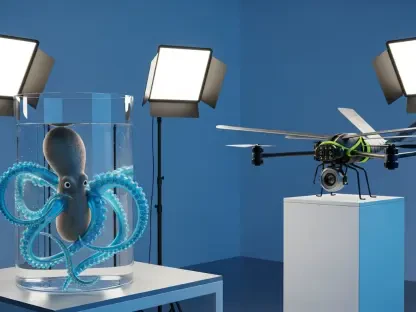

What if a robot no smaller than a paperclip could zip through a disaster-stricken area with the nimbleness of a bumblebee, reaching places no human or machine could access? This isn’t science fiction—it’s a reality crafted by engineers at MIT, where a groundbreaking aerial microrobot has emerged as a game-changer. With speed and agility rivaling nature’s tiny flyers, this microscopic marvel opens up a world of possibilities for tackling real-world crises. The story of this innovation isn’t just about technology; it’s about redefining what’s possible in the tightest, most dangerous spaces.
Why This Tiny Robot Is a Giant Leap
The significance of this microrobot lies in its potential to transform how society responds to emergencies. In scenarios like earthquakes or industrial accidents, where rubble and hazardous environments block access, traditional robots often fall short due to their size and limited maneuverability. This device, weighing less than a paperclip, promises to navigate such confined spaces with an insect-like finesse, offering hope for faster, more effective search-and-rescue missions. Its development marks a pivotal moment in robotics, where miniaturization meets nature-inspired design to solve pressing human challenges.
Beyond immediate applications, this breakthrough taps into a broader trend of biomimicry—learning from the natural world to push technological boundaries. The ability to replicate a bumblebee’s flight dynamics at such a small scale signals a shift in how engineers approach complex problems. It’s not just a robot; it’s a proof of concept that small machines can have an outsized impact on global issues, from disaster response to environmental monitoring.
Unpacking the Magic of Insect-Like Flight
At the heart of this microrobot’s prowess is a design that mirrors the elegance of insects. Developed over several years by MIT’s Soft and Micro Robotics Laboratory, the robot features larger flapping wings and soft artificial muscles that mimic the rapid wingbeats of a bumblebee. This bioinspired approach allows for extraordinary agility, enabling movements that were once thought impossible for machines of this size. Every flutter and turn reflects a deep study of nature’s finest flyers, distilled into a mechanical masterpiece.
Complementing the physical design is a cutting-edge AI-driven control system that powers its precision. The two-step framework pairs a model-predictive controller for plotting complex maneuvers with a deep-learning policy for real-time execution. This innovation overcomes the sluggishness of older, hand-tuned controllers, achieving a staggering 447% increase in speed and a 255% acceleration boost compared to earlier models. Such numbers reveal how far the technology has come in bridging the gap between artificial and natural flight.
Then there’s the raw performance that turns heads. Imagine a robot completing 10 consecutive somersaults in just 11 seconds, all while staying within a tight 4 to 5 centimeter trajectory. Add to that rapid saccade movements—quick pitches and stops akin to an insect scanning its surroundings—and the result is a device that not only flies but thinks like its biological counterpart. These metrics aren’t just impressive; they’re a benchmark for what microrobots can achieve.
Yet, real-world conditions pose unique hurdles. Wind gusts and tiny manufacturing inconsistencies could easily throw off such a small machine, but the robust control system adapts to these disturbances with surprising resilience. Still, limitations persist—current prototypes operate on a tethered system, relying on external computers for control. Addressing these constraints remains a critical step toward unleashing the full potential of this technology in unpredictable environments.
Hearing from the Minds Behind the Marvel
The vision for this project comes alive through the words of those who built it. Associate Professor Kevin Chen, a key figure at MIT’s Department of Electrical Engineering and Computer Science, emphasizes the goal of creating robots that can “navigate disaster zones with the same ease as insects dart through a garden.” His passion for blending biology with engineering shines through in every detail of the design. Meanwhile, co-senior author Jonathan P. How from the Department of Aeronautics and Astronautics highlights the control system’s role, noting that “achieving real-time agility at this scale was a monumental challenge overcome by AI innovation.”
External perspectives add further weight to the achievement. Sarah Bergbreiter from Carnegie Mellon University, a respected voice in microrobotics, points out the broader implications, stating, “This work paves the way for insect-scale robots with autonomy that could rival their natural counterparts.” Published in Science Advances, the study garners credibility not just from its results but from the chorus of experts who see it as a turning point. Their insights paint a picture of a field on the cusp of transformation, driven by relentless curiosity and technical precision.
Real-World Impact and What Lies Ahead
Picture a collapsed building after an earthquake, where survivors are trapped in spaces too narrow for conventional rescue tools. This microrobot could slip through the cracks, delivering critical data or even small supplies to those in need. Its potential in search-and-rescue operations stands out as the most immediate and life-saving application, offering a glimpse of how technology can directly address human suffering. In industries, too, such devices could inspect tight machinery spaces, preventing costly failures before they occur.
However, the journey from lab to field isn’t without obstacles. Current reliance on tethered systems limits outdoor use, and the lack of onboard sensors means it can’t yet fully “see” its surroundings. The team aims to integrate cameras and develop untethered flight capabilities within the next few years, from 2025 to 2027, alongside features like collision avoidance for swarm coordination. These advancements would enable fleets of microrobots to work together, amplifying their impact in complex scenarios.
Staying engaged with this rapidly evolving field offers a chance to witness history in the making. Platforms like MIT News provide regular updates on such breakthroughs, while academic journals dive deeper into the technical details. Exploring related areas, such as AI’s role in robotics, can also broaden understanding of how these tiny machines might shape the future. Keeping an eye on these developments ensures that the public remains informed as microrobots move closer to real-world deployment.
Reflecting on a Boundary-Breaking Achievement
Looking back, the creation of this aerial microrobot stood as a testament to human ingenuity, blending the raw beauty of nature with the precision of modern engineering. The strides made in mimicking a bumblebee’s flight captured imaginations and set a new standard for what small machines could accomplish. Each somersault and rapid turn in the lab hinted at a future where technology could reach the unreachable.
Moving forward, the focus shifted to practical next steps. Equipping these robots with onboard sensors promised to untether them from external controls, while swarm coordination offered the potential for collective action in disaster zones. These goals weren’t just technical challenges; they were stepping stones to saving lives and solving problems once deemed impossible. As research continued, the dream of microrobots buzzing through rubble or hazardous sites grew ever closer to reality, inspiring a renewed commitment to innovation.