
Oscar Vail is a seasoned technologist whose work spans the frontiers of quantum computing and robotics, but his recent focus on digital media security has made him a pivotal voice in the fight against unauthorized generative AI. As deepfake technology becomes increasingly sophisticated, the threat to creative autonomy has never been more urgent, allowing nearly anyone to hijack a professional’s identity with minimal effort. In this conversation, we explore the nuances of vocal cloning and a revolutionary new safeguard designed to protect the very soul of professional musicianship.
The following discussion examines the existential threat posed by high-fidelity voice cloning, the intricate mechanics of adding adversarial noise to audio waveforms, and the technical strategies used to disrupt machine learning models without compromising acoustic quality. We also delve into the real-world results of recent pilot tests involving various musical genres and the vital role of industry-scale collaborations in establishing new standards for intellectual property protection.
Generative AI can now replicate a singer’s signature voice using just a few seconds of raw audio. How does this capability fundamentally threaten an artist’s brand and revenue, and what specific emotional toll does this form of digital identity theft take on professional creators?
The reality we are facing is that a mere few seconds of audio is now enough for an AI to bypass years of vocal training and brand building. When the internet is suddenly flooded with studio-quality versions of a song sung by “infamous” people or digital clones, even the most diehard fans struggle to tell the real track from a synthetic imitation. This creates a massive crisis where an artist’s revenue is siphoned off by unauthorized content that they never sanctioned or performed. Beyond the financial loss, there is a profound emotional toll on musicians who pour their heart and soul into their work, only to see their identity used for nefarious or mocking purposes. It feels like a violation of the self, as the technology allows others to make a creator “sing” things they would never naturally say or perform.
Protecting intellectual property now involves adding tiny, imperceptible modifications to a song’s waveform. How exactly do these shifts confuse AI models while remaining silent to human listeners, and what are the practical steps a musician must take to apply this digital safeguard before a new track is released?
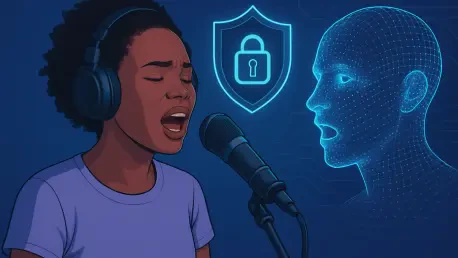
The core of the “My Music My Choice” technology lies in introducing microscopic shifts into the song’s waveform that are effectively invisible to the human ear. To a person listening to the track, the vocals sound exactly the same as the original recording, maintaining the intended emotional resonance and clarity. However, from the perspective of an AI model, these modifications make the audio sound like a completely different vocal track, effectively masking the true signature of the voice. For a musician, the process is designed to be a proactive shield that they apply to their master tracks before the music is ever released to the public or uploaded to streaming platforms. By integrating this step into their final production workflow, they ensure that any “bad actor” attempting to scrape their audio for cloning purposes will find the data useless.
When an AI model attempts to clone a track protected by adversarial noise, the output is often reduced to distorted static. What specific technical failures occur within the machine learning architecture during this process, and how do you ensure these protective layers do not degrade the original audio quality?
The failure occurs because the generative model attempts to map the audio features it perceives, but the adversarial noise creates a mathematical contradiction that the machine cannot resolve. Instead of a clean vocal clone, the architecture produces nothing but distorted noise, essentially breaking the cloning process at its foundational level. The challenge for the researchers at Binghamton University and Cauth AI was to minimize the impact on human listeners while simultaneously maximizing the disruption for the machines. They achieve this by using a model that identifies the exact “tiny modifications” that will throw off the AI’s pattern recognition without altering the audible frequencies humans are sensitive to. It is a delicate balancing act of digital camouflage where the protection is robust enough to crash a neural network but subtle enough to satisfy an audiophile.
Recent tests on 150 tracks across various genres suggest these tools are effective at stopping unauthorized cloning. How does the effectiveness of this protection vary across different musical styles, and what metrics are used to measure the balance between preserving audio fidelity and maximizing disruption for the machines?
Testing the system on 150 music tracks was a critical milestone because it proved that the defense isn’t limited to a single style of singing or production. Whether it is a sparse acoustic performance or a heavily layered pop track, the goal remains the same: ensuring the AI output is reduced to unintelligible static. The researchers use specific metrics to ensure that the human experience remains unblemished, comparing the original waveform to the protected one to verify that no audible degradation has occurred. At the same time, they measure the “cloning error” of the AI models to ensure that the disruption is maximized across the board. While the pilot program was successful across multiple genres, the team is already planning to expand testing to even larger data samples to ensure the tool remains bulletproof as AI continues to evolve.
As bad actors find new ways to bypass digital protections, how must defensive technologies evolve to stay ahead of more sophisticated generative models? What role should industry-scale collaborations play in standardizing these protections so they can be integrated into the workflows of major recording labels?
Defensive technology must be as disruptive as the generative models it seeks to combat, which is why the partnership between academic researchers and startups like Cauth AI is so vital. This collaboration bridges the gap between lab-scale concepts and the industrial-scale impact needed to protect the global music industry. To stay ahead of bad actors, these protective layers must be constantly updated to account for new machine learning architectures that might try to “filter out” adversarial noise. Ultimately, for this to be effective on a global scale, major recording labels need to adopt these protections as a standard part of their release protocol. When these safeguards are integrated into the professional workflow, it creates a unified front that makes unauthorized voice cloning significantly more difficult and less profitable for those looking to exploit artists.
What is your forecast for the future of AI-generated music and artist protections?
My forecast is that we are entering a period of intense digital escalation where the battle for “vocal sovereignty” will become a standard part of the music business. I expect that within the next few years, tools like My Music My Choice will be as common as digital rights management or watermarking, as they are presented at major venues like the NeurIPS 2025 conference to prove their technical validity. We will likely see a shift where the industry moves away from reactive legal battles and toward proactive, technological “shroud” methods that prevent the theft from happening in the first place. As we continue to test these systems on larger and more diverse datasets, the protection will become so seamless that the average listener won’t even know it’s there, while the AI models will find themselves hitting a wall of static every time they try to infringe on a creator’s identity.