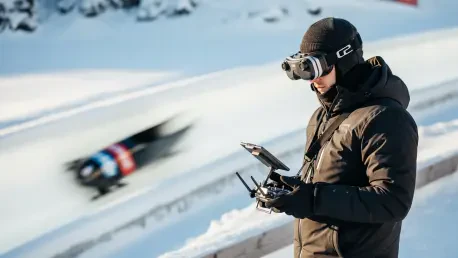

The cutting-edge integration of small, high-speed drones into live sports broadcasting is fundamentally transforming how global audiences experience the Winter Olympics, offering a visceral and dynamic perspective previously unimaginable. This technological leap has moved beyond simple aerial shots, placing viewers virtually on the shoulders of elite athletes as they navigate treacherous courses at breathtaking speeds. Events like alpine skiing, bobsledding, luge, and snowboarding are now being presented with an immediacy that bridges the gap between spectator and competitor. This revolution in sports coverage provides a more immersive, action-packed connection, reshaping the visual narrative of these high-stakes competitions and setting a new standard for how athletic prowess is captured and conveyed to millions of fans watching from home. The result is a more complete and thrilling story, one that captures not just the outcome of the race but the raw emotion and sheer velocity of every moment.
A New Dimension in Sports Broadcasting
The adoption of advanced drone technology has been met with overwhelmingly positive reception, widely hailed as a groundbreaking tool that delivers stunning, high-pace visuals and adds an entirely new dynamic to sports broadcasting. Unlike static cameras or even manned aerial platforms, these agile drones can fly just feet behind an Olympian, perfectly mirroring their speed and trajectory down a mountain or through an icy track. This capability provides an unparalleled intimate point-of-view that traditional camera angles simply cannot replicate. For the home viewer, this translates into a tangible sense of the incredible velocity and the split-second, precise movements required at this elite level of competition. As noted by Norwegian skier Kajsa Vickhoff Lie, this unique perspective finally allows spectators to genuinely appreciate the speed involved in the sport, making the viewing experience more authentic and profoundly more thrilling than ever before. This is not just a new angle; it is a fundamental shift in visual storytelling.
Beyond the adrenaline-fueled action shots, drone technology serves a crucial dual purpose by masterfully showcasing the breathtaking beauty and scale of the Olympic venues. The International Olympic Committee (IOC) has strategically embraced these drones for their unique ability to fulfill two key broadcasting objectives simultaneously: displaying the grandeur of the host settings and providing the athlete’s personal, immersive point of view. For example, drones can seamlessly transition from tracking a skier to pulling back to reveal the majestic Dolomite rock walls of the Tofana schuss in Cortina, Italy. This dual capability allows broadcasters to weave a more complete and compelling narrative, framing the extraordinary athletic feats within the spectacular natural landscapes where they unfold. The result is a richer, more cinematic presentation that elevates the broadcast from a simple sports report to an epic visual journey, capturing both the human drama and the awesome power of the environment.
The Fusion of Pilot Skill and Advanced Technology
A significant aspect of this technological revolution is the profound human element, particularly the deep, symbiotic connection the drone pilots feel with the events they are filming. Through the experiences of pilots like Martin Bochatay, it becomes clear that their role transcends merely operating a machine; they describe it as “flying with the skiers.” This intense immersion is facilitated by first-person-view goggles that show the pilot exactly what the drone’s camera sees, enabling the instantaneous, intuitive control required to shadow an Olympian at top speed down a perilous course. This incredible expertise is not lost on the athletes themselves. U.S. bobsledder Frank Del Duca has called the skill of the drone pilots “phenomenal,” praising the “really unique perspective” their work provides. This acknowledgment underscores the fact that the stunning visuals are a product of a perfect fusion between cutting-edge technology and exceptional human skill and focus.
From a technical standpoint, the broadcasting drones in use today represent a monumental evolution in unmanned aerial vehicle technology. They stand in stark contrast to the primitive, massive machines of the past, such as the one that nearly injured Austrian skier Marcel Hirscher in a crash eleven years prior. Today’s models are remarkably agile and tiny, weighing only about half a pound (250 grams), yet they are incredibly powerful. These compact devices can accelerate to speeds exceeding 100 miles per hour (over 170 kph), a crucial capability for keeping pace with the world’s fastest winter athletes. Despite their performance, safety remains the paramount concern. Strict regulations are rigorously enforced, mandating that the drones must always maintain a safe distance behind competitors. Furthermore, they are explicitly prohibited from ever overtaking the athletes, a critical rule that ensures the technology enhances the broadcast without ever compromising the performance or well-being of the competitors.
Operational Realities and Audience Impact
The logistical execution of flying these high-performance drones in cold, high-stakes Olympic environments is a complex and meticulously managed operation. Each drone is outfitted with a sophisticated dual-camera system. The first is a high-quality camera that captures the actual broadcast feed, with settings for brightness and color balance controlled remotely by the main television production unit to ensure seamless integration with the overall broadcast. The second is a lower-quality camera that transmits a live feed directly to the pilot’s goggles, providing the essential first-person view necessary for precise navigation and control. Pilots utilize a complex two-handed remote to manage the drone’s flight, simultaneously manipulating inputs for pitch, roll, yaw, and throttle. A significant practical challenge is battery life, which is rapidly depleted by the cold temperatures. To counter this, a dedicated “pit stop crew” stands by to perform rapid battery swaps between athletes’ runs, using special warming cases to keep replacement batteries at an optimal temperature for peak performance.
The successful integration of this hyper-realistic footage created an impact on the audience that was both exhilarating and profoundly visceral. The immersive quality of the drone visuals proved so effective that it induced a physical reaction in some viewers, bridging the gap between spectator and athlete in an unprecedented way. IOC sports director Pierre Ducrey admitted to almost feeling “motion sickness” while watching the downhill skiing footage, framing it as a powerful testament to how successfully the technology projected the viewer directly into the heart of the action. This sentiment was shared by U.S. bobsledder Elana Meyers Taylor, who found the drone footage from a luge run to be “slightly nauseating.” While seemingly a negative side effect, this was presented as the ultimate proof of the technology’s success in creating a viewing experience more intense than ever before. Initial concerns about whether the “humming noise” of the drones might distract the athletes were thoroughly dispelled by competitors like Kajsa Vickhoff Lie, who clarified that any sound was imperceptible once the race began, confirming that the technology enhanced the spectacle without interfering with the competition.