
For nearly three decades, the fundamental purpose of the web browser has remained remarkably unchanged, serving primarily as a passive portal through which users view a digital world constructed by others. This long-standing paradigm, however, is now being fundamentally challenged by a new breed of software that envisions the browser not just as a window, but as an active, intelligent workspace. Opera Neon stands at the forefront of this evolution, presenting a compelling argument that the future of browsing lies in creation and autonomous action, powered by a sophisticated suite of artificial intelligence models. This new browser is not an incremental update; it is a redefinition of our primary interface to the internet, transforming it from a simple information retriever into a powerful tool for building and doing.
What If Your Browser Was Less of a Window and More of a Workbench
The central question posed by Opera Neon’s existence is transformative: what happens when the browser sheds its role as a passive viewer and becomes an active instrument? For years, browsers like Chrome, Safari, and Firefox have perfected the art of displaying content. They are meticulously engineered windows looking out onto a pre-built digital landscape. Neon proposes a radical shift from this model toward what can be described as an “agentic workspace.” This concept recasts the browser as a dynamic environment where users direct an AI agent to not only find information but also to synthesize it, act upon it, and even use it to construct new digital artifacts.
This evolution from information retrieval to task execution represents a significant leap in human-computer interaction. The agentic workspace is not merely about finding answers more quickly; it is about delegating complex, multi-step processes to the browser itself. Instead of the user manually opening tabs, copying data, and consolidating information, the browser becomes a proactive assistant capable of understanding and executing complex commands. This functional pivot suggests a future where our relationship with the internet is less about navigating a vast library and more about commanding a personal workshop to build precisely what we need.
The End of Passive Surfing Why the Modern Web Demands a New Kind of Browser
The limitations of traditional browsers have become increasingly apparent in an era dominated by interactive applications and generative AI. Designed primarily for content consumption, these established platforms are ill-equipped to handle the growing user demand for active creation and task automation. Navigating today’s web often involves a disjointed workflow, forcing users to juggle multiple applications and services to accomplish a single goal, from planning a trip to compiling market research. This friction highlights a significant gap between what the modern internet offers and what conventional browsers allow users to do with it.
Opera Neon’s arrival is a direct response to this technological and cultural shift. The proliferation of powerful generative AI models has created an expectation for tools that do more than just display information. Users now seek platforms that can help them create, organize, and automate directly within their primary digital environment. Neon is framed not as another competitor in the browser wars but as a new category of software altogether. It recognizes that the internet is no longer a place one simply visits but a medium one actively shapes, and it provides the tools necessary for that creative engagement.
The Chat Do Make Framework Deconstructing Neon’s Creative Engine
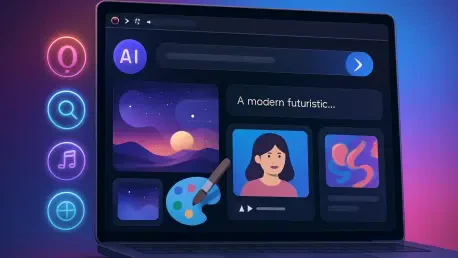
At the core of Opera Neon’s functionality is a simple yet powerful philosophy built around three distinct modes of AI interaction: “Chat, Do, and Make.” This framework organizes the browser’s capabilities, guiding the user from simple queries to complex creation. This entire suite of features, powered by leading models like Gemini 3 Pro, GPT-5.1, and Veo 3.1, is offered through a single subscription priced at $19.90 per month, positioning Neon as a premium productivity platform.
The “Chat” function offers a familiar conversational AI experience, comparable to established tools like ChatGPT Search. It serves as the entry point for quick queries, allowing users to ask questions and receive synthesized, AI-generated answers without leaving their current context. Moving beyond simple conversation, the “Do” mode embodies the browser’s agentic power. Here, Neon can autonomously execute complex, multi-step tasks. A user could, for example, instruct it to research a topic across several specified websites, extract key data points, and compile them into a summary, freeing the user to focus on higher-level analysis.
The most innovative feature, however, is “Make.” This mode transforms the browser into an integrated, simplified web development environment. Using natural language prompts, users can direct the AI to build small, personalized web tools and pages, which are then hosted on Opera’s servers. A key distinction of this feature is its ability to pull context and information from other open tabs, enabling the rapid creation of custom dashboards and resources. This trinity of functions—Chat, Do, and Make—creates a seamless workflow from inquiry to execution to creation, all within a single application.
A New Frontier in Browsing Neon vs The Competition
In the emerging landscape of AI-powered browsers, Neon’s most direct competitor is Perplexity’s Comet. While both leverage AI to enhance the browsing experience, a comparative analysis reveals fundamental differences in their core philosophies. Comet has earned praise for its exceptional speed and its effective integration of an AI assistant that provides “snappy” and context-aware answers. It excels at augmenting the traditional browsing model with a layer of intelligent assistance, making information retrieval faster and more efficient.
However, where Comet integrates a powerful assistant into a familiar browser framework, Neon builds an entire ecosystem for creation around its AI. The ambition is not merely to improve search but to replace a suite of disparate productivity applications by embedding their functionality directly into the browsing experience. This difference is best understood through the “Window vs. Workbench” metaphor. Traditional browsers, and to a large extent Comet, offer a clearer, faster window to the web. Neon, in contrast, hands the user a set of power tools and a workbench, inviting them to build their own corner of it.
Building Your Corner of the Web A Practical Guide to Neon’s Make Mode
The true potential of Opera Neon is most evident in its “Make” mode, which empowers users to construct personalized web utilities with remarkable ease. A practical exploration of this feature reveals its intuitive power. In one instance, a custom news feed was created to aggregate stories from specific sections of the TechRadar website—namely, AI, Apple, and Gaming. By issuing a simple natural language prompt, Neon generated a functional page with headlines, summaries, and links from these chosen categories in approximately ten minutes, a task that would otherwise require complex extensions or third-party RSS services.
A more ambitious project involved creating a personalized tracker for top-rated PC role-playing games. The instruction was to compile a list of the 20 best RPGs based on their Metacritic score and then augment this list with data from other sources. Neon successfully browsed to HowLongToBeat to fetch game completion times and to the Steam store to find current prices. The result was a single, coherent, and functional list that combined data from three different websites into a custom resource. This process of building a small, useful piece of the internet evokes a sense of ownership and personalization reminiscent of the early web.
Navigating the Bumps A Critical Look at Neon’s Performance and Price
Despite its groundbreaking vision, Opera Neon is not without significant shortcomings that temper its current appeal. An objective assessment reveals several areas needing improvement. The browser’s performance can be sluggish, with task execution times lagging behind the responsiveness of competitors like Perplexity’s Comet. More critically, stability issues were observed; for instance, the browser would lose all progress on a complex “Do” task if the computer entered sleep mode, forcing a complete restart of the process.
Furthermore, the “Make” interface, while powerful, presents a notable learning curve for new users and has limitations in handling complex web layouts or integrating live, real-time data feeds. These technical hurdles, however, are secondary to what is likely the most significant barrier to mainstream adoption: its price. In a market where leading browsers are offered for free, the $20 monthly subscription fee positions Neon as a niche tool for professionals and enthusiasts. This premium model makes it a difficult proposition for the average user, who may be unwilling to pay for a browser, no matter how advanced its capabilities.
Ultimately, Opera Neon’s initial release presented a compelling, if imperfect, vision for the future of web interaction. While its performance issues and premium price point were significant obstacles, its core concept of transforming the browser from a passive window into an active workbench was both exciting and new. The true innovation was not merely the addition of another AI chatbot but the fundamental restructuring of the browser as a platform for direct creation and task automation. Although its market success was limited by its business model, Neon successfully laid the groundwork for a new category of software, demonstrating a future where the primary tool for accessing the internet also became the primary tool for building it.