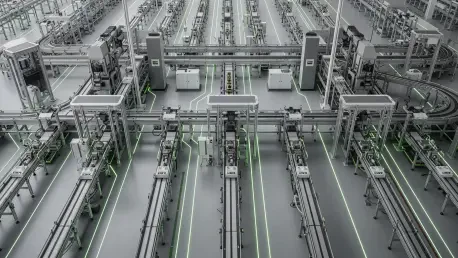

In the high-stakes world of industrial automation, we often focus on the walls we build to keep hackers away from our data, yet we overlook the heartbeat that keeps the entire factory alive: time. Oscar Vail, a visionary in emerging technologies from robotics to quantum computing, has spent his career at the intersection of hardware and software resilience. As we move toward the 2026 landscape of smart manufacturing, his insights into the vulnerabilities of microsecond-level synchronization reveal a chilling reality where an attacker doesn’t need to steal a single file to bring a multi-million dollar facility to its knees. Our discussion explores the shift from data-centric security to “timing” security, the evolution of Time-Triggered Ethernet (TTEthernet), and the multi-layered defenses required to protect the invisible signals that choreograph modern industry.
Many industrial defenses prioritize data protection, but how does a shift in microsecond-level clock synchronization specifically impact machine coordination? What safety risks arise when robotics misinterpret instructions due to these subtle timing drifts, and could you provide a scenario where this causes physical damage?
When we talk about smart factories, we aren’t just looking at machines that communicate; we are looking at machines that perform a complex choreography. In a time-triggered environment, devices rely on a shared sense of time to coordinate actions within a window of just a few microseconds. If an attacker induces a timing drift, that perfect synchronization shatters, leading to a state where machines misinterpret the sequence of instructions. Imagine a heavy robotic arm in an automotive assembly line that is programmed to weld a frame at a precise microsecond while a conveyor belt moves the chassis into position. If the clock drifts even slightly, the arm might swing before the frame arrives or after it has passed, resulting in a violent collision that crushes expensive equipment and sends shards of metal across the factory floor. These safety signals, which are meant to prevent such catastrophes, become useless if the robot’s internal clock tells it that the path is clear when it actually isn’t.
Delaying Protocol Control Frames can mimic natural network jitter to avoid detection. How exactly does this latent manipulation degrade system determinism, and what specific metrics or indicators should engineers look for to distinguish a deliberate timing attack from standard technical lag?
System determinism is the guarantee that a specific action will happen at a specific time, every single time, without fail. When an attacker targets Protocol Control Frames, they are essentially whispering lies to the network’s time-base, causing a gradual degradation of this certainty. Unlike a sudden hardware failure that creates a massive, obvious spike in lag, these “delay attacks” mimic the natural, messy jitter we see in any electrical system. Engineers need to move beyond looking for simple “up or down” connectivity and start monitoring the rate of change in clock offsets and synchronization messages. If the jitter starts to show a persistent, incremental trend rather than a random distribution, it is a massive red flag that someone is trying to quietly pull the network out of sync. Standard technical lag is usually chaotic and short-lived, but a deliberate timing attack feels more like a slow, rhythmic tide that eventually drowns the system’s ability to stay coordinated.
Time-Triggered Ethernet was originally designed to withstand accidental technical faults rather than malicious actors. Why is this distinction so critical for modern IIoT environments, and in what ways do “intelligent” attacks exploit these protocols differently than a simple hardware failure or random glitch?
The original architects of TTEthernet were focused on reliability in the face of nature—things like cosmic rays, heat-induced hardware fatigue, or random electrical noise. These are “dumb” faults because they don’t have a strategy; they are random occurrences that the protocol can filter out using standard redundancy. However, an “intelligent” attack is a completely different beast because it is purposeful, persistent, and designed to bypass those very filters. Instead of a random glitch that might cause a single packet to drop, an intelligent attacker understands the protocol’s heartbeat and injects delays that the system is programmed to “accept” as normal variance. By exploiting the way the network handles its own time-base, an attacker can turn the system’s built-in fault tolerance against itself, making the network trust a falsified timeline that leads to total operational instability.
Securing timing checkpoints often requires a multi-layered approach involving AI and distributed-ledger techniques. How can factories implement these tools without compromising microsecond-level performance, and what are the step-by-step requirements for linking edge-side detection with cloud-side situational awareness?
The challenge is that you cannot add heavy security “gates” that slow down the very traffic you are trying to synchronize, so we use a four-layer defense framework that operates in parallel with the data flow. First, you establish foundational resilience through strong identity controls at the hardware level, ensuring every device is who it says it is. Second, we deploy AI and machine learning at the edge—right there on the factory floor—to spot those subtle timing anomalies in real-time without needing to send every packet to a distant server. Third, we use lightweight distributed-ledger techniques to create a tamper-evident audit trail of timing checkpoints, so even if an attacker changes the clock, the history of those changes is preserved and cannot be erased. Finally, all these signals are fed into a cloud-side platform that uses big-data correlation to link a tiny timing hiccup in a robot with wider signals across the entire IIoT ecosystem, giving us a “god’s eye view” of the attack as it unfolds.
As automation expands into autonomous vehicles and smart manufacturing, the concept of a “shared clock” becomes a primary target. How does securing this invisible signal protect human workers on the floor, and what changes are needed to ensure industry can fully trust these autonomous systems?
Securing the shared clock is quite literally a matter of life and death when you have humans working alongside autonomous systems. In a modern warehouse, autonomous forklifts move at high speeds, relying on a shared clock to ensure they don’t cross paths or strike a human worker who is following a digital pick-list. If that invisible timing signal is compromised, the forklift might “think” a safety curtain is active when it actually hasn’t been triggered yet, leading to catastrophic accidents. To build true trust, the industry must stop treating timing as a background utility and start treating it as a primary security asset that requires its own dedicated monitoring and protection. We need a cultural shift where developers and engineers realize that if you don’t own the clock, you don’t own the machine, and you certainly cannot guarantee the safety of the people around it.
What is your forecast for the security of time-triggered industrial networks?
My forecast is that we are entering an era where “Temporal Security” will become a standalone discipline within the cybersecurity world. By 2026 and beyond, as the research from the University of East London suggests, we will see a massive move away from purely perimeter-based defenses toward these adaptive, multi-layered frameworks that protect the integrity of time itself. We will likely see the integration of “Time-Aware” firewalls and AI-driven synchronization guardians as standard components in every smart factory. Ultimately, the winners in the industrial sector will be those who recognize that a millisecond of deception can be just as damaging as a terabyte of stolen data, and they will invest in the “invisible” layers of their network to ensure their autonomous futures remain both productive and safe.