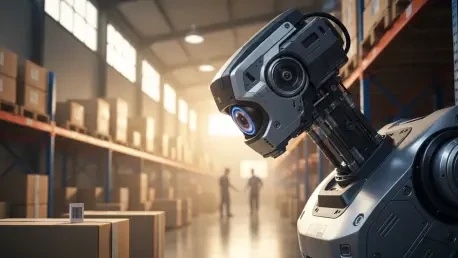

Imagine a robot patrolling a busy warehouse, seamlessly zooming in on a misplaced package while maintaining a wide view of the entire floor, reacting to instructions with uncanny precision. This isn’t a distant dream but a tangible reality emerging in the field of embodied AI, thanks to groundbreaking advancements in robotic vision. The industry stands at a pivotal moment where visual perception is no longer a static limitation but a dynamic strength, poised to redefine how machines interact with the world. This report dives into the cutting-edge development of a bio-inspired robotic eyeball known as EyeVLA, exploring its transformative potential within the broader AI and robotics landscape.
Unveiling the Future of Robotic Vision
The robotics industry today is experiencing a surge of innovation, particularly in the realm of visual perception, which serves as the backbone of embodied AI systems. Robots are increasingly expected to navigate complex environments, interpret nuanced visual data, and act with autonomy, pushing the boundaries of traditional technology. Key players like Shanghai Jiao Tong University and the Chinese Academy of Sciences are at the forefront, driving research that bridges the gap between human-like capabilities and machine efficiency. Their efforts highlight a critical need for systems that can adapt to unpredictable settings, a demand that static vision tools struggle to meet.
Moreover, the rise of bio-inspired technologies marks a significant shift in approach. Drawing from natural systems like the human eye, researchers are crafting solutions that mimic biological processes to enhance machine perception. This trend not only addresses technical shortcomings but also signals a growing convergence between biology and technology. As the industry leans toward such innovative paradigms, the stage is set for a new era where robots see and understand their surroundings with unprecedented clarity and flexibility.
Breaking New Ground with EyeVLA Technology
Innovations Driving Active Perception
Robotic vision is undergoing a profound transformation, moving away from the constraints of static RGB-D cameras to dynamic, active perception systems like EyeVLA. Traditional cameras, while effective for basic color and depth data, often fail to adjust to changing environments or focus on specific details without sacrificing broader context. EyeVLA, inspired by the human eyeball, introduces a revolutionary ability to rotate and zoom based on user instructions, capturing both wide-area coverage and fine-grained details without the need for additional costly hardware.
This leap forward is fueled by a blend of cutting-edge technologies, including reinforcement learning and vision-language model integration. These advancements enable the system to interpret complex instructions and translate them into precise actions, enhancing its utility in open-world applications. As robots are increasingly deployed in diverse scenarios—from industrial inspections to household tasks—the demand for such adaptable vision systems grows, positioning active perception as a cornerstone of future innovation in the field.
Market Impact and Growth Potential
The embodied AI sector is witnessing remarkable expansion, with projections indicating significant growth over the next few years from 2025 onward. EyeVLA’s introduction into this market promises to be a game-changer, offering a cost-effective yet powerful solution to longstanding visual perception challenges. Experimental results from indoor testing environments demonstrate the system’s ability to accurately acquire visual data through directed movements, suggesting a strong foundation for scalability across various industries.
Analysts forecast that successful implementation in controlled settings could pave the way for broader adoption in more complex, outdoor environments by 2027. Performance indicators point to a potential increase in robotic efficiency by streamlining tasks like infrastructure monitoring and environmental surveillance. As investment in AI-driven robotics continues to climb, EyeVLA stands out as a pivotal technology that could capture substantial market share, driving both innovation and profitability in the sector.
Confronting Challenges in Robotic Vision Advancements
Despite its promising capabilities, EyeVLA faces several hurdles that must be addressed to ensure its real-world viability. Performance in unpredictable conditions remains a significant concern, as factors like variable lighting, rapid environmental shifts, and physical obstructions could impede its effectiveness. While indoor tests have shown impressive results, the transition to dynamic, uncontrolled settings introduces complexities that the current system may not fully anticipate.
Furthermore, seamless integration with other robotic components, such as navigation systems or mechanical manipulators, poses another layer of difficulty. Ensuring that EyeVLA operates harmoniously within a broader robotic framework requires meticulous engineering and testing. Solutions are on the horizon, however, with potential algorithm refinements and hardware upgrades aimed at enhancing adaptability and robustness.
Expanding the scope of testing to include diverse, real-world scenarios will also be critical. Collaborative efforts between research institutions and industry stakeholders could accelerate this process, providing the data and feedback necessary to fine-tune the technology. Overcoming these challenges is not just feasible but essential for unlocking the full spectrum of possibilities that active perception systems offer.
Navigating the Regulatory Terrain of AI Vision Systems
The deployment of advanced AI vision technologies like EyeVLA must navigate a complex regulatory landscape that governs safety, privacy, and data security. Governments and international bodies are increasingly establishing standards to ensure that robotic systems operate within ethical and legal boundaries, particularly concerning how visual data is collected and processed. Compliance with these regulations is non-negotiable for widespread adoption, as lapses could undermine public trust and hinder market entry.
In addition, the evolving nature of AI policies means that industry players must remain agile, anticipating changes that could impact innovation or operational practices. For instance, stricter privacy laws might necessitate adjustments in how EyeVLA handles sensitive visual information, while safety mandates could influence hardware design. Staying ahead of such shifts requires proactive engagement with policymakers and a commitment to aligning technological advancements with societal expectations.
The balance between regulation and innovation is delicate yet crucial. While stringent rules can pose short-term challenges, they ultimately foster a more sustainable and trustworthy ecosystem for AI vision systems. As the industry grapples with these dynamics, ensuring that groundbreaking tools like EyeVLA meet regulatory benchmarks will be key to their long-term success and acceptance.
Envisioning Tomorrow’s AI Visual Capabilities
Looking ahead, the trajectory of robotic vision appears poised for remarkable evolution, with EyeVLA playing a central role in shaping this future. Its active perception approach could redefine benchmarks for robotic autonomy, enabling machines to tackle increasingly sophisticated tasks with minimal human oversight. Potential market disruptors, such as competing bio-inspired systems or novel AI algorithms, may further intensify innovation, pushing the boundaries of what robots can achieve visually.
Consumer demands are also evolving, with a growing appetite for versatile robotic solutions that can adapt to varied contexts—from domestic assistance to public safety. Global economic factors, including investment trends and supply chain dynamics, will likely influence the pace of adoption and development. Continuous technological advancements, particularly in machine learning and sensor design, promise to amplify EyeVLA’s capabilities, ensuring it remains at the forefront of this transformative wave.
Reflecting on EyeVLA’s Transformative Potential
Looking back on the insights gathered, it became evident that EyeVLA marked a turning point in enhancing AI visual perception through its innovative, human-inspired design. Its capacity to dynamically adjust focus and interpret instructions set a new standard for robotic interaction with complex environments. The journey through its market potential, challenges, and regulatory considerations painted a comprehensive picture of an industry on the cusp of change.
Moving forward, the path was clear: stakeholders needed to prioritize extensive real-world testing to validate and refine the technology under diverse conditions. Investment in complementary research, particularly in integration and scalability, emerged as a vital next step to solidify EyeVLA’s place in the market. Additionally, fostering collaborations between academia, industry, and regulators offered a strategic avenue to address hurdles and accelerate adoption. This pioneering system held the promise to reshape robotics, and the collective effort to nurture its growth was the logical and exciting road ahead.