
The promise of a robot effortlessly gliding across a window, erasing every smudge and streak with futuristic precision, has long captured the imagination of homeowners weary of ladders and squeegees. This vision of automated, hands-free brilliance is a powerful draw, tapping into the desire to eliminate one of household maintenance’s most tedious and often precarious chores. But as these devices have moved from concept to consumer product, their performance reveals a more complex reality. They represent a significant step toward automated home care, yet they are far from the autonomous, set-it-and-forget-it solution many envision.
These automated cleaners stand at the intersection of convenience and limitation, offering a compelling trade-off that warrants careful consideration. While they undeniably save physical labor, they demand a different kind of investment: supervision, setup, and an understanding of their specific strengths and weaknesses. The story of the robot window cleaner is not one of flawless execution, but of a specialized tool that, when used in the right context, provides a valuable service that was previously difficult or dangerous to achieve. For anyone considering this technology, understanding this nuance is the key to avoiding disappointment and harnessing the genuine benefits these bots offer.
Beyond the Sci-Fi Promise Do These Robots Deliver a Hands-Off Shine
The core appeal of any domestic robot is its ability to reduce human effort, yet window cleaning bots challenge this notion. Unlike a robotic vacuum that can be scheduled to operate independently, these devices require constant human partnership. An operator must physically place the robot on each pane of glass, initiate the cleaning cycle, and then retrieve it to move to the next window. This process means that while the physical act of scrubbing is eliminated, the user’s time is not necessarily freed up, as they must remain present throughout the entire operation.
Furthermore, the “hands-off” promise is complicated by a crucial safety protocol. These robots defy gravity using powerful suction, but this system is not infallible. A startling incident where a test unit detached from a third-floor window serves as a stark reminder of the potential for failure. Though no damage occurred, the event underscores the absolute necessity of using the provided safety tether for every single use. Gaining confidence and skipping this step, especially on upper-floor windows, introduces a significant risk of property damage or injury, making vigilant supervision an non-negotiable part of the process.
The Allure of Automation for a Perennial Problem
For generations, clean windows have been a hallmark of a well-kept home, yet achieving that clarity is a universally disliked chore. The work is often strenuous, repetitive, and, depending on the window’s location, genuinely dangerous. The prospect of delegating this task to a machine is therefore incredibly appealing. Automation promises to solve the logistical challenges of reaching high or awkwardly placed windows and to reclaim the time and energy spent on manual cleaning. This desire for a simpler solution has fueled the development and adoption of robotic window cleaners, positioning them as a modern answer to an age-old problem.
These devices aim to transform window cleaning from a dreaded, periodic event into a simple maintenance routine. By making the process less physically demanding, they encourage more frequent cleanings, preventing the heavy buildup of dirt and grime that makes the task so daunting in the first place. The allure lies not just in avoiding the labor but in maintaining a consistently higher standard of cleanliness with minimal physical exertion, effectively changing the homeowner’s relationship with the chore itself.
How They Cling Clean and Stay Safe
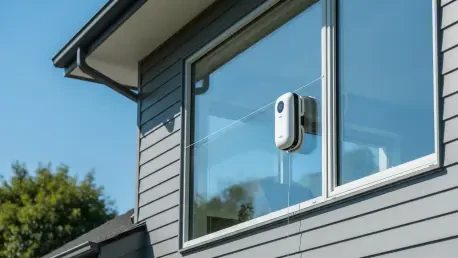
The engineering behind a robot window cleaner is a clever balance of physics and mechanics. The device adheres to glass using a powerful, centrally located suction motor, which creates a vacuum strong enough to hold the unit firmly against the vertical surface. This seal is enhanced by microfiber cleaning pads that surround the suction area, helping to maintain pressure and grip. To keep the robot light enough to work against gravity, most models draw their primary power from a wall outlet via a long cord, rather than from a heavy onboard battery.
Cleaning is a methodical, low-moisture process. The robot navigates in a pre-programmed pattern, often spraying a fine mist of cleaning solution ahead of itself. Vibrating mop pads then pass over the dampened area, buffing away surface-level dirt and dust. This gentle action is designed for maintenance, not for tackling stubborn, caked-on grime. For safety, a multi-layered system is in place. In addition to the essential safety tether, most units contain a small backup battery. This battery is not meant for operation but is designed to keep the suction motor running for a short period, preventing an immediate fall if the main power is unexpectedly disconnected.
A Tale of Two Bots The Inconsistent Reality of a Spotless Finish
Perhaps the most critical question for any prospective buyer is whether these robots actually clean well, and the answer is highly variable. Performance is not uniform across the market and can differ dramatically from one model to another. For example, extensive testing on one model, the Hobot S7 Pro, revealed an adequate but imperfect performance. While it successfully removed general surface dirt, its turning mechanism left behind visible track marks on the glass, marring the final finish.
In stark contrast, a different experience with the Ecovacs Winbot W2 Pro Omni yielded overwhelmingly positive results, with the device demonstrating excellent cleaning power and leaving a near-spotless shine. This disparity highlights that a consumer’s satisfaction is heavily dependent on the specific brand and model they choose. However, a universal limitation remains: these robots are designed for light-duty work. They excel at lifting dust and recent surface dirt, but their gentle buffing action and minimal water usage are insufficient for tougher jobs like removing bird droppings or dried mud.
The High-Stakes Chore Where Robot Cleaners Truly Excel
Despite their flaws, robot window cleaners possess a singular, compelling advantage: their ability to safely access areas that are difficult, if not impossible, for a person to reach. This capability is arguably their most valuable feature. In homes with architectural challenges, such as protective railings outside second-story windows or fixed panes of glass in high ceilings, manual cleaning becomes a logistical and safety nightmare. A slim, automated bot can often navigate these tight or elevated spaces with ease, providing a practical solution where one did not previously exist.
Moreover, their utility extends beyond exterior windows. The technology is effective on virtually any hard, flat, non-porous surface, making these robots surprisingly versatile. This allows them to be used indoors on large bathroom mirrors, glass shower enclosures, or even tiled walls in a kitchen or bathroom. This adaptability broadens their usefulness within the home, helping to justify the investment by addressing multiple cleaning tasks and solidifying their place as a specialized, yet uniquely capable, tool in the modern home maintenance arsenal.
Ultimately, the journey of the robot window cleaner from a futuristic concept to a tangible household product has been marked by both impressive innovation and practical shortcomings. The technology successfully addressed the physical strain and danger associated with cleaning hard-to-reach windows, offering a solution where none was previously viable. However, the dream of a fully autonomous system remained just out of reach, as the devices required more supervision and delivered more inconsistent results than their floor-bound counterparts. The experience revealed that while these robots were not a universal replacement for traditional methods, they carved out a crucial niche, proving themselves to be a flawed but undeniably useful tool for specific, high-stakes cleaning challenges.