
In the meticulously climate-controlled air of a Silicon Valley summit, a pair of orange-tipped mechanical claws methodically pinched the fabric of a simple t-shirt, executing a series of precise folds until the garment lay in a neat, compact square. This quiet, almost hypnotic act of automating one of humanity’s most mundane chores served as the silent, powerful centerpiece for a much louder phenomenon: a multi-billion-dollar investment frenzy signaling that the age of the humanoid robot is no longer a distant sci-fi fantasy, but an imminent economic reality. The simple folding of a shirt has become the tangible proof-of-concept for a technological revolution, convincing venture capitalists that the time has come to pour unprecedented capital into giving artificial intelligence a physical, functional body.
When a Robot Folds a T-Shirt What Does the Future Look Like
The demonstration at the Humanoids Summit in Mountain View, California, was striking in its simplicity. Two robots, focused and unwavering, worked through a pile of laundry with a patience that no human could ever sustain. For the thousands of engineers, entrepreneurs, and investors in attendance, this was not just a clever party trick. It was a clear and compelling vision of a future where machines handle the tasks that are often described as dull, dirty, and dangerous, freeing up human potential for more creative and complex endeavors. The act of a machine performing a chore so intrinsically tied to domestic life was a powerful symbol of technology crossing a new threshold.
This single act represents a pivotal moment in the convergence of artificial intelligence and physical automation. For years, AI existed primarily in the digital realm, processing data, generating text, and learning within servers. Now, that intelligence is being channeled into articulated limbs, sensor-laden fingers, and bipedal legs capable of navigating the world built for humans. The laundry-folding robot is more than just an appliance; it is a testament to the industry’s belief that the next great leap for AI is to grant it a physical presence, allowing it to interact with, manipulate, and ultimately reshape our physical environment.
The Race to Give AI a Body
The tech industry is in the midst of a profound strategic shift, moving beyond the confines of digital intelligence to create physical, human-like forms. The logic is compelling: after developing AI “brains” with astonishing cognitive capabilities through large language models, the next frontier is embodiment. Companies recognize that for AI to achieve its full potential and justify soaring valuations, it must be able to act in the real world. This requires a chassis that can open doors, operate machinery, and handle objects with human-like dexterity, leading to an intense race to design and build the most capable humanoid robot.
This new chapter in automation is directly connected to the broader AI boom. The immense processing power and learning capabilities of modern AI have created a foundation upon which complex robotic systems can be built. Investors see a clear line from a powerful algorithm to a functional robot that can operate in human-designed environments—from warehouses and factories to laundromats and, eventually, homes. The tangible need for robots that can seamlessly integrate into society is fueling this race, transforming abstract code into machines that walk, work, and collaborate alongside people.
A Glimpse of Tomorrow at the Humanoids Summit
The Humanoids Summit itself served as the global stage for this emerging industry, convening approximately 2,000 attendees and top robotics firms from around the world at the Computer History Museum. Organized by venture capital firm ALM Ventures, the two-day event brought together innovators from the United States, China, and Japan, with industry giants like Google, Disney, and Boston Dynamics sharing the floor with agile California startups. It was a concentrated microcosm of a future where human-robot collaboration is envisioned as the norm.
The demonstrations offered a vivid, if curated, preview of this new era. Beyond the laundry-folders, a small companion robot used its mechanical hands to form a heart symbol, another diminutive bot in a bear hat executed punching motions, and an anime-esque robot articulated its head and arms with fluid grace. A particularly poignant moment came from Codey, a child-like educational robot from Mind Children, which stated, “By teaming up, humans and robots can solve big problems like making education more accessible, caring for people and protecting our planet.” These showcases were meticulously designed to articulate a vision of helpful, non-threatening automation.
However, a crucial reality check tempered the futuristic displays. A closer look revealed that few of the robots on the summit floor were truly autonomous. Many of their actions were the result of pre-programmed movements or were being actively controlled by unseen human operators in a form of high-tech puppeteering. This limitation underscores that the industry remains in its nascent stages. While the hardware is impressive, the software and AI required for full, independent operation in unpredictable environments are still under heavy development, a fact that even the most optimistic proponents concede is a significant hurdle to overcome.
The Unprecedented Investment Frenzy
Underpinning the technological optimism is an unprecedented flood of capital. Venture capital deals in U.S. humanoid robotics companies have skyrocketed, reaching nearly $2.8 billion this year, a staggering leap from just $42.6 million five years ago, according to PitchBook data. California has cemented its status as the global epicenter of this boom, with its companies attracting approximately $1.6 billion of that total, representing the majority of national funding in the sector.
A striking case study in this investment frenzy is Figure, a San Jose-based AI robotics company. This year, the startup, which is developing a humanoid robot capable of performing household tasks like doing the dishes and folding laundry, announced it had surpassed $1 billion in total funding, achieving an astonishing valuation of $39 billion. This illustrates the immense financial confidence being placed in companies that promise to bring general-purpose robotics into the mainstream.
This enthusiasm is echoed in long-term market projections from Wall Street. Morgan Stanley Research forecasts that the market for human-like robots could swell to an incredible $5 trillion by 2050, potentially making it twice the size of the modern auto industry. The firm estimates that over one billion humanoid robots could be in operation by that time, with economies of scale driving down costs. A robot priced at around $200,000 in 2024 is projected to fall to approximately $50,000 by mid-century.
The core investor thesis, as articulated by ALM Ventures founder Modar Alaoui, targets tasks that are “dull, dangerous, boring, mundane” as the first wave of widespread adoption. He views the initial deployment in manufacturing and logistics as a “natural transition from just smart automation to highly intelligent automation.” This strategy focuses on clear, immediate return on investment in industrial settings, paving the way for the more complex and ambitious goal of placing a robot in every home.
From the Lab to the Laundromat Robots on the Job
Beyond summit showcases, robots are already being integrated into real-world commercial environments. Weave Robotics, a California startup founded by former Apple engineers, has begun placing its laundry-folding robots in businesses. At Sea Breeze Cleaners in San Francisco, one of their machines operates behind a large window, where its patient and methodical folding of shirts has become a spectacle for passersby, effectively serving as a marketing tool that draws in new customers. Though slower than its human counterparts, its ability to work relentlessly through piles of laundry demonstrates clear commercial viability.
The consumer perspective on this integration is nuanced. Kay Astorga, co-owner of Sea Breeze Cleaners, expressed a clear preference for robots that are unambiguously machine-like for chore-based tasks, while reserving creative or joyful activities for humans. “I don’t want to have a croissant made by a robot,” she commented. “I want a shirt folded by a robot for sure.” Weave Robotics has made its current model cost-effective at under $10,000 by focusing on a specific task without the expense of a full humanoid body, and is already planning expansions into manufacturing and hospitality.
In more physically demanding industrial settings, Agility Robotics is deploying its bipedal robot, Digit. This blue-green machine, equipped with claw-like grippers capable of lifting up to 35 pounds, is being used by companies like Amazon to handle repetitive and heavy tasks, such as moving totes in warehouses. By automating these physically taxing jobs, Digit helps reduce the risk of injury to human workers, directly addressing the “dangerous” and “dull” aspects of the investor thesis. For now, safety protocols require these robots to operate within a cage or behind a guardrail, a reminder that full integration remains a work in progress.
Hype Skepticism and the Human Question
The rapid ascent of the robotics industry is accompanied by grandiose promises that often border on hyperbole. Tech mogul Elon Musk, for instance, has claimed that Tesla’s humanoid robot, Optimus, will eventually “eliminate poverty” and fundamentally reshape the global economy by out-producing humans. Such bold predictions generate headlines and fuel investor excitement, but they also set expectations that the current technology is far from meeting.
In contrast to this hype, some analysts offer a more sobering assessment. Bill Ray, an analyst at Gartner, has called the current generation of robots “impractical,” with “limited in functionality,” and “not nearly as clever as they demo.” This critical viewpoint is reinforced by the prevalence of puppeteering and pre-programmed routines at industry showcases, suggesting that the leap to true, adaptable autonomy is still a significant one. This skepticism serves as an important counterweight to the industry’s soaring narrative.
Beyond the technical and financial considerations, the rise of humanoid robots raises profound societal questions. Widespread anxiety persists over the potential for mass job displacement as machines become capable of performing tasks currently done by humans. Furthermore, the prospect of robots equipped with advanced sensors operating in homes and public spaces brings forward serious concerns about the invasion of personal privacy. The industry’s “bot builders” frequently attempt to allay these fears by insisting their creations are designed to augment human capabilities, not replace them entirely, but these reassurances have yet to fully quell public apprehension.
Innovation Beyond the Whole The Critical Role of Component Technology
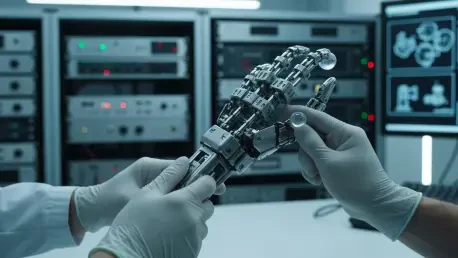
The march of progress in robotics is not only about building complete humanoid systems but also about perfecting the critical components that give them their advanced capabilities. The San Diego startup Psyonic exemplifies this trend, specializing in robotic hands. At the summit, the company showcased its flagship product, the “Ability hand,” a bionic hand so sophisticated that it serves a dual purpose: as an end-effector for robots and as an advanced prosthetic for human amputees.
A key innovation driving this technology is the engineering of touch. Psyonic’s hand integrates sensors that allow a human user to feel the sensation of pressure and grip when holding an object, a breakthrough that creates a new frontier for both prosthetics and robotics. The company’s CEO, Aadeel Akhtar, was inspired to pursue this work after a childhood encounter with a girl who had a missing limb. His success highlights the broad appeal of enabling technologies that bridge the gap between human and machine.
Ultimately, the goal for entrepreneurs like Akhtar is the normalization of this technology. He envisions a future where seeing and interacting with robots becomes commonplace, a technology that is “more integrated in society” and “not such a novel concept anymore.” This focus on componentry underscores the deep, multi-faceted ecosystem of innovation that is required to turn the grand vision of humanoid robotics into an unremarkable part of everyday life.
The gathering in Silicon Valley represented a definitive moment where theoretical concepts and financial speculation crystallized into tangible machinery. The summit showcased a future that felt simultaneously within grasp and yet years away, a duality that defined the current state of the industry. It was a clear demonstration that the quest to build a mechanical helper was no longer a niche pursuit; it had become a global economic race fueled by human ambition, technological breakthroughs, and an unwavering belief that the answer to some of society’s most tedious problems was being assembled one circuit, one sensor, and one perfectly folded shirt at a time.