
In robotics, we’ve made incredible strides with vision; machines can see and navigate the world with impressive skill. But the sense of touch, the very first way we experience our own world, remains a profound challenge. My work in soft robotics is dedicated to bridging this gap, exploring how we can build machines that not only touch but feel. We’ll discuss the incredible sophistication of our own skin, draw inspiration from the distributed intelligence of creatures like the octopus, and explore how a physical, tactile education could be the key to true robotic intelligence. We will also touch on how these advancements are already shaping practical applications, from training healthcare professionals to envisioning a future where robots can provide safe, gentle care.
You mentioned that human touch involves distinct mechanoreceptors for stimuli like vibration and stretch, making it more than a simple pressure map. Could you detail the technical steps and primary obstacles in designing an artificial skin that can both detect and interpret these varied, dynamic sensations?
It’s a fantastic question because it gets right to the heart of the problem. The first technical step is to move beyond a single type of sensor. We have to develop and fabricate multiple, distinct sensor types that can be co-located on a flexible substrate—our artificial skin. Some of these sensors need to be highly sensitive to high-frequency vibrations, like when your finger detects a texture, while others need to register slow, deep pressure or the sheer force of the skin stretching. The next step is embedding these sensors into a soft, compliant material that mimics human tissue, which is a significant material science challenge in itself. But the single greatest obstacle isn’t just building the hardware; it’s interpreting the flood of data that comes from it. Our brains are constantly filtering and making sense of this rich sensory flow through active exploration. Replicating that—giving a robot the ability to press, slide, and adjust to turn that raw data into a coherent perception of the world—is a challenge of a completely different order than just reading a static pressure map.
The article highlights the octopus as a model for “embodied intelligence,” with neurons distributed in its limbs. How does this concept concretely change the design process for a robot’s physical body and control systems, compared to a more traditional, brain-centric approach?
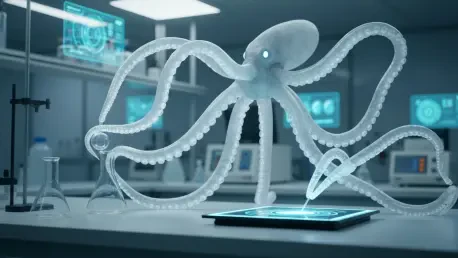
The octopus completely upends the traditional robotics paradigm. In a classic brain-centric model, a central processor does all the heavy lifting. It receives sensor data, calculates every joint angle, and sends explicit commands to every motor. It’s computationally expensive and often slow. Embracing embodied intelligence means we start designing the body to be part of the solution. For example, instead of a rigid gripper with a complex control algorithm to avoid crushing a grape, we design a soft gripper that naturally and passively conforms to the grape’s shape. The material properties of the gripper do some of the “thinking.” In terms of control systems, it means we design a more hierarchical structure. The central “brain” might only issue a high-level command like, “pick up that object.” The arm itself, equipped with local sensors and processors, handles the fine details of the grasp, adjusting its posture and grip strength based on immediate tactile feedback, much like an octopus arm can run its own movement patterns. It’s a shift from micromanaging the body to trusting the body to handle its local environment.
Given that touch is the first sense humans develop and is crucial for learning physics, what kind of “physical curriculum” would you design for a robot? What specific, hands-on explorations would be essential for it to develop true intelligence rather than just execute pre-programmed tasks?
I love thinking about this—a “physical curriculum” for a robot toddler, in a way. It wouldn’t start with complex tasks but with pure, unstructured exploration. The first module would be about learning boundaries and resistance. The robot would simply push against various surfaces—hard walls, soft cushions, yielding materials—to build an internal model of force and support. The next phase would involve manipulation: grasping objects of different sizes, weights, and textures. It would learn, through thousands of trials, the difference between a heavy, solid block and a light, deformable one. It would feel the slickness of polished metal versus the high friction of rubber. Crucially, it wouldn’t be told these properties; it would discover them. A later, more advanced stage would involve dynamic interactions, like learning to slide a finger across a surface to identify its texture or tapping an object to infer something about its internal structure. This hands-on learning is essential because it grounds the robot’s “knowledge” in real physical experience, allowing it to develop an intuition for physics rather than just executing commands based on a pre-loaded simulation.
Your patient simulator, Mona, translates a press on a pain point into a verbal and physical “hitch.” Can you walk me through the step-by-step process of how the system translates that raw tactile data from the skin into a nuanced, whole-body reaction that feels realistic to a trainee?
Of course. It’s a process that connects sensation directly to behavior. First, when a trainee interacts with Mona, let’s say by pressing on what we’ve designated as a simulated sore shoulder, the artificial skin doesn’t just register pressure. The array of sensors in that specific area detects the intensity, location, and even the sharpness of the contact. Second, this raw tactile data is processed locally to classify the interaction. A gentle, supportive hold is interpreted differently than a focused, potentially painful prod. If the press crosses a certain threshold on that “pain point,” it triggers a specific event signal. Third, this signal is sent to the robot’s central control system, which acts as the ‘brainstem,’ coordinating a multi-part reaction. Finally, the system simultaneously activates two outputs to create a believable response: it plays a pre-recorded verbal cue, like a sharp intake of breath or a soft “ouch,” while also sending a command to the motors in the torso and shoulder to execute a quick, involuntary “hitch.” This tight coupling of a specific tactile input to an immediate, whole-body output is what makes the feedback so powerful for the trainee.
Progress on care robots has been slower than expected, facing high costs and strict safety rules. Looking beyond these general barriers, what is the single biggest technical breakthrough or specific policy change that you believe would most rapidly accelerate the deployment of these robots into homes?
That’s a critical question for the future of this field. On the technical side, the single biggest breakthrough would be the development of a low-cost, mass-producible, and inherently safe whole-body artificial skin. Right now, sensorizing a full robot is incredibly expensive and complex. If we had a “smart” skin that was as easy to apply as a vinyl wrap and could reliably detect and modulate contact force across the entire body, the safety problem would be largely solved at a fundamental level. A robot wrapped in this skin simply couldn’t, by its very nature, exert dangerous forces without knowing it. On the policy side, the most impactful change would be the creation of an international safety standard specifically for soft, collaborative robots in care environments. Current regulations are designed for rigid, industrial robots that operate in cages. They are completely ill-suited for a machine designed for close human contact. A clear and appropriate regulatory pathway would give companies a defined target to build toward, dramatically reducing uncertainty and encouraging the investment needed to bring these incredible technologies from the lab into people’s homes.
What is your forecast for the integration of touch-sensitive robots into our daily lives?
I believe that over the next decade, we will see a significant shift from robots that primarily see the world to robots that feel it. The initial integration won’t be the fully autonomous caretakers we see in science fiction, but rather assistive devices in structured environments. Think of robotic arms in physical therapy clinics that can provide gentle, responsive support during exercises, or collaborative robots in logistics that can safely handle delicate or oddly shaped items alongside human workers. The key will be this whole-body sensitivity; it’s the enabling technology that allows for safe and intuitive physical interaction. As the cost of tactile sensing comes down and our understanding of embodied intelligence grows, these robots will gradually move into more personal spaces. It’s a future where our interactions with machines are not just functional, but also gentle, safe, and meaningful, all because they will finally have a sense of touch.