
The subtle tensing of your shoulders as a car merges too closely or the instinctive tap on an imaginary brake pedal are precisely the silent, biological alarms that could soon become an autonomous vehicle’s most crucial safety feature. While self-driving technology has made remarkable strides, a persistent gap remains between a machine’s cold, calculated logic and the nuanced, intuitive risk assessment that defines human driving. This divide is the primary roadblock to widespread public trust. A groundbreaking new approach, however, aims to bridge this chasm not with more powerful external sensors, but by turning inward and listening to the real-time cognitive and emotional responses of the passenger.
This innovative research proposes a symbiotic relationship where the passenger is no longer a passive occupant but an active contributor to the vehicle’s safety protocol. The core idea is that the human brain, with its sophisticated ability to perceive danger and experience stress, can function as the ultimate safety sensor. By monitoring a passenger’s neural signals, a self-driving car could gain invaluable insight into the perceived risk of a situation, allowing it to adapt its driving style proactively. This fusion of human physiology and artificial intelligence represents a new frontier in automotive safety, one designed to create a driving experience that is not only secure but also feels intuitively safe to its occupants.
The Trust Paradox in Autonomous Driving
The most significant hurdle for autonomous vehicle adoption is not purely technological; it is deeply psychological. Despite years of development and millions of miles tested, a fundamental trust paradox persists. Passengers struggle to cede complete control to a system that operates on pure logic, devoid of the fear, caution, and intuition that guide human drivers. This lack of trust is a critical barrier, as the feeling of safety is just as important as the statistical reality of it.
To solve this, researchers are exploring a compelling question: what if the key to building that trust lies in teaching the car to sense and react to our own biological safety signals? Instead of relying solely on cameras and LiDAR to interpret the road, a vehicle could also monitor its passenger’s cognitive state. By recognizing the neural markers for anxiety or a heightened sense of risk, the car could learn what a human considers dangerous and adjust its behavior accordingly, transforming the machine from a cold chauffeur into a responsive co-pilot.
Why Today’s Smartest Cars Fall Short
Current autonomous systems, including those from industry leaders like Tesla, have demonstrated impressive capabilities in handling routine driving tasks. They can navigate highways, manage traffic, and execute precise maneuvers with a level of consistency that often surpasses human ability. However, their limitations become starkly apparent in unpredictable, high-stakes scenarios that demand nuanced judgment—a sudden pedestrian, an aggressive driver, or confusing road conditions.
It is in these moments that an AI’s struggle with complex judgment calls becomes a critical liability. A machine can calculate probabilities, but it cannot yet replicate the intuitive leap a human driver makes when sensing that a situation “feels wrong.” This gap between computational analysis and instinctual awareness defines the mission for the next generation of autonomous technology: to infuse machine intelligence with the fundamental human desire for safety and comfort, creating a system that not only drives well but also inspires confidence.
A Symbiotic Solution Your Brain as the Co-Pilot
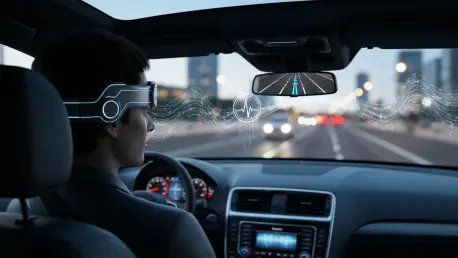
The proposed solution lies in creating a symbiotic relationship where the passenger’s brain acts as a real-time safety sensor for the vehicle’s AI. This system leverages the brain’s highly evolved capacity for risk perception to guide the car’s decision-making process. When a passenger feels anxious about an upcoming merge or a vehicle following too closely, their brain activity shifts. The system is designed to detect these subtle changes and interpret them as a signal to drive more cautiously.
This connection is made possible by a non-invasive technology known as functional Near-Infrared Spectroscopy (fNIRS). By wearing a lightweight monitoring device, a passenger’s brain activity can be tracked in real-time. The fNIRS system measures changes in blood oxygenation in the cerebral cortex, which are directly linked to cognitive states like stress and alertness. An intelligent algorithm then synthesizes this brain data with the car’s traditional sensor data. If it detects a spike in passenger anxiety, it automatically shifts the vehicle to a more defensive driving mode, effectively making the passenger’s sense of security a key operational parameter.
From Theory to Reality The Evidence for a Safer Ride
This brain-computer interface is more than a theoretical concept; research has provided tangible evidence of its effectiveness. Lead author Professor Xiaofei Zhang of Tsinghua University noted that this technology provides a “direct window into the passenger’s cognitive state,” which serves to powerfully augment the AI’s decision-making. By incorporating this human element, the vehicle can learn and adapt in ways that conventional systems cannot.
The study yielded several key findings that highlight the benefits of this approach. Firstly, the AI demonstrated accelerated learning, mastering safer driving strategies more efficiently by using the immediate, unfiltered feedback of human emotion. Secondly, the fNIRS-integrated system consistently adopted a more defensive driving style in response to passenger unease, navigating potentially hazardous situations with greater care. Finally, this alignment between the vehicle’s actions and the occupant’s sense of security created a more reassuring ride, directly tackling the critical issue of human trust in autonomous machines.
Charting the Course from the Lab to the Highway
While the results are promising, the researchers objectively acknowledge the study’s current limitations. The initial tests were conducted in simple, controlled scenarios that do not fully represent the chaotic and unpredictable nature of real-world traffic. Furthermore, the participant group was homogenous, with a narrow age range and similar backgrounds, meaning the findings may not apply universally to a more diverse population with varying driving experiences and risk tolerances.
A strategic roadmap has been established to bridge the gap from the laboratory to public highways. The first step involves validating the algorithm in more complex and dynamic traffic environments. Subsequently, testing will be expanded to include a diverse pool of participants to ensure the system is responsive and reliable for everyone. The final stage will focus on enhancing the system’s robustness by more deeply integrating the passenger’s physiological data with the vehicle’s full suite of advanced sensors, paving the way for a truly collaborative and safer driving future.
The research established a compelling proof-of-concept for a new paradigm in automotive safety. It demonstrated that by integrating human cognitive feedback directly into a vehicle’s control loop, it was possible to create a system that was not only safer but also felt more comfortable and trustworthy to its occupants. This work moves the conversation beyond simply adding more external sensors, suggesting that the next major leap in autonomous technology will come from a deeper collaboration between human intelligence and artificial intelligence, creating a future where our journey is protected by a machine that truly understands our need for security.