
In a significant pivot away from the powerful, factory-floor humanoids that have long dominated robotics discourse, a new class of machine is emerging, designed not for heavy labor but for the subtle and complex dynamics of human interaction. Social companion robots represent a significant advancement in the field of human-robot interaction. This review will explore the evolution of this technology, its key design philosophies, performance metrics, and the impact it is beginning to have on social and domestic applications. The purpose of this review is to provide a thorough understanding of this emerging class of robots, its current capabilities, and its potential future development.
The Dawn of a Social Robotics Era
The field of robotics is undergoing a fundamental reorientation, shifting its focus from the structured, predictable environments of industry to the fluid, unpredictable spaces of daily human life. This evolution marks the beginning of a new era where robots are envisioned not merely as tools for production but as active participants in social settings. This paradigm shift required a complete rethinking of a robot’s core purpose, prioritizing attributes like safety, approachability, and emotional connection over raw power and efficiency. The recent public debut of Fauna Robotics’ “Sprout” serves as a compelling case study for this movement. Sprout is engineered explicitly for human-centric environments like homes and schools, embodying a deliberate counter-narrative to the imposing designs of its industrial counterparts.
This transition is fueled by the central thesis that for robots to gain widespread acceptance in personal spaces, their design must be fundamentally empathetic. The core principles guiding this new wave of social robotics involve a deep consideration of human psychology and the cultural context in which these machines will operate. Instead of optimizing for task completion in isolation, engineers are now focused on creating machines that can coexist safely and harmoniously alongside people. Fauna Robotics’ approach with Sprout crystallizes this philosophy, moving beyond the utilitarian to create a robot that is not only functional but also actively welcomed into the human sphere.
Analysis of Core Features and Technology
Philosophy Driven Physical Design
The most striking feature of this new generation of social robots is a design philosophy that places emotional resonance and psychological comfort at the forefront. Sprout’s physical form is a direct product of this thinking, intentionally crafted to be approachable and non-intimidating. Standing at a modest 3.5 feet, it interacts with the world from a child’s perspective, a deliberate choice to mitigate any sense of dominance or threat. Its exterior, which is covered in a soft, sage-green foam, replaces the cold, hard metal common in traditional robotics with a material that invites physical interaction rather than cautioning against it. This tactile design is a clear departure from the industrial aesthetic, aiming to build trust from the very first encounter.
This design ethos extends to the robot’s expressive capabilities, which draw inspiration from the beloved robotic sidekicks of popular culture rather than the dystopian figures often seen in science fiction. Features such as a nodding rectangular head, blinking lights, and windshield wiper-like “eyebrows” are engineered to convey a range of simple, recognizable emotions. Rob Cochran, Fauna’s CEO, explicitly points to characters like WALL-E and Baymax as benchmarks for creating an endearing and friendly presence. This focus on abstract and character-driven design, influenced by the friendly droids of Star Wars, underscores a critical insight: for a robot to be accepted in the home, people must genuinely want to be around it, a consideration often overshadowed by the pursuit of pure mechanical capability.
Advanced Locomotion and Environmental Interaction
For a social robot to be effective, it must navigate the chaos of human environments safely and reliably. The technical capabilities underpinning Sprout’s mobility demonstrate significant progress in this area. Its locomotion system allows for a steady gait across varied and uneven surfaces, a crucial requirement for operating in homes that are not perfectly flat factory floors. Beyond simple movement, its autonomous navigation system integrates advanced sensors and AI-driven pathfinding to perceive its surroundings in real-time. This allows it to dynamically react to changes, such as a person stepping into its path, by recalculating a new route rather than coming to an abrupt halt or causing a collision.
Furthermore, the robustness of its mobility platform was showcased in its ability to handle “perturbation,” or unexpected physical disturbances. During a demonstration, the robot encountered a low-lying obstacle outside its immediate field of vision. Instead of toppling, it exhibited a remarkable ability to recover its balance, adjust its posture, and continue its mission without interruption. This capacity for recovery, which mirrors how a person might recover from a misstep, is vital for ensuring the robot’s reliability and safety. It proves that the system is not fragile and can withstand the minor, unforeseen bumps and challenges inherent in a dynamic domestic setting.
Dexterous Manipulation and User Control Systems
A social robot’s utility is also defined by its ability to physically interact with its environment and its users. While not designed for heavy lifting, Sprout’s manipulation system is engineered for gentle and precise interaction with everyday objects. It demonstrated the dexterity to playfully dance and to gently grasp items like a toy block and a teddy bear, showcasing its potential for assistance and entertainment. This focus on gentle manipulation is key to its role as a companion, ensuring it can handle delicate objects and interact safely with people without posing a risk.
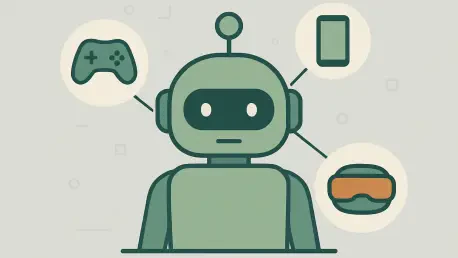
Crucially, the technology is designed as an open platform, and its versatility is reflected in its multiple control interfaces. Developers and users can operate the robot using a standard video game controller for direct input, a smartphone application for accessible commands, or an immersive virtual reality headset for a first-person telepresence experience. This flexibility is a cornerstone of its identity as a developer platform, providing researchers and creators with a range of tools to build and test new applications. By offering varied and intuitive control schemes, the system lowers the barrier to entry for innovation and encourages a wider community to explore its potential.
Emerging Trends and Innovative Market Strategies
One of the most innovative aspects of this new wave of social robotics is the commercialization strategy being employed. Rather than following the conventional path of deploying humanoids in industrial settings first, Fauna Robotics is bypassing this phase entirely. The company is launching Sprout not as a finished consumer product but as a sophisticated developer platform with an initial price of $50,000. This approach subverts the long-held assumption that robots must prove their worth in factories and warehouses before they are ready for the complexities of the home.
This strategy aims to directly cultivate a creative ecosystem of “robot tinkerers,” including university researchers, tech entrepreneurs, and corporate innovators. The model mirrors the growth trajectory of personal computers and smartphones, where providing powerful hardware to a community of developers led to an explosion of unforeseen applications that ultimately defined the technology’s value. By positioning Sprout as a programmable and extensible platform, Fauna hopes to accelerate the discovery of meaningful social applications, allowing the market itself to determine the robot’s most compelling use cases. This developer-first approach is a calculated risk, betting that a collaborative community can unlock a robot’s potential far faster than a single company could alone.
Real World Applications and Target Sectors
The initial applications for this technology are focused on its role as a foundational platform for research and development. Instead of being sold to households, the first units are being deployed in university laboratories, where they will serve as tools for cutting-edge research in human-robot interaction, artificial intelligence, and autonomous systems. This provides a critical resource for academics who previously had limited access to advanced, American-made hardware platforms, offering an alternative to hardware from international firms that may come with geopolitical or logistical complications.
Beyond academia, corporate innovation departments are emerging as a key target sector. Major companies like Disney have already acquired units to explore how social robots could be integrated into entertainment and customer experience. Even competing robotics firms, such as Boston Dynamics, have recognized the platform’s value, praising its user-friendly design and visionary approach. This adoption by industry leaders validates the robot’s potential not as a final product, but as a foundational tool upon which future consumer-facing skills and applications can be built. It is in these creative and experimental environments that the true value of a social companion robot will likely first be realized.
Addressing Industry Challenges and Limitations
Overcoming Past Technological Hurdles
The history of social robotics is littered with promising concepts that ultimately failed to deliver, creating a sense of skepticism around the category. However, many of these past failures can be attributed to immature technology rather than a flawed vision. Early attempts, such as Jibo and Anki’s Cozmo, were hampered by limitations in AI, motor efficiency, and battery life, which prevented them from living up to their ambitious promises of intelligent and engaging companionship. They offered a glimpse of the future but lacked the technical foundation to make it a reality.
The current landscape is markedly different. Recent and rapid advancements across several key technological domains have created what many in the field believe is a “precipice” moment. The convergence of more powerful and efficient motors, longer-lasting batteries, and breakthroughs in AI and machine learning has made the vision of a capable and truly interactive social robot finally feasible. The technology that underpins today’s companion robots, including sophisticated AI learning techniques refined in simulated environments, provides a level of mobility and intelligence that was simply unattainable a decade ago, setting the stage for a new and more successful chapter in social robotics.
Mitigating Safety Risks and Psychological Barriers
A primary challenge in introducing robots into intimate human environments is overcoming both physical safety risks and deep-seated psychological barriers. The powerful humanoids developed for industrial use, while impressive, would be inherently dangerous in a home. Their size, weight, and strength mean that a simple fall or malfunction could cause serious injury, making them unsuitable for close proximity to people, especially children. This has created a public perception of humanoid robots as imposing and potentially threatening.
The design philosophy of social companion robots directly addresses these concerns. By intentionally creating a smaller, lighter, and softer machine, developers mitigate the physical risks. Sprout’s design, for instance, rejects the “industrial automotive machismo” in favor of a form that is physically harmless. This choice also tackles the psychological barriers. Its cute, non-humanlike appearance is perceived as less “creepy” and more friendly, positioning it as a “buddy” or “pal” rather than a human substitute. This deliberate effort to manage perceptions is just as critical as the underlying technology in paving the way for acceptance in social settings.
Future Outlook and Societal Impact
The trajectory for social companion robots appears to be following the path of other transformative technologies, where the initial platform serves as a canvas for a burgeoning developer community. Just as the personal computer and the smartphone were defined by the millions of applications created by third-party developers, the future of social robots may be shaped by an ecosystem of innovators who unlock unforeseen uses. This open-platform approach has the potential to spawn a diverse range of skills and functionalities, from educational tools and therapeutic aids to novel forms of entertainment and assistance for the elderly.
In the long term, the successful integration of these robots could fundamentally reshape human-robot relationships. As the technology matures and becomes more accessible, these companions could become a common presence in homes, schools, healthcare facilities, and other social spaces. This would mark a profound shift from viewing robots as mere tools to accepting them as interactive partners in daily life. The ultimate societal impact rests on the ability of developers to create meaningful, valuable experiences, but the foundation has been laid for a future where humans and robots coexist in a much more personal and collaborative way.
Concluding Assessment
This new generation of social companion robots represents a pivotal and promising direction for the future of personal robotics. The technology’s current state is defined by a strategic shift away from raw industrial power and toward emotionally resonant, psychologically astute design. This move is complemented by an innovative market strategy that prioritizes the creation of a developer ecosystem over the immediate sale of a finished consumer product, a bet on collaborative innovation to unlock the technology’s true potential. The combination of advanced, yet safe, hardware and an open platform for software development creates a powerful foundation for growth.
The core achievement of this emerging class of robots is its holistic approach to human-robot interaction. By thoughtfully engineering a machine that is not only capable but also approachable, non-intimidating, and engaging, developers are directly addressing the historical barriers that have kept robots out of personal spaces. The focus on fostering psychological comfort and mitigating physical risk is a critical step toward mainstream acceptance. This philosophy-driven engineering, coupled with a developer-first commercialization model, suggests that social companion robots are on a viable path toward becoming a meaningful part of everyday life.