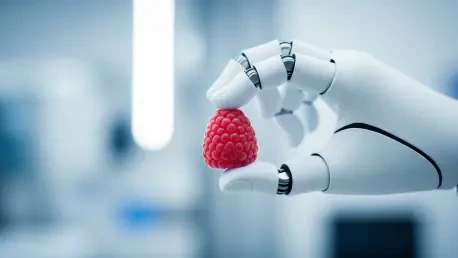

The delicate task of picking a ripe raspberry without crushing it has long represented a monumental challenge for robotics, but a new design is closing the gap between machine and human touch by imbuing soft grippers with a comprehensive, human-like sense of perception. Researchers have developed an innovative robotic hand, named FlexiRay, engineered to overcome the persistent trade-off between sensory acuity and mechanical compliance. This breakthrough addresses the core challenge of creating soft robots that can interact with their environment with dexterity and sensitivity, effectively solving the “blind spot” problem that has historically plagued soft sensor technologies when they deform. The development signals a major advancement toward creating adaptive, versatile robots capable of performing the complex manual tasks that currently require a gentle, nuanced human approach.
Introducing FlexiRay: A Leap in Human-Like Robotic Touch
The FlexiRay system represents a paradigm shift in how robotic perception is achieved. It is an advanced robotic hand specifically designed to provide a rich, tactile understanding of the physical world without sacrificing the inherent safety and adaptability of a soft structure. The central innovation lies in its ability to maintain full sensory awareness even when its fingers are bent, twisted, or wrapped around an object. This capability directly confronts the long-standing issue where the very act of grasping—the physical deformation of the sensor—obstructs the sensor’s ability to gather data, leaving it effectively blind at the most critical moments of interaction.
By fundamentally rethinking the relationship between a sensor’s physical form and its function, FlexiRay introduces a novel architecture where mechanical change is not a bug, but a feature. This approach allows the robotic hand to conform to objects of varying shapes and fragility while continuously collecting high-fidelity sensory information across its entire contact surface. Consequently, the system moves beyond the rigid, limited sensing of its predecessors, establishing a new standard for what is possible in the realm of human-like robotic touch and manipulation.
The Challenge: Bridging the Gap Between Robotic Sensing and Softness
For years, progress in robotic dexterity has been hampered by a fundamental conflict between a robot’s ability to feel and its ability to be soft. Most high-fidelity tactile sensors, particularly those that use embedded cameras to detect surface deformations, rely on stiff, unyielding materials. This rigidity is necessary to maintain the precise optical pathways required for the cameras to capture clear images, which are then used to interpret force, texture, and shape. However, this stiffness is directly at odds with the compliance needed for a robot to safely and effectively handle delicate, soft, or irregularly shaped items.
This limitation has significant practical consequences, effectively barring robots from performing a wide range of complex manual tasks. Activities that humans perform effortlessly, such as sorting delicate produce, assisting with household chores, or assembling intricate products with fragile components, require a gripper that can adapt its shape and apply force gently. The inability of rigid sensors to provide both high-resolution feedback and mechanical softness has been a major bottleneck, preventing robots from being safely and reliably deployed in dynamic, unstructured environments where they must interact with a diverse array of objects and, increasingly, with people.
Research Methodology, Findings, and Implications
A Bio-Inspired Design: Leveraging Deformation for Perception
The design of FlexiRay draws its primary inspiration from biological systems, particularly the elegant mechanics of fish fins. The researchers implemented the “Fin Ray Effect,” a principle that allows the robotic finger to bend passively and wrap around an object upon contact, ensuring a secure yet gentle grip without complex actuation. This bio-inspired structure forms the foundation for FlexiRay’s most revolutionary feature: a unique “multi-mirror” optical system integrated within the finger’s soft body. Unlike conventional designs where bending would block a camera’s view, this internal mirror array dynamically repositions as the finger deforms, effectively redirecting the camera’s line of sight to maintain an unobstructed view of the entire contact surface.
This innovative optical architecture is complemented by a multi-layered skin that provides rich, multimodal sensory data. The skin incorporates thermochromic materials that change color in response to temperature variations, allowing the system to perceive thermal properties. It also includes reflective materials that help the internal camera track surface deformations with high precision. All of this raw visual data—capturing changes in shape, color, and texture—is then fed into a sophisticated deep learning algorithm. This algorithm acts as the system’s brain, translating the complex patterns of light and shadow into coherent, actionable information about force, location, texture, temperature, and the finger’s own physical configuration.
Achieving Comprehensive, Human-Like Haptic Sensation
The primary finding of the research is FlexiRay’s unprecedented ability to replicate five distinct human-like senses within a single, compliant body. The system can accurately measure the magnitude and location of applied forces, discern the fine-grained texture of a surface, sense an object’s temperature, and, crucially, possess proprioception—the ability to know its own shape and posture. This comprehensive haptic feedback allows the robot to build a far more nuanced understanding of the objects it manipulates. The most significant performance metric demonstrated was the achievement of over 90% effective sensing coverage, even during the large-scale deformations required to grasp complex objects.
This breakthrough marks a fundamental departure from the prevailing philosophy in sensor design. For decades, the goal has been to isolate sensors from the “noise” of physical deformation, often by encasing them in rigid structures. In stark contrast, the FlexiRay system successfully leverages deformation as an integral part of its sensing mechanism. The physical bending and twisting of the finger are not hindrances to be overcome but are instead the very means by which the optical system can see around corners and gather a complete sensory picture. This achievement proves that softness and high-fidelity sensing are not mutually exclusive, opening new pathways for creating robots that can touch and feel with human-like sensitivity.
Transforming Industries with Safer, More Dexterous Robots
The practical implications of this research are vast and poised to transform industries where gentle and dexterous manipulation is paramount. In fields like agriculture, robots equipped with FlexiRay could handle delicate produce such as fruits and vegetables without bruising, improving efficiency and reducing waste. Similarly, in logistics and e-commerce, these robots could manage a wide variety of irregularly shaped and fragile packages, a task that has traditionally been difficult to automate. The ability to perceive texture and temperature could also unlock applications in food preparation, healthcare, and scientific research.
Beyond its dexterity, the inherent softness of the FlexiRay design is a key factor in enhancing safety, particularly in settings where robots and humans work in close proximity. A robot that can physically yield upon unexpected contact is significantly less likely to cause injury, making it better suited for collaborative roles in manufacturing, elder care, and home assistance. By combining a compliant body with a sophisticated sense of touch, this technology paves the way for robots that are not only more capable but also fundamentally safer and more intuitive to interact with.
Reflection and Future Directions
From Hindrance to Harmony: A New Paradigm in Sensor Design
The study’s most profound achievement is the successful reconceptualization of a long-standing challenge in robotics. It fundamentally reframes the role of physical deformation in sensor design, transforming it from a sensory obstruction into an essential mechanism for perception. For years, the robotics community sought to build sensors that were immune to the distortions caused by bending and pressure. This research, however, demonstrates a more elegant and effective solution: creating a system where deformation and sensing work in harmony.
This shift in philosophy overcomes a major technological barrier that has limited the capabilities of soft robots. By proving that a sensor can bend and twist without losing its “sight,” the research establishes a new design paradigm. This breakthrough paves the way for a new class of robotic systems that do not have to choose between being soft and being smart, allowing for the development of machines that can safely and intelligently navigate the complexities of the physical world.
Building Multi-Fingered Hands and Enabling Imitation Learning
Looking forward, the research team plans to scale the technology from a single finger to fully articulated, multi-fingered hands. This expansion will enable robots to perform far more complex manipulation tasks, such as in-hand object reorientation, tool use, and intricate assembly, which require the coordinated action of multiple digits. A multi-fingered FlexiRay hand would be able to envelop and understand objects with a level of dexterity that begins to approach that of its human counterpart.
Furthermore, a key future direction is the integration of this advanced hardware with sophisticated imitation learning frameworks. By combining FlexiRay’s rich, multi-modal sensory data with machine learning algorithms, robots could learn complex tasks simply by observing human demonstrations. A human could show the robot how to handle a delicate object, and the robot could use its comprehensive sense of touch and proprioception to internalize the nuances of the action—learning not just the motions but also the appropriate pressures and grips. This synergy of advanced hardware and intelligent software promises to accelerate the development of robots that can learn and adapt with unprecedented speed and safety.
Conclusion: A Softer, Smarter Future for Robotics
The FlexiRay system represents a decisive step toward resolving the critical conflict between mechanical softness and high-fidelity sensory perception in robotics. By creating a design where physical deformation enhances rather than hinders sensing, this work has effectively eliminated the “blind spots” that have long constrained the dexterity of soft robots. The integration of a bio-inspired mechanical structure, an innovative optical system, and advanced deep learning has produced a robotic hand capable of achieving a comprehensive, human-like sense of touch. The success of this approach has laid the groundwork for a future where robots are no longer limited by a trade-off between compliance and awareness. Instead, this research contributes significantly to the development of the next generation of adaptive, versatile, and inherently safe robots that can interact with the world more intuitively, gently, and effectively than ever before.