
The persistent belief that artificial intelligence has evolved into an autonomous creative force capable of genuine artistic innovation has been significantly undermined by recent findings from an international scientific coalition. Led by researchers from the University of Barcelona, the Institute for Biomedical Research, and the Vienna Cognitive Science Hub, a comprehensive study has deconstructed the imaginative process to reveal a profound deficit in machine agency. While generative models are frequently celebrated for producing visually striking images that mimic the aesthetics of human art, this research suggests that such outputs are devoid of the cognitive depth and independent drive essential to true creativity. By analyzing the structural differences between human ideation and algorithmic pattern matching, the team demonstrated that the perceived “creative spark” in AI is largely a reflection of the human-derived data and specific prompts used to guide the software. This investigation provides a much-needed empirical baseline for distinguishing between the technical ability to generate pixels and the biological capacity to conceive of original concepts.
A New Framework: Assessing Visual Imagination
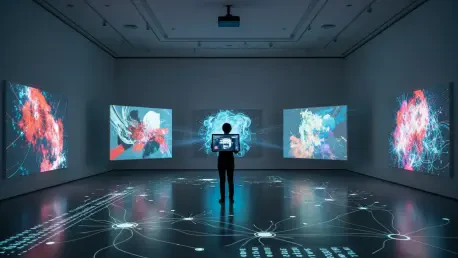
To establish a rigorous standard for comparison, the research team developed a methodology that focused on visual imagination through abstract stimuli rather than traditional verbal tasks. This approach originated from a collaborative workshop that aimed to bridge the gaps between science, technology, and art, specifically by training an AI model on the unique creative outputs produced by human participants. By using this localized and controlled data set, the researchers ensured that the AI and the humans were operating from the same foundational information, allowing for a direct assessment of their ability to innovate from a baseline. This controlled environment was critical for isolating the “spark” of creativity from mere data volume, ensuring that any differences in output could be attributed to the cognitive process itself rather than the size of the training library. Such a framework allows scientists to view creativity as a dynamic process of transformation rather than a static act of retrieval.
The study categorized participants into four distinct groups to capture a full spectrum of creative potential: professional visual artists, members of the general population, a human-guided AI model, and an unguided AI model. This tiered structure allowed researchers to observe how different levels of expertise and agency influenced the final artistic product. Professional artists served as the benchmark for high-level creative cognition, while the general public provided a baseline for standard human imagination. By comparing these to AI models—one receiving elaborate human prompts and the other generating images autonomously—the study could pinpoint exactly where the machine’s capabilities began to falter. The results provided a comprehensive map of how original ideas are formed, showing that the transition from abstract stimuli to a finished work requires a level of subjective interpretation that currently remains exclusive to biological intelligence. This structural analysis reveals that the human mind does not just process data but actively constructs meaning.
Quantifying the Creativity Gap: Results and Hierarchies
Performance across all groups was evaluated using five specific qualitative dimensions: personal appeal, vividness, originality, aesthetics, and curiosity. Both human judges and AI systems were employed to assess the drawings, ensuring a balanced and multifaceted evaluation process. The findings established a remarkably consistent hierarchy of creative output that placed professional visual artists at the definitive top of every metric. Following the experts, the general population of non-artists demonstrated a level of imaginative depth that significantly surpassed the capabilities of the machines. This sequence suggests that even an average human possesses an inherent cognitive toolkit for innovation that current technology cannot replicate. The data indicated that while machines can follow stylistic rules, they struggle to generate the “vividness” and “originality” that evaluators associated with human-led work, highlighting a persistent gap between technical execution and conceptual brilliance.
The most revealing aspect of the performance hierarchy was the disparity between guided and unguided AI models. The human-guided AI, which relied on detailed and specific prompts from people, ranked third in the overall assessment, while the unguided AI performed the worst by a substantial margin. This significant drop in quality when human direction was removed proves that the “creativity” often attributed to artificial intelligence is essentially borrowed from the person providing the input. Without a human to navigate the complexities of abstract thought and aesthetic nuance, the unguided model produced results that were deemed uninspired and repetitive. This “creativity gap” confirms that even when an AI is equipped with the same foundational data as a professional artist, it lacks the internal mechanism required to synthesize that data into something truly groundbreaking. The results underscore the reality that machine learning is a process of imitation rather than one of genuine, autonomous discovery.
Distinguishing Agency: Process Versus Polished Output
A central theme of the investigation is the critical distinction between creativity as a final product and creativity as a complex cognitive process. Public perception of AI is often skewed because it focuses almost exclusively on the polished, high-resolution images that these models can generate in seconds. However, when the researchers analyzed the steps taken from the initial ideation stage to the final execution, the AI’s total lack of genuine agency became undeniable. Human creativity involves a series of conscious choices, emotional reflections, and iterative refinements that are fundamentally absent in algorithmic processing. The machine does not “choose” to create; it merely executes a statistical prediction based on its training. This distinction is vital for understanding why AI-generated work often feels hollow or derivative upon closer inspection, as it lacks the intentionality that defines the artistic endeavors of a human creator who is engaged in a purposeful act of expression.
The research team argued that the current fascination with AI art stems from a misunderstanding of how these models function. They are sophisticated pattern recombination engines rather than independent thinkers. When a human artist approaches an abstract stimulus, they draw upon a lifetime of sensory experience, cultural context, and personal emotion to build a concept. In contrast, the AI identifies mathematical correlations between pixels and metadata. This means that while the output may look “creative” to a casual observer, it is actually the result of a mechanical process that lacks any internal drive or understanding. The study suggests that without a human to provide the initial direction and assign meaning to the result, the machine’s ability to generate original thought effectively vanishes. Consequently, the term “AI creativity” is more of a metaphorical description of the result rather than an accurate characterization of the underlying technical operation.
The Collaborative Reality: Human-in-the-Loop Systems
These findings align with a growing scientific consensus that generative models should be viewed as sophisticated tools rather than independent creators. The study highlighted the “human-in-the-loop” necessity, where the success of an AI is directly proportional to the quality and depth of the human guidance it receives. This collaborative relationship suggests that the most effective use of AI in the creative industries is as an augmentative force that extends human capability rather than replacing it. By acting as a high-speed collaborator, AI can help artists explore a wider range of iterations, but the “creative spark” still originates from the person behind the prompt. This shift in perspective moves the focus away from the threat of machine replacement and toward the potential for technological partnership, where the unique strengths of both biological and digital systems are leveraged to push the boundaries of what is possible in art.
Furthermore, the researchers called for a significant methodological shift in how machine learning is evaluated within the scientific community. Relying on simple verbal tasks or isolated aesthetic results provides an incomplete and often misleading picture of what an AI can actually do. Future research must evaluate the multiple components of the creative process, including ideation, selection, and the ability to handle abstract concepts, to truly understand the limitations of artificial intelligence. By diversifying the measures of success and including more visual and conceptual challenges, scientists can better track the progress of these models and identify the specific areas where human intelligence remains unparalleled. This approach encourages a more grounded and realistic expectation of technology, moving past the hype of “autonomous artists” and toward a deeper understanding of the cognitive foundations that make human imagination such a unique and powerful biological phenomenon.
Future Considerations: Reclaiming the Creative Spark
The research concluded that human creativity remained a unique biological phenomenon that artificial intelligence was unable to replicate during the testing period. The study effectively demonstrated that while technology followed complex aesthetic rules to generate striking visuals, it failed to capture the essence of original ideation or the internal drive necessary for imagination. AI functioned primarily as a mirror of human cognitive processes, remaining dependent on human data for its training and human prompts for its specific direction. By debunking the myth of the autonomous digital creator, the investigators reaffirmed that the core of imagination was rooted in a complex interplay of cognitive functions. This realization highlighted the importance of protecting and nurturing human talent, as the specific qualities of professional artists—such as subjective interpretation and emotional depth—represented a standard that machines could not reach through mathematical optimization.
To move forward, organizations and individuals should prioritize the development of human-centric creative workflows that utilize AI for speed and iteration while reserving the conceptual heavy lifting for human minds. Training programs in 2026 and beyond should focus on enhancing “prompt literacy,” teaching creators how to effectively guide AI to achieve specific artistic visions without losing their unique voice. Scientific research should also transition toward exploring the internal motivations and consciousness-related aspects of creativity that currently distinguish us from software. By recognizing AI as a powerful but dependent collaborator, the industry can avoid the pitfalls of over-reliance on automated systems. This balanced approach will ensure that the future of art remains grounded in genuine human experience, using technology to amplify the reach of our imagination rather than allowing it to define the limits of what we are capable of creating.