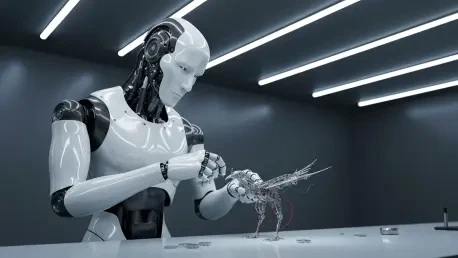

Creating robots that can match the fluid dexterity and effortless grace of the human hand has long been one of the most formidable challenges in engineering, a goal that has often seemed just beyond the reach of conventional programming and imitation-based learning. Synergy-Based Robot Learning represents a significant advancement in robotics and artificial intelligence. This review will explore the evolution of this brain-inspired approach, its core principles, key models, performance, and the impact it has had on various applications. The purpose of this review is to provide a thorough understanding of the technology, its current capabilities, and its potential for future development.
An Introduction to Kinematic Synergies
The core principle of synergy-based learning is inspired directly by neuroscience, specifically how the human brain manages the incredible complexity of motor control. Rather than micromanaging every single muscle and joint for every action—a computationally overwhelming task—the brain coordinates groups of them to move in synchronized patterns known as kinematic synergies. These synergies act as fundamental building blocks of movement, dramatically simplifying the control problem and allowing for fluid, efficient, and adaptable actions.
This approach marks a profound shift away from direct imitation, where a robot is taught to perform a complete, monolithic action. Instead, synergy-based learning focuses on teaching a robot a foundational “alphabet” of motion. Just as the 26 letters of the English alphabet can be combined to form an almost infinite number of words and sentences, a finite set of movement synergies can be combined in novel ways to generate a vast repertoire of complex actions. This paradigm is essential for creating robots that can not only replicate tasks but also adapt and generalize their skills to new situations they have not previously encountered.
Foundational Models for Synergy Extraction
The effectiveness of a synergy-based system is critically dependent on the source from which its “alphabet” of motion is derived. The data used to extract these fundamental movements shapes the robot’s ultimate capabilities, defining the breadth and flexibility of its potential actions. Researchers have primarily explored two distinct and contrasting sources for deriving these synergies: the functional, task-oriented movements of everyday life and the highly structured, expressive motions found in classical art forms.
Each of these approaches yields a unique set of synergies with inherent characteristics and trade-offs. The choice between a model based on pragmatic utility and one based on artistic expression has significant implications for the resulting system’s performance, particularly its ability to generalize beyond its training data. Comparing these foundational models reveals a deeper understanding of what constitutes a truly versatile and powerful set of motor primitives for intelligent machines.
Synergies from Natural Task Oriented Movements
One of the most direct methods for deriving kinematic synergies involves observing and analyzing common, functional actions performed in daily life. In this model, researchers capture data from subjects grasping a variety of everyday objects, ranging from large water bottles to tiny beads. By applying mathematical techniques to this dataset, they can identify the underlying coordinated patterns that are consistently used across these different tasks. This approach creates a practical and effective set of movements tailored specifically to known, functional objectives.
Through this analysis, research has shown that a surprisingly small number of core synergies—often around six—can account for the vast majority of the variation in movement observed during these grasping tasks. This finding confirms the brain’s efficiency in simplifying control. However, while this model produces a robust alphabet for the types of actions it was trained on, its specialization can also be a limitation. The resulting synergies may lack the inherent flexibility needed to construct movements that fall far outside the domain of simple object manipulation.
Synergies from Structured Artistic Movements
An innovative and highly effective alternative approach involves extracting synergies from a source rich in structure, precision, and expressive range: the mudras of classical Indian dance. These hand gestures are not random; they form a sophisticated and ancient language used to convey complex narratives and emotions. Researchers hypothesized that this “super healthy” or highly trained vocabulary of movement would yield a more versatile and powerful motor alphabet than one derived from more limited, task-oriented actions.
To test this, a comparative experiment was conducted. A set of six primary synergies was extracted from the dance mudras and compared against the six synergies derived from natural grasping. Both “alphabets” were then challenged to reconstruct a completely unrelated set of hand motions: letters from the American Sign Language alphabet. The results were conclusive. The synergies derived from the structured, artistic movements of the mudras significantly outperformed the task-oriented set, demonstrating a superior ability to generalize and construct novel gestures. This finding suggests that a more expressive and dexterous training source provides a more flexible foundation for robotic control.
Emerging Trends and Current Research
Recent developments in the field are moving away from the search for a single, universal “golden alphabet” of motion. Instead, the current trend is toward developing specialized libraries of task-specific synergies. This concept envisions a future where a robot could possess multiple alphabets, intelligently selecting the most appropriate one for the task at hand. For example, it might utilize a “kitchen alphabet” for cooking and a “workshop alphabet” for assembling parts, allowing for a much higher degree of proficiency across diverse and unrelated domains.
Another significant trend is the push toward using accessible, cost-effective technologies to democratize the applications of this research. Rather than relying on expensive, laboratory-grade motion-capture systems, many research teams are now developing methods that use simple, off-the-shelf cameras and software for motion capture and analysis. This pragmatic approach is critical for translating advanced concepts into real-world solutions, aiming to make powerful applications like at-home virtual physical therapy systems both affordable and widely available to the public.
Real World Applications and Implementations
The theoretical promise of synergy-based learning is now being actively translated into practical applications across several high-impact sectors. Researchers are moving beyond computational models to implement these learned alphabets of movement in physical hardware, from sophisticated robotic hands to full-scale humanoid robots. This transition from simulation to reality is where the true potential of the technology becomes apparent, enabling machines to perform tasks with a level of dexterity and adaptability previously unattainable. These real-world implementations are providing tangible solutions in fields ranging from advanced robotics to human health and rehabilitation.
Advancing Robotic Dexterity and Control
A primary application of synergy-based learning is in the direct enhancement of robotic manipulation and control. By “teaching” a robot a foundational set of synergies, engineers can enable it to perform complex actions it has not been explicitly programmed for. The robot can combine these fundamental movements in novel sequences to adapt to new objects and scenarios, effectively problem-solving on the fly. This capability is being implemented in hardware ranging from standalone robotic grippers to complex humanoid platforms.
The process involves the critical step of translating the abstract mathematical models of human synergies into precise, executable commands for a robot’s motors and actuators. This effort bridges the conceptual understanding of human motion with the physical realities of robotic hardware, accounting for differences in weight, materials, and dynamics. Success in this area is leading to robots that move more naturally and perform tasks more efficiently, from delicate assembly to dynamic interaction with their environment.
Innovations in Prosthetics and Human Rehabilitation
The field of medicine, particularly prosthetics and rehabilitation, stands to benefit immensely from synergy-based models. This technology offers a pathway to creating more intuitive and dexterous prosthetic limbs that can be controlled more naturally by the user. By mapping a user’s residual muscle signals or neural commands to a library of pre-learned synergies, these advanced prosthetics can execute fluid, coordinated movements, more closely mimicking the function of a biological hand and feeling less like a tool and more like an extension of the body.
Furthermore, this technology is fueling the development of accessible, at-home virtual physical therapy systems. Using a simple camera, these systems can capture and analyze a patient’s movements during rehabilitation exercises. By comparing the patient’s motions to ideal synergy-based models, the system can provide real-time, corrective feedback. This approach has the potential to make consistent, data-driven physical therapy more convenient and affordable, empowering patients to take a more active role in their recovery from the comfort of their own homes.
Key Challenges and Technical Hurdles
Despite the significant progress and immense promise of synergy-based robot learning, its path toward widespread adoption is not without formidable obstacles. The technology faces both technical challenges in its physical implementation and conceptual limitations in its ability to scale and generalize to the complexities of the real world. These hurdles represent the next frontier of research in the field, and overcoming them is essential for unlocking the full potential of this brain-inspired paradigm. Addressing these issues will require further innovation in both control theory and artificial intelligence.
The Simulation to Reality Gap
One of the most persistent challenges in all of robotics is the “simulation-to-reality gap,” and it is particularly relevant for synergy-based learning. A mathematical model that perfectly describes a human synergy in a clean, simulated environment often fails to translate flawlessly to physical hardware. The dynamics of a real-world robot—with its specific material properties, motor constraints, friction, and sensor noise—introduce complexities that are not present in the idealized model.
Accurately bridging this gap is a critical step for effective real-world performance. It requires the development of sophisticated control algorithms that can adapt the theoretical synergy to the physical constraints and unique dynamics of the specific robotic platform. Without this precise and robust translation, the elegance, efficiency, and grace of the original human movement can be lost, resulting in clunky or inaccurate performance that limits the robot’s practical utility.
Scalability and Task Generalization
As the field moves toward creating libraries of task-specific synergies, a new set of conceptual challenges arises concerning scalability and generalization. Building and managing extensive libraries of different “alphabets” for a multitude of tasks is a significant data management and architectural problem. A robot designed for complex, multi-stage activities, such as preparing a meal or tidying a room, would need to seamlessly and intelligently switch between different synergy sets as the context of its task changes.
Beyond simply selecting the right alphabet, the ultimate goal is to enable a system to generalize its knowledge to handle completely novel situations. This would require the robot to not only choose from its existing libraries but perhaps even combine synergies from different “alphabets” to devise a solution for a problem it has never encountered before. Achieving this level of abstract reasoning and contextual understanding remains a key area of ongoing research, representing a major step toward creating truly autonomous and adaptable machines.
Future Outlook and Potential Breakthroughs
The current trajectory of synergy-based robot learning points toward a future where machines possess unprecedented levels of motor intelligence and physical adaptability. By fundamentally shifting the approach from teaching whole actions to teaching foundational components, this paradigm is unlocking capabilities that were recently the domain of science fiction. The continued refinement of these models, coupled with advances in hardware and AI, promises to dramatically reshape the landscape of human-robot interaction in the coming years.
Potential breakthroughs driven by this technology could have a profound impact across industry and society. It is conceivable that robots equipped with highly dexterous, synergy-driven control systems could soon perform delicate surgical procedures with superhuman precision, assist in complex manufacturing processes that still require a human touch, or provide highly capable physical assistance to the elderly and individuals with disabilities. In the long term, this technology is not just about making robots better at specific tasks; it is about creating a new class of machines that can work alongside humans as fluid, adaptable, and intuitive partners.
Conclusion and Synthesis
This review provided an analysis of synergy-based robot learning, charting its evolution from a brain-inspired concept to a powerful practical tool. The core finding that a “movement alphabet” derived from the structured art of classical dance was more versatile than one from everyday tasks represented a significant paradigm shift. It underscored the idea that the quality and richness of the foundational building blocks were paramount to achieving true dexterity and adaptability in artificial systems.
The technology’s implementation in real-world robotics and advanced prosthetics demonstrated its immense potential to create more intuitive and capable machines that could seamlessly integrate into human environments. However, persistent challenges related to the simulation-to-reality gap and the complexities of task generalization highlighted the technical and conceptual hurdles that remained on the path to widespread adoption. Ultimately, the research affirmed that by deconstructing complex movement to its essential components, synergy-based learning has offered one of the most promising pathways yet conceived for closing the long-standing gap between human and machine motor intelligence.