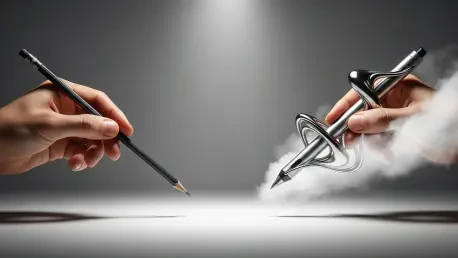

The creative world stands at a precipice where the line between human ingenuity and machine-generated content has blurred into a state of permanent ambiguity. The rapid proliferation of generative artificial intelligence has fundamentally altered the landscape of artistic production, shifting the primary focus from slow, deliberate craftsmanship to a model centered on high-speed synthetic output. While early experiments with neural networks were viewed as curious novelties, the current reality of 2026 presents a much more complex and troubling scenario for professionals across the globe. This transition is not merely a technical update to the creative toolkit but a deep existential threat that forces society to question the inherent value of human expression in an age defined by automation. By prioritizing algorithmic mimicry over genuine artistic labor, the creative industry finds itself at a crossroads between supporting long-term cultural integrity and embracing a cold, corporate-driven future. The tension highlights a growing divide between the efficiency of machines and the depth of lived experience.
Economic Realities of the Automated Workforce
One of the most immediate concerns is the systematic erosion of professional livelihoods across the creative sector as companies increasingly favor software that can churn out “good enough” work. This “race to the bottom” creates an environment where speed and profit margins are valued far more than the technical mastery or the creative intent of a human designer. In sectors like graphic design and commercial copywriting, the displacement is no longer a theoretical risk but a present reality that has significantly driven down the market value of original work. When a machine can generate thousands of iterations in a matter of seconds, the patient labor of a person becomes a financial liability for stakeholders who prioritize quarterly earnings over aesthetic soul. This shift threatens to turn art into a mere commodity produced on a digital assembly line, where the nuances of human emotion are traded for the sterile efficiency of a prompt-based interface that lacks any real connection to the physical world or the nuances of the human condition.
This economic shift creates a dangerous hierarchy where the act of making art might eventually become a luxury reserved only for those who do not need to earn a living from their craft. Professional designers, writers, and musicians find their specialized skills undercut by tools specifically designed to mimic their specific output without requiring their physical presence or intellectual consent. The resulting landscape is one where the creative workforce is being squeezed out by automation fueled by corporate interests rather than a genuine desire to enhance or support human talent. As professional paths vanish, the industry risks losing the mentorship and institutional knowledge that have historically sustained artistic communities. This leads to a future where creative expression is dominated by a few tech giants who own the infrastructure, while the actual creators are relegated to the margins. The democratization of art, once a noble goal, has been replaced by a system that prioritizes the ownership of data over the ownership of the human imagination.
Ethical Implications of Industrialized Plagiarism
Beyond the immediate economic fallout, the rise of generative models presents a massive ethical crisis centered on the opaque methods used to build these powerful systems. Modern AI architectures are trained on billions of pieces of human-made content, often scraped from public and private digital repositories without the consent or compensation of the original creators. This process is frequently described as a “vampirical” extraction of value, where machines learn from human ingenuity only to eventually compete against those very same individuals in the open market. These machines do not possess the capacity to create anything from a void; they simply blend, redistribute, and remix existing human work based on statistical probability. This reality exposes the common democratization argument as a convenient myth, as the technology relies on the systematic exploitation of the global creative community to function. If a technological advancement requires the uncompensated labor of an industry, it cannot be framed as progress.
Teaching a machine to mimic a specific artist’s style or a writer’s unique voice is not an act of inspiration but a sophisticated form of cultural strip mining that devalues the individual. When the foundation of a product is built upon the stolen intellectual property of millions, the legal and moral frameworks of the creative world begin to crumble under the weight of corporate scale. Proponents of these systems argue that the data is merely “learning,” similar to how a student studies the masters, yet a student does not operate at the speed of a million humans while charging a subscription fee for the results. This ethical gap creates a deep sense of betrayal among the community of creators who see their life’s work being used to train the very tools that will render them obsolete. The legal battles currently working through the courts are not just about copyright; they are about the right of a human being to maintain control over their identity and the fruits of their labor in an increasingly automated society.
The Cultural Cost of Predictive Creativity
There is also a significant concern regarding the long-term quality and authenticity of the art produced by algorithms that are fundamentally predictive in nature. Because AI relies on averaging what has already been created to determine its output, it inevitably leads to a feedback loop of mediocrity that prioritizes the familiar over the revolutionary. True creativity often emerges from the unexpected “mistakes,” the unique vulnerabilities, and the specific lived experiences of a human voice—elements that a machine is programmed to filter out in favor of mass appeal. When culture is curated by probability, the risk of stagnation becomes a pressing reality as new works become mere echoes of the past rather than visions of the future. This feedback loop ensures that the most popular and prevalent styles are reinforced, while the experimental or the challenging are marginalized because they do not fit the statistical norm. The result is a sea of synthetic noise that mimics the form of art without ever capturing the specific resonance that makes it meaningful.
Proponents of AI often compare it to the invention of the camera or the paintbrush, but this analogy fails to account for the total loss of human agency in the generative process. While traditional tools require a person to guide the vision and make critical decisions about every stroke or frame, generative AI takes over the decision-making process itself. Reducing a creator to a “prompt engineer” minimizes the human element to the point where the final product is often just a calculation rather than a statement. This shift suggests that the “how” and “why” of creation are secondary to the “what,” treating the artistic process as a hurdle to be cleared rather than a journey that gives the work its value. If society accepts this reduction, it risks losing the ability to distinguish between genuine communication and the sophisticated mimicry of a machine. The challenge lies in recognizing that the “imperfections” of human art are not bugs to be fixed by an algorithm, but the very features that allow us to connect with one another on a profound level.
Navigating the Path Toward Cultural Resilience
The industry moved toward a defensive posture as the realization set in that protecting human expression required more than just technological skepticism. Stakeholders across the creative spectrum began to demand clear labeling for synthetic content, ensuring that the human voice remained distinguishable from the algorithmic echo. This initiative was paired with the development of new licensing frameworks that sought to return agency and compensation to those whose work fueled the training of large language and image models. Collective bargaining units and professional guilds played a pivotal role in negotiating contracts that restricted the use of AI in ways that would displace workers, focusing instead on narrow, task-specific applications. By establishing these boundaries, the community attempted to preserve a space where artistic labor remained a viable profession rather than a hobby for the wealthy. This proactive approach underscored the necessity of viewing technology as a servant to the creative spirit rather than its master.
Moving forward, the focus shifted to educating the public and future creators on the irreplaceable value of human perspective and the importance of ethical consumption. Schools and universities redesigned their curricula to emphasize the philosophical and emotional foundations of art, rather than just the technical execution that machines could now replicate. This cultural pivot encouraged a renewed appreciation for the “handmade” and the “authentic,” fostering a market that prioritized transparency and human-centered stories. Organizations also explored decentralized platforms that allowed artists to share work without the intervention of data-hungry algorithms, effectively creating “safe zones” for genuine innovation. These practical steps served to remind society that while a machine could simulate the appearance of a story or a song, it could never participate in the shared consciousness that defines the human experience. The objective remained clear: to ensure that the tools of the future would enhance, rather than extinguish, the light of human creativity.