
The recent injection of tens of millions of yuan into Shenzhen Tianyuanxing Technology Co., Ltd. represents a decisive shift toward the realization of general industrial embodied intelligence within modern manufacturing facilities. This angel-round funding, led by prominent backers such as Hongde Investment, Shengshi Hongyuan, and Haiyuan Capital, highlights a growing investor confidence in the capacity of humanoid systems to move beyond experimental prototypes into high-stakes production roles. Since its emergence as a strategic spinoff from SenseTime Group’s Industrial Robot Division in late 2024, the startup has focused on bridging the gap between sophisticated computer vision and physical robotic manipulation. The infusion of capital is specifically designated to accelerate the commercialization of machines that are no longer confined to rigid, repetitive tasks but are instead capable of navigating the nuanced requirements of flexible production lines. This development is particularly timely as global industries seek more adaptable automation solutions that can reduce the long-term costs associated with specialized hardware and manual labor. By focusing on “embodied intelligence,” the company aims to provide the industrial sector with a new class of versatile tools that possess the cognitive and physical flexibility required to handle complex assembly and quality control processes. As the manufacturing landscape evolves, the integration of these intelligent agents is expected to become a cornerstone of the next generation of industrial productivity, transforming how factories manage rapid product cycles and diverse operational demands.
Strategic Heritage: The SenseTime Ecosystem and Leadership
Access to the “X ecosystem” provides Tianyuanxing with a significant competitive advantage, granting the startup immediate entry into a vast repository of industrial vision data and sophisticated large-scale AI models. Unlike many newcomers in the robotics field that must spend years gathering training data, this company benefits from a foundation established during its time within the SenseTime Group, allowing it to bypass the standard early-stage hurdles of algorithm development. This heritage ensures that the robots produced are equipped with high-level perception capabilities from the outset, enabling them to identify and interact with diverse objects in cluttered factory environments with a precision that was previously unattainable. Furthermore, the existing relationships with tier-one industrial clients, forged during the parent company’s tenure, provide a ready-made market for testing and deployment. This established network allows the team to focus on refining their hardware and software integration while having direct access to real-world feedback from some of the most demanding manufacturing environments in the world. The synergy between high-end AI research and practical industrial application remains a cornerstone of the company’s ability to scale its operations rapidly across different sectors. This strategic alignment not only reduces the risks associated with technical development but also ensures that the final products are closely aligned with the actual operational needs of the modern industrial economy.
Dr. Kuang Zhanghui, the visionary leader at the helm of Tianyuanxing, brings a distinguished background from premier institutions like Microsoft Research Asia and Huawei Noah’s Ark Lab to the forefront of the startup’s mission. Having earned a PhD in Artificial Intelligence from the University of Hong Kong, his expertise is not merely theoretical; he has already demonstrated an exceptional ability to implement complex perception solutions in high-growth industries. During his previous work in the lithium battery sector, he successfully oversaw the deployment of over 100 sets of intelligent perception systems for major industry players such as Contemporary Amperex Technology Co. Limited (CATL). This transition from leading researcher to a serial innovator in industrial applications provides the company with the “engineering implementation capabilities” necessary to translate abstract AI concepts into rugged, reliable factory equipment. His leadership ensures that the company maintains a focus on solving actual production bottlenecks rather than pursuing purely academic advancements. By grounding the company’s technical roadmap in the practical needs of current manufacturing leaders, he has positioned the startup as a bridge between the high-level capabilities of AI and the physical demands of the factory floor. This blend of academic excellence and proven field experience is vital for navigating the transition from proof-of-concept designs to mass-market industrial machinery.
Physical Engineering: The TX01 Wheeled Humanoid Platform
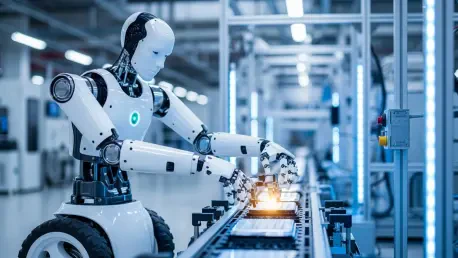
The flagship TX01 robot represents a departure from conventional humanoid designs, utilizing a wheeled-chassis dual-arm configuration specifically engineered for the rigors of high-intensity industrial service. One of the most significant innovations in the TX01 is its “bamboo-joint electric cylinder” structural design, which was developed to solve the persistent issue of balance and stability in mobile humanoid platforms. By keeping the center of gravity perfectly centered throughout various movements, this configuration allows the robot to perform high-precision tasks, such as intricate assembly or active quality inspection, without the risk of swaying or losing accuracy. The machine is built for endurance, featuring a robust 100 kg load capacity and a battery system that supports between four and eight hours of continuous operation. Such specifications are critical for integration into modern factory workflows, where downtime is costly and equipment must be capable of handling substantial weights and repetitive motions over multiple shifts. This focus on physical durability and operational stability ensures that the TX01 can function as a reliable “last mile” solution for flexible production, moving beyond simple transportation to engage in complex physical interactions. The result is a platform that combines the mobility of a wheeled vehicle with the dexterity of a humanoid, offering a versatile tool for the changing demands of industrial automation.
Beyond its impressive physical stature, the TX01 stands out in the robotics market due to its revolutionary integrated control architecture that unifies the management of the chassis, arms, and dexterous hands. Traditionally, industrial robots have relied on fragmented control systems where each component operates as a separate module, often leading to synchronization lags and excessive hardware complexity that drives up the total cost of ownership. Tianyuanxing has overcome these limitations by developing a synthesized system that enhances the overall responsiveness and coordination efficiency of the robot’s movements. This integration not only improves the fluid motion of the machine but also significantly reduces the hardware bill of materials, making the technology more accessible to manufacturers who are sensitive to capital expenditures. By streamlining the internal communication between the robot’s “brain” and its physical extremities, the company has created a leaner and more agile platform that can adapt to environmental changes in real time. This unified approach is essential for achieving the level of dexterity required for tasks that were once reserved exclusively for human workers, such as the delicate handling of sensitive components or the precise alignment of parts during assembly. The optimization of these controls represents a significant step forward in making humanoid robots a practical and cost-effective reality for the broader manufacturing sector.
Technical Evolution: Moving Toward End-to-End Intelligence
The transition from “rule-based” serial control to “end-to-end” control systems marks the defining technical evolution of the current decade within the industrial robotics sector. Traditional automation relies heavily on pre-programmed trajectories and rigid visual guidance, which, while effective for high-volume repetition, fail when faced with the variability of modern flexible manufacturing. These legacy systems often require weeks of on-site debugging by specialized engineers whenever a production line is reconfigured, creating a significant barrier to efficiency. In contrast, the end-to-end architecture pioneered by Tianyuanxing allows the robot to learn directly from scene data through a closed-loop system, bypassing the cumbersome perception-calibration-regulation cycles of the past. This means the robot can adapt its behavior based on visual and tactile input in real time, rather than following a static set of rules that must be manually updated. As manufacturing moves toward more customized product cycles, the ability of a robotic system to “learn” its way through new tasks becomes a critical competitive advantage, allowing for much faster transitions between different product models without the need for extensive downtime. This shift toward autonomy represents a fundamental change in how industrial robots are perceived, moving them from rigid tools to intelligent partners on the production floor.
By utilizing a data-driven approach to robot control, the company has effectively solved one of the most persistent headaches in the industry: the high cost and complexity of on-site implementation. When a factory environment changes, the TX01 does not require an engineer to rewrite thousands of lines of code; instead, it ingests new data from its surroundings to adjust its operational model. This capability drastically reduces the time required to deploy new systems and minimizes the ongoing maintenance costs associated with traditional automation. The system utilizes a three-pillared architecture—TengenData, TengenBrain, and TengenBuddy—to ensure that every movement is grounded in safety, quality, and cost-effectiveness. This holistic approach ensures that as more robots are deployed, the iterative “flywheel effect” kicks in, where the collection of more data leads to better models, which in turn leads to more capable hardware. The ability to generalize across different tasks means that a single robot can be repurposed for multiple roles within the same facility, providing a level of utility that was previously unthinkable. Ultimately, this move toward end-to-end intelligence is about lowering the barrier to entry for advanced automation, making it possible for a wider range of industries to benefit from the efficiency of robotic labor without the prohibitive setup costs that have historically limited adoption.
Commercialization Roadmap: Scaling the Industrial Future
To support its ambitious development goals, Tianyuanxing has adopted a pragmatic “self-financing” business model that generates immediate revenue through the sale of embodied intelligence perception modules. These modules serve as sophisticated eyes and ears for existing industrial systems, allowing the company to tap into current market needs while simultaneously gathering the real-world data required to refine its full-scale humanoid models. This “data entry point” strategy ensures a steady stream of cash flow and operational insights, distinguishing the startup from more capital-intensive competitors who may struggle with long development cycles without revenue. By integrating these perception modules into current production lines, the company establishes a presence in the factory long before its full humanoid robots arrive, building trust with clients and ensuring that its technology is battle-tested in diverse environments. This incremental approach to commercialization allows for a more sustainable growth trajectory, funding the expensive R&D necessary for the TX01 while proving the value of the company’s underlying AI technology. It also creates a natural pathway for upselling full robotic systems as clients become comfortable with the intelligence provided by the initial modules, facilitating a smoother transition toward comprehensive automation.
The company’s strategic roadmap reached a critical milestone in early 2026 with the commencement of on-site testing for the TX01 at the facilities of a leading new-energy customer. This phase of development was focused on proving the robot’s capabilities in high-stakes, real-world scenarios, paving the way for the transition to large-scale shipments and batch implementations scheduled for the latter half of the year. Beyond the domestic market, the startup proactively expanded its reach into Germany and Thailand, regions where the demand for advanced manufacturing is high but the competition in humanoid robotics is currently less saturated. By leveraging established relationships with major international players such as the Beijing-Shanghai High-Speed Railway Maintenance Company and Sunwoda, the team successfully secured a stable early-stage order pool that provided the necessary scale for mass production. This global perspective was essential for establishing an early footprint in the international industrial landscape, ensuring that the technology was adaptable to different regulatory and operational standards. The transition from proof-of-concept to batch delivery marked a significant turning point, demonstrating that embodied intelligence had finally moved from the laboratory to the center of global industrial operations. Moving forward, the focus was placed on further reducing production costs and expanding the robot’s versatility to ensure long-term viability in an increasingly competitive market.