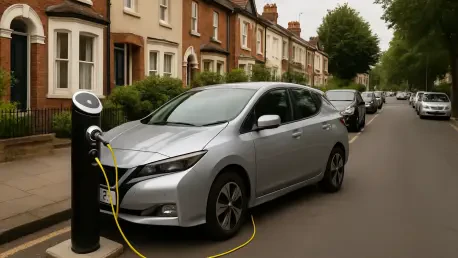

The architectural reality of terraced housing and high-rise apartments has long acted as a silent gatekeeper, preventing nearly forty percent of British motorists from accessing the cost-saving advantages of at-home electric vehicle charging. For years, the inability to park off-street created a structural inequality known as driveway discrimination, where those with private garages enjoyed low overnight electricity rates while urban dwellers remained tethered to expensive public networks. The current landscape is witnessing a profound correction as the United Kingdom pivots toward a more inclusive infrastructure strategy. This shift is not merely a matter of convenience but a critical economic necessity to ensure that the transition to electric mobility does not leave a significant portion of the population behind.
Strategic efforts are now focused on integrating residential energy rates into the public-facing sphere, effectively democratizing access to cheap power. Key market players and energy providers are collaborating to dismantle the logistical barriers that have historically frustrated residents of dense urban centers. By prioritizing the needs of apartment dwellers and those living in terraced homes, the government is signaling that the electric transition must be a universal endeavor. This inclusive approach is essential for maintaining momentum in the national decarbonization strategy, especially as the fleet of internal combustion engine vehicles begins to shrink in the face of rising environmental mandates.
Bridging the Driveway Divide in the United Kingdom’s Electric Vehicle Landscape
The disparity between different housing types has been one of the most stubborn obstacles in the domestic automotive market. While homeowners with driveways have seen the adoption of electric vehicles as a way to slash monthly expenses, many others viewed the switch as a financial burden due to the high cost of public rapid chargers. Recent policy shifts have sought to erase this divide by treating the curb as a domestic charging extension. By allowing residents to pull power from their own home meters to the street, the financial profile of vehicle ownership is being fundamentally rewritten for the urban middle class.
This transformation requires a coordinated effort between the Department for Transport and local authorities to harmonize bylaws that once prohibited such infrastructure. The integration of domestic rates into street-side solutions ensures that the price per mile remains consistent regardless of a driver’s property type. Moreover, this movement toward inclusivity has sparked interest from energy firms looking to provide specialized tariffs for those using shared charging points. As these initiatives take root, the psychological barrier to going electric is fading for millions who previously felt excluded from the benefits of the new energy economy.
Key Trends and Market Projections for Urban Charging Solutions
Innovations in Cross-Pavement Infrastructure and Consumer Behavior
One of the most notable technical advancements in the current market is the rise of gully technology, which provides a safe and permanent channel for charging cables to cross public sidewalks. These embedded pavement channels eliminate trip hazards, allowing residents to safely run a cable from their front door to a vehicle parked at the curb. This simple mechanical solution has unlocked the ability for millions of people to use their domestic electricity supply, avoiding the volatile prices associated with commercial charging hubs. As these installations become more commonplace, consumer behavior is shifting away from occasional fast-charging toward more frequent, low-powered domestic sessions.
The integration of smart lamp-post chargers and localized street furniture is also emerging as a dominant trend in high-density areas. These hubs provide a discreet way to expand the charging network without cluttering the urban environment with bulky hardware. This aesthetic and functional integration is proving popular with local councils who are under pressure to improve air quality while maintaining the historical character of their streets. Consequently, the urban charging landscape is becoming a patchwork of creative engineering that prioritizes both pedestrian safety and driver convenience.
Statistical Growth and Forecasts for the UK EV Sector
Industry leaders have reported a consistent month-on-month increase in charger sales, with recent data showing a twenty percent jump in the adoption of home-to-street hardware. This surge is directly linked to the expansion of government grants, which now offer forty percent more financial support to renters and small business owners than in previous cycles. These incentives have significantly lowered the entry barrier for individuals who do not own the land where they park their vehicles. Projections suggest that this trend will continue as the hardware becomes more standardized and installation costs drop due to economies of scale.
Long-term infrastructure expansion is being bolstered by a multi-year funding commitment that provides local councils with the certainty they need to plan large-scale rollouts. Forecasts for the 2026 to 2028 period indicate that the ratio of public charging points to electric vehicles will improve dramatically, particularly in regions that were previously underserved. This growth is expected to trigger a secondary market in used electric vehicles, as urban buyers gain the confidence that they can charge their cars as easily and cheaply as their neighbors with driveways.
Overcoming the Economic and Logistical Hurdles of Public Charging
The economic gap between domestic and public charging remains a significant point of friction that policymakers are working to resolve. High-cost public rapid chargers often charge a premium that can make the per-mile cost of an electric vehicle comparable to that of a diesel engine, particularly during peak demand hours. To mitigate this, new strategies are focusing on reducing the upfront costs of hardware for landlords and flat owners. By providing tax breaks and direct subsidies for shared infrastructure, the government is encouraging property managers to view charging points as a standard utility rather than a luxury amenity.
Navigating the logistical red tape of local council approvals is another area where progress is being made. Historically, the process of modifying a public sidewalk for a private cable gully was slow and plagued by inconsistent standards between different boroughs. Standardized safety protocols and streamlined application processes are now being implemented to reduce the administrative burden on homeowners. These measures ensure that cable management is handled with a uniform level of care, protecting pedestrians in high-traffic areas while allowing for the rapid expansion of the residential charging network.
The Regulatory Framework Driving Inclusive Mobility
The policy overhaul that began in the spring of 2024 has matured into a robust regulatory framework that defines how urban charging operates today. The Electric Vehicle Chargepoint Grant was significantly modified to include more diverse living situations, ensuring that the financial aid reached those most in need of support. These regulations also set high compliance standards for cross-pavement installations, mandating that all hardware meet specific durability and safety benchmarks. This regulatory clarity has given the private sector the confidence to invest in new products specifically designed for the British streetscape.
Furthermore, the Department for Transport has taken a more active role in harmonizing local authority bylaws with national decarbonization goals. This top-down approach has prevented a fragmented landscape where charging rules differed from one street to the next. Security measures and data privacy standards have also been integrated into the smart charging networks, ensuring that as vehicles become more connected, the energy grid remains protected from cyber threats. This comprehensive framework serves as the foundation for a reliable and secure transportation system that can handle the demands of a fully electrified fleet.
Future Outlook: The Evolution of Accessible Green Transportation
As technology continues to advance, the role of vehicle-to-grid systems and wireless curbside charging is expected to expand, further lowering the per-mile cost for urban drivers. These innovations will allow vehicles to act as mobile batteries, storing cheap renewable energy and selling it back to the grid during periods of high demand. This bidirectional flow of power could turn an electric vehicle from a simple transportation tool into a financial asset for the owner. Such developments will be particularly beneficial for those without driveways, as shared street chargers could become centers for localized energy management.
The speed of the internal combustion engine phase-out will remain sensitive to global economic conditions and energy security. However, the foundational work being done to make charging accessible to everyone ensures that the transition is resilient to external shocks. The long-term viability of the charging for all strategy depends on the continued cooperation between the public and private sectors. If the current trajectory of innovation and regulatory support continues, the UK will likely meet its net-zero targets while maintaining a transportation system that is both economically sustainable and socially equitable.
Summary of Findings and Strategic Recommendations for the EV Transition
The findings indicated that the democratization of electric vehicle ownership was heavily dependent on the removal of physical and financial barriers for urban residents. Regulatory shifts and enhanced grant programs played a pivotal role in shifting the market toward a more inclusive model. It was observed that when drivers were provided with a safe and legal way to access domestic electricity rates, their willingness to adopt electric mobility increased substantially. Local authorities that acted quickly to implement standardized sidewalk policies saw a much faster rate of infrastructure deployment compared to those that remained caught in bureaucratic delays.
Strategic recommendations for the future focused on the necessity of local councils maximizing their use of available government funding to upgrade street lighting and public walkways. Property owners were encouraged to view electric vehicle infrastructure as an essential investment in the longevity of their assets. The transition proved that inclusive design was not just a social goal but a practical requirement for national energy independence. Ultimately, the successful expansion of charging access for those without driveways served as a blueprint for how other nations could tackle the geographic challenges of the green energy transition.