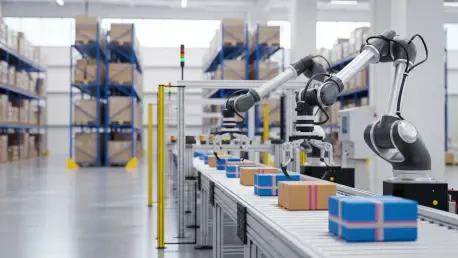

The sight of a multi-armed mechanical titan navigating a South Carolina fulfillment center promised a new era of logistical efficiency that seemed destined to redefine the very nature of global e-commerce. Amazon has successfully deployed more than one million robots across its global network since its landmark acquisition of Kiva Systems, yet even a giant with a near-perfect track record faces the occasional high-profile setback. The Blue Jay project, a multi-armed robotic system developed in record time, went from a celebrated debut to a quiet cancellation in less than six months. This rapid lifecycle raises a significant question for the logistics industry: why would a company known for relentless scaling pull the plug on its most AI-advanced hardware so quickly?
The Billion-Dollar Pivot: Amazon’s Automation Playbook
While the initial rollout of Blue Jay generated massive headlines, the subsequent disappearance of the project signaled a shift in how the tech giant manages its experimental portfolio. The company has historically leaned into the philosophy of “failing fast,” allowing engineers to explore radical designs without the burden of decades-long commitments. This approach ensures that even when a specific machine is shelved, the investment contributes to a larger repository of intellectual property.
The decision to pivot away from Blue Jay was not a sign of financial distress but rather a calculated move to prioritize long-term stability over short-term spectacle. In the high-stakes environment of warehouse automation, every second of downtime translates into thousands of delayed packages. Consequently, any technology that shows even a hint of operational instability during the testing phase is often redirected before it can impact the broader supply chain.
From Kiva to Blue Jay: A Decade of Robotics Evolution
To understand the fate of Blue Jay, one must look at the trajectory of the fulfillment strategy since the early 2010s. The shift toward same-day delivery has placed immense pressure on warehouse efficiency, leading to the development of robots that can handle more than just moving shelves. Blue Jay was born out of recent breakthroughs in artificial intelligence that allowed engineers to compress a multi-year development cycle into just twelve months.
This background highlights a broader trend where the speed of AI innovation currently outpaces the physical infrastructure of traditional fulfillment centers. While software can be updated in an instant, the mechanical joints and sensors of a physical robot must withstand the grueling, repetitive motions of a twenty-four-hour warehouse cycle. This friction between digital agility and physical durability remains one of the greatest hurdles for modern robotics engineers.
Analyzing the Short Life: Sudden Exit of the Blue Jay Program
The decline of Blue Jay was characterized by a disconnect between public perception and internal strategy. While early reports framed the South Carolina tests as a permanent operational rollout, the organization later clarified that the project was a prototype designed to stress-test specific AI capabilities. Several core factors contributed to the cancellation, ranging from mechanical complexity to the evolving needs of the same-day delivery framework.
The multi-armed design, while innovative, faced challenges in matching the specific precision required for high-density fulfillment. Engineers discovered that the transition from experimental testing to long-term operational sustainability was more difficult than anticipated within the existing infrastructure. As a result, internal resource allocation shifted toward more versatile hardware capable of handling a wider variety of package weights and shapes with fewer mechanical points of failure.
Inside the Decision: Prototype Realities and the Rise of Vulcan
Leadership maintains that the Blue Jay initiative was not a failure but a foundational step in the evolution of warehouse intelligence. By ending the project early, the company managed to harvest the intellectual property and “DNA” of the project to fuel its successor, Vulcan. Expert insights into the program reveal that the personnel and software innovations from Blue Jay were directly integrated into other robotics programs to prevent any loss of momentum.
This strategic redirection ensured that the investment in AI-driven grasping and route planning matured into a more robust system. The Vulcan project benefited immensely from the data gathered during Blue Jay’s brief tenure, particularly regarding how multi-armed systems interact with dense storage environments. This transition allowed the engineering teams to refine their approach to haptic feedback and spatial awareness, leading to a more reliable generation of automation.
Navigating the Shift: High-Density Automation Systems
The move from Blue Jay to Vulcan provided a blueprint for how large-scale enterprises evaluate and pivot their technological investments. Vulcan represents a more sophisticated approach to automation, utilizing a dual-arm system where one arm organizes storage while the other executes precise picking with advanced suction technology. For organizations looking to implement similar AI-driven workflows, this strategy offered several specific frameworks for success.
Future considerations for warehouse automation involved prioritizing precision over pace to prevent the package damage that often plagued faster, less sensitive units. Effective robots needed to communicate in real-time with management systems to avoid bottlenecks, focusing on versatility rather than specialized tasks. This evolution proved that the true value of a prototype lay in the lessons it provided for the next iteration of industrial design.