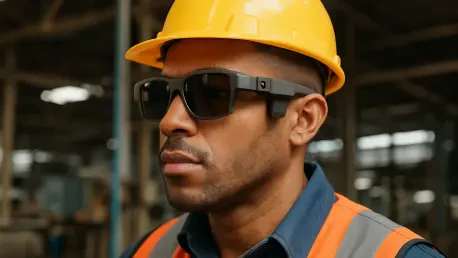

Hands are busy. Heads are available. That is the simple reason smart glasses are finally earning a seat in industrial toolkits. The winning devices are not consumer gadgets with a camera strapped on. They are rugged, voice-first edge computers built for noisy plants and tight catwalks. They are also suited to regulated sites where a dropped phone could cause a safety incident. Treated that way, they move real metrics that matter to operations leaders and CFOs.
What Changes with On-Head, Voice-First Computing
A head-mounted computer changes three things at once. It frees the hands, it puts the camera and sensors where the work happens, and it turns the worker’s voice into the primary interface.
Hands stay on the wrench, and digital work instructions become glanceable, not yet another device to juggle. In high-consequence environments, fewer hand movements mean fewer errors.
The camera becomes a sensor so that remote experts can see what the technician sees. Thermal imaging attachments surface overheating components that a human eye would miss. Photos and short clips become objective evidence for inspections and audits.
Voice becomes the command line. Wake words and constrained vocabularies let workers capture a finding or start a Microsoft Teams call without breaking PPE protocols. In high-noise zones, beamforming microphones and acoustic models trained for industrial soundscapes contain error rates.
The device itself must be industrial by design. Think hot-swappable batteries for full-shift use. PPE-ready mounts for hard hats and bump caps. IP ratings for dust and water. Intrinsically safe variants with ATEX Zone 1 and mining certifications for combustible atmospheres. A bright HD microdisplay that is readable in the sun or glare. This is not a smartphone on a strap. It is a wearable computer built for work.
Where Smart Glasses Create Measurable Value
The strongest use cases cluster around three operational goals. Reduce time to resolution. Increase first-time fix rate. Improve documentation quality with less friction.
Remote expert assistance. A senior engineer can support four sites in the morning from a desktop. This eliminates travel and reduces waiting time for “the expert.” It also spreads scarce skills across a larger asset base. Many field service teams quantify truck-roll savings between 1,000 and 2,000 dollars per avoided visit, which compounds quickly across a fleet.
Digital workflows and inspections. Voice-stepped procedures reduce omission errors. Photos and short clips attached at each checkpoint create defensible records for ISO, FDA, or internal audits. Completion data flows into enterprise asset management (EAM) or computerized maintenance management system (CMMS) records without rekeying.
Commissioning and quality. New hires can follow annotated procedures while an experienced tech shadows remotely. Quality teams can call up specs, torque values, or recent deviations at the point of work. The result is fewer rework cycles and faster learning curves.
Quantifying the impact is not hand-waving. Organizations that roll out remote assist and guided workflows at scale often see double-digit gains in first-time fix rate. They also experience significant reductions in mean time to repair, which directly impacts costs and uptime. For heavy manufacturing and energy, each hour of unplanned downtime is very costly, making even small reductions meaningful at the P&L level.
The Integration Test Most Pilots Fail
The fastest way to stall a smart glasses program is to treat the device as a standalone tool. Frontline work lives inside a web of systems. The glasses must fit that web from day one.
Communications. If the organization runs Microsoft Teams or Zoom, remote expert calls on the glasses must authenticate with the same single sign-on (SSO) and respect the same retention rules.
Work management. Work orders, checklists, and asset records live in EAM or CMMS. A technician should be able to open a job, step through a procedure, attach evidence, and close out a task without touching a separate tablet.
Identity and device management. Mobile device management (MDM) should push configurations, certificates, and updates. Compliance policies need to cover camera use, encryption at rest, and data in transit.
Network and OT alignment. Plants often segment operational technology networks. Smart glasses need a clear path for video when on-site Wi-Fi is congested, and a tested fallback for low-bandwidth links at remote pads.
Vendors now ship ecosystems rather than bare devices. Integrations with tools like Microsoft Teams, TeamViewer, and Zoom matter because they lower friction for both IT and the end user. If it launches with the same icon and login, a worker already knows, and adoption accelerates. Buyers should insist on prebuilt connectors to their core stack and test them in live conditions.
Safety, Compliance, and Ergonomics Are Non‑Negotiable
Every hour on the head magnifies small design choices. Weight distribution matters. Heat buildup on the temple matters in midsummer. Displays must adjust for eye dominance and sit below the line of sight to avoid blocking hazards. Battery changes should not require removing a hard hat. This is ergonomics as risk reduction.
Compliance is broader than device certifications. In regulated industries, video and images become regulated content the moment they show a lot number, a batch record, or a patient label. Retention, redaction, and access controls must reflect that reality. At high noise levels, organizations should validate that voice models understand local accents and the task vocabulary of the site. A small percent command error rate that looks acceptable in a lab can ruin a shift on a compressor deck.
Treat AI as a Service with an SLA
Too many pilots frame AI as a magic assistant. In production, it is a service with an SLA. Set explicit targets for latency, accuracy, and fallback behavior.
On-device wake words minimize round-trip latency for speech commands. If tasks require cloud natural language models, a strict latency budget is essential. Two seconds is often the outer limit before workers abandon voice for manual steps. Thermal and object-detection modules can flag anomalies and confirm procedures, but false positives erode trust. Monitoring error rates and falling back to simpler checklists when confidence drops is critical.
For cross-border teams, translation and transcription must be “good enough.” Minor errors are acceptable in inspection notes, but critical instructions like lockout/tagout cannot tolerate mistakes. Model updates require careful data handling. Decide what stays on-device, what streams to private endpoints, and what never leaves the network. Private AI endpoints often provide the best balance of capability and control.
Selecting the Right Device Class
Not every environment needs an intrinsically safe unit. Sites with combustible atmospheres do. Buyers should map environments to device classes.
Intrinsically safe. Required for ATEX Zone 1, mining, or similar designations. Expect a higher unit cost and a narrower accessory set. These devices trade some compute headroom for safety certifications.
General industrial. Suitable for most plants, warehouses, and utilities. Expect a broader range of mounts and modules, such as thermal cameras from partners like FLIR.
Camera and optics. Prioritize a primary camera that performs in low light and glare. If thermal imaging matters, choose a vendor-backed module rather than an improvised add-on.
Display. The best displays provide clear HD resolution, sit below the line of sight, and adjust for either eye without causing neck strain.
There is credible proof that this category is not experimental. Vendors report material enterprise deployment at the highest tier. For example, RealWear has stated that 41 of the Fortune 100 have deployed its devices. That does not replace due diligence, but it signals market readiness.
What Buyers Often Miss
Three blind spots keep appearing in stalled programs:
Treating the remote expert as the end state. It is the on-ramp. The real gains come when digital work becomes the default and documentation happens as a byproduct of doing the job.
Underestimating content work. Converting dense SOPs into voice-stepped flows is work. The payoff is fewer errors and better evidence. Budget time for it.
Ignoring the line manager. Adoption rises or falls with the person who sets the day’s jobs. If supervisors do not require their use, devices gather dust.
The Upshot
Smart glasses are a practical way to put communications and sensors at the front line of the enterprise stack. They shorten resolution times and create better evidence with less friction. Those outcomes move cost, safety, and compliance in the right direction.
There is still complexity. AI components need explicit performance targets. Connectivity will fail at the worst moment in the worst corner of a site. Content will lag in the first quarter as teams convert SOPs into voice-first flows. All of that is manageable when the initiative is anchored in operations metrics and integrated with the systems workers already use. The organizations that win treat head-worn computing as a service with clear SLAs and unglamorous execution. The technology is ready. The work is to make it routine.