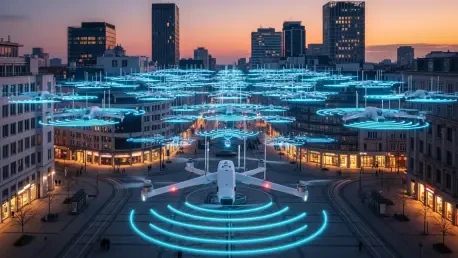

The sudden silence of a smartphone during a major emergency or a massive public gathering serves as a stark reminder of how fragile our digital lifelines truly remain. Despite the widespread rollout of advanced cellular technology, the fundamental reliance on fixed, ground-based infrastructure means that when the environment changes rapidly, the network often fails to keep pace. This vulnerability is not just a nuisance for social media users at a music festival; it represents a critical failure point for emergency services and disaster response teams who require unfailing connectivity to save lives.
Modern communication is transitioning away from the era of “dead zones” toward a future where the network itself is mobile. By leveraging autonomous drone swarms, researchers are finding ways to bypass the limitations of physical towers. This shift promises to turn the sky into a responsive digital canopy, ensuring that bandwidth is always available exactly where the human population is most concentrated.
Beyond the Bars: Why Your Smartphone Still Fails in a Crisis
Mobile connectivity remains surprisingly fragile because it is anchored to the earth by permanent steel and concrete structures. These towers are engineered based on average daily traffic patterns, meaning they are ill-equipped to handle the massive, localized spikes in demand that occur during unforeseen events. When a hurricane destroys a local substation or a hundred thousand fans enter a stadium, the hardware simply reaches its physical limit, leaving users with full signal bars but zero data throughput.
Furthermore, the “one-size-fits-all” nature of traditional cell sites fails to account for the vertical and architectural complexities of modern cities. Concrete canyons and dense foliage create shadows where signals cannot penetrate, even in the heart of a metropolitan area. This structural rigidity forces users to adapt to the network’s location rather than the network adapting to the needs of the people, a design flaw that becomes dangerous when every second counts during a rescue operation.
The Rigidity of Static Towers vs. the Fluidity of Human Movement
Traditional networks are built on a foundation of static geography, utilizing fixed points to provide coverage across specific, unchanging zones. However, human activity is inherently dynamic, characterized by sudden surges in density that these permanent installations were never intended to manage. This mismatch between unyielding infrastructure and the fluid nature of human movement creates a persistent reliability gap that simply adding more ground towers cannot solve.
When thousands of people converge on a single city block, the nearest tower becomes a bottleneck, unable to allocate enough spectrum to every device. In contrast, the vision of a “liquid” network suggests that infrastructure should be as mobile as the people it serves. By moving the point of connection from the ground to the air, service providers can follow the crowd, ensuring that the network density increases in tandem with user demand rather than remaining stuck in a fixed grid.
How AURA-GreeN Orchestrates Drone Swarms for Dynamic Coverage
The Stevens Institute of Technology has introduced a paradigm shift with AURA-GreeN, a system that reimagines drones as intelligent, mobile cell towers. Instead of acting as isolated units, these drones operate in coordinated swarms that function as a cohesive aerial network. This system allows the nodes to “flow” toward areas of high demand in real time, autonomously redistributing spectrum and signal strength to eliminate bottlenecks before they can cause a total blackout.
AURA-GreeN utilizes sophisticated algorithms to evaluate signal interference and traffic load on the fly, allowing the swarm to self-optimize without human intervention. These aerial nodes communicate with one another to ensure seamless handoffs as they move, creating a stable blanket of coverage even in the most challenging environments. By transforming drones into a flexible infrastructure layer, the system provides a level of agility that traditional telecommunications companies have struggled to achieve for decades.
Achieving the 460% Edge: Research Insights from Stevens Institute
The effectiveness of this technology is measured through the “age of information,” a critical metric that tracks how quickly data is refreshed and delivered to the end user. Research conducted at the Stevens Institute demonstrated that the AURA-GreeN system produced a staggering 460% improvement in data freshness compared to standard mobile configurations. This leap in performance ensures that high-priority information, such as GPS coordinates for first responders, is transmitted with near-zero latency.
However, maintaining this level of efficiency requires a delicate balancing act managed by the system’s core software. Engineers had to calibrate the swarm to manage the inherent trade-offs between signal stability, low latency, and the finite battery life of the drones. The research proved that by optimizing the flight paths and transmission power of each node, it is possible to maintain a high-performance network for extended periods, even when operating in unpredictable weather or high-interference urban settings.
Scaling the Swarm: A Framework for Deploying Temporary Aerial Networks
To successfully integrate these swarms into the existing communication ecosystem, a strategic approach to deployment was necessary. This involved a “piggybacking” strategy, where drones already in the air for secondary purposes—such as broadcasting a marathon or conducting security patrols—were utilized to host network nodes. This dual-purpose utility allowed for the rapid expansion of coverage without the need for a dedicated fleet of specialized hardware for every event.
In high-stakes disaster response scenarios, a tiered deployment strategy was implemented to prioritize essential communications. The swarm first established a dedicated link for emergency services before expanding its reach to provide general internet access to the public. By intelligently prioritizing spectrum distribution based on real-time urgency, these aerial frameworks created a resilient bridge that functioned even when every ground-based system had been rendered offline. The success of these trials indicated that the next generation of mobile reliability would be defined by its ability to take flight.