
Oscar Vail is a veteran in the tech world who has seen everything from the rise of open-source to the dawn of quantum computing. Today, he joins us to discuss a breakthrough in “stealth” communication developed by researchers at UNSW Sydney and Monash University: the ability to hide data within the natural infrared glow of objects. By moving away from bright pulses and instead manipulating the thermal signatures we all emit, this technology is redefining the concept of secure transmissions. We explore the mechanics of thermoradiative diodes, the strategic advantages of invisible signaling, and why extreme cold might be the only enemy of this innovative hardware.
Traditional optical systems use bright light pulses, but this approach relies on subtly reducing natural infrared glow. How does a thermoradiative diode manipulate thermal noise to encode information, and what specific technical steps or hardware improvements are necessary to push the current 100 KB/s transfer rate toward higher speeds?
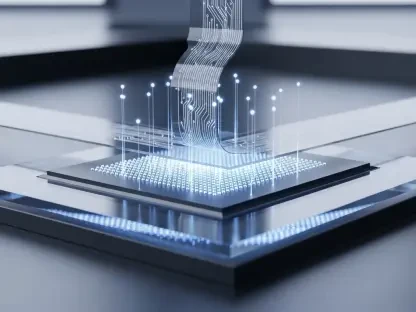
The thermoradiative diode is a fascinating piece of engineering because it doesn’t just blast a signal; it creates a “negative luminescence” effect by rapidly switching between slightly brighter and darker infrared states. This flickering is so subtle that it blends into the ambient thermal noise, making the data essentially invisible to the naked eye or standard sensors that aren’t specifically looking for it. To push past the current benchmark of 100 kilobytes per second, we really need to focus on the switching speed of the semiconductor materials involved in the diode’s construction. Improving the efficiency of how these diodes modulate their thermal output will involve refining the fabrication process to minimize the physical lag during the transition between these light and dark states. It’s a sensory experience of “cooling” and “warming” on a microscopic level that, once optimized, could see speeds climb significantly as we move beyond these early, successful laboratory tests.
Security usually focuses on encryption, but hiding the signal’s existence introduces a different defense. If an observer cannot distinguish data from background heat, how does this change the hacking landscape, and what specific steps would be required for a receiver to successfully isolate the signal from natural noise?
This technology shifts the security paradigm from “unbreakable locks” to “invisible doors,” where a hacker cannot attack a signal they don’t even know exists. In a world where we can see every available WiFi network just by opening a laptop, this stealth approach ensures that the act of communication itself remains a secret from any outside observer. For a legitimate receiver to isolate this signal, it first requires a specialized detector tuned precisely to the specific longer wavelengths of the emitter’s thermal radiation. The process involves synchronizing the receiver to look for those minute, rhythmic variations in the infrared glow, effectively filtering out the chaotic thermal noise of the surrounding environment. It is a delicate dance of signal processing where the hardware must distinguish an intentional, patterned “dip” in heat from the random thermal fluctuations of a living room, a busy office, or an industrial floor.
System performance improves at higher temperatures but fails in extreme cold around -100C. In what real-world industrial or outdoor environments would this technology be most reliable, and how can the emitter maintain a consistent signal when the ambient temperature of the surrounding environment fluctuates?
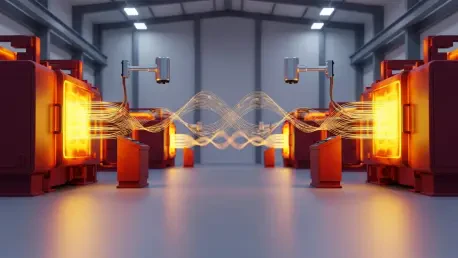
Interestingly, the technology thrives in warmth, as the negative luminescence effect actually grows stronger when the environment provides more thermal energy for the diode to manipulate. This makes it incredibly reliable for industrial settings like data centers or factory floors where equipment is naturally warm, or even in sun-drenched outdoor urban areas where concrete absorbs significant heat. Unlike many high-end electronics that require aggressive cooling to function, these emitters should ideally be left at ambient temperatures to better blend into their surroundings without the need for active climate control. The system only hits a functional wall in “Mars-like” cold—around -100C—where the thermal radiation is simply too faint to be manipulated with enough contrast for data encoding. In everyday use, whether it’s a sweltering summer day or a climate-controlled office, the emitter adapts naturally because it is essentially using the environment’s own heat as its canvas for communication.
This technology operates at longer wavelengths than LiFi and requires a clear line of sight. What are the practical design trade-offs when choosing thermal radiation over visible light, and how could future versions be adapted for guided or directional use in complex office or field settings?
The primary trade-off is moving from the high-frequency, visible spectrum used in LiFi—which was a major highlight at MWC 2026—to the much lower frequencies of the thermal infrared band. While visible light allows for massive bandwidth and lighting-fast speeds, it is also highly detectable; you can see the “on/off” pulses with a simple camera or a common light sensor quite easily. Thermal radiation allows for a level of discretion and secrecy that visible light simply cannot match, even if it requires a strict line of sight between the diode and the detector to maintain the link. Future hardware designs could incorporate sophisticated directional lenses or even guided fiber-like systems to route this thermal data through the complex corners of office layouts or rugged field environments. We are looking at a future where your hardware doesn’t just sit on a desk; it integrates into the physical architecture, using the very heat of the building to carry secure, invisible data streams.
What is your forecast for thermal data transmission?
I believe we are witnessing the birth of a new tier of high-security communication that will eventually sit alongside WiFi and traditional optical links in our daily infrastructure. In the next decade, as we refine the engineering behind these thermoradiative diodes and increase their modulation frequency, I expect to see this technology deployed in environments where privacy is the absolute priority, such as government facilities or high-stakes corporate boardrooms. While it won’t replace the raw speed of fiber optics overnight, its unique ability to hide from an outside observer is a game-changer for the future of digital sovereignty. We will likely see integrated systems where thermal transmission handles the most sensitive metadata and security keys, while traditional channels handle the bulk of the heavy data traffic. It’s a move toward a more “natural” form of digital communication that mirrors the invisible, ever-present heat of the world around us.