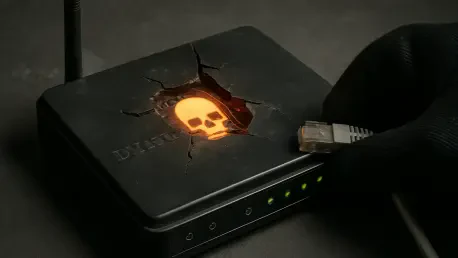

The unassuming plastic box blinking quietly in the corner of a room often holds the keys to an entire digital kingdom, a reality that has become dangerously clear with the discovery of a severe, actively exploited vulnerability. A critical flaw has been identified in several older D-Link gateway routers, leaving countless home and small business networks exposed to remote takeover without any user interaction. This situation highlights a persistent challenge in cybersecurity: the latent risk posed by aging, unsupported hardware.
This article serves as a comprehensive frequently asked questions guide to understand the specifics of this vulnerability, identified as CVE-2026-0625. It will break down the technical nature of the flaw, identify the affected devices, and detail the significant risks associated with continued use. The primary objective is to provide clear, actionable guidance for users to protect their networks from this ongoing threat.
Key Questions or Key Topics Section
What Is the Nature of This Vulnerability
The core of this issue is a critical command injection vulnerability, tracked as CVE-2026-0625. Security researchers discovered that certain legacy D-Link routers fail to properly sanitize, or clean, data that is entered into their DNS configuration settings. This oversight allows a remote attacker to craft special inputs that the router interprets not as data, but as system commands. Because this can be done without any login credentials, it is classified as an unauthenticated remote code execution (RCE) flaw.
With a severity score of 9.3 out of a possible 10, this vulnerability is considered extremely dangerous. It grants attackers the ability to execute arbitrary shell commands on the device, effectively giving them complete control over the router’s operating system. The flaw is not a new or complex exploit but rather a fundamental failure in secure coding practices that has left a wide-open door for malicious actors.
Which Router Models Are Confirmed to Be at Risk
The vulnerability directly impacts a range of D-Link’s older, end-of-life (EoL) products. D-Link has confirmed that models such as the DSL-2740R, DSL-2640B, DSL-2780B, and DSL-526B are affected. The central theme connecting these devices is that they are all legacy hardware, meaning the manufacturer no longer provides security patches, firmware updates, or technical support for them.
The company is still working to identify a complete list of all vulnerable models, a task made more difficult by the numerous firmware versions and regional variations released over the years. However, the ShadowServer foundation has confirmed that active exploitation of these devices has been occurring since at least November 2025, indicating that attackers are already well aware of the issue and are actively scanning the internet for these easy targets.
What Are the Consequences of a Compromised Router
A compromised gateway router is one of the most severe security incidents a network can face, as it is the single point of entry and exit for all internet traffic. Attackers with control over the router can intercept, inspect, and redirect any unencrypted data passing through it, leading to the theft of login credentials, financial information, and other sensitive data. Moreover, they can redirect users to malicious websites for phishing or malware delivery.
The danger extends far beyond simple data theft. An attacker can use the compromised router as a foothold to pivot and move laterally within the internal network, scanning for other vulnerable devices like computers, smart home gadgets, or network-attached storage. The router can also be absorbed into a botnet for use in large-scale distributed denial-of-service (DDoS) attacks or repurposed as a proxy or command-and-control server, hiding the attacker’s true location.
Summary or Recap
This FAQ addresses the urgent security threat posed by the CVE-2026-0625 vulnerability in legacy D-Link routers. The central issue is an unauthenticated command injection flaw that allows for complete remote takeover of affected devices. The flaw’s severity is compounded by the fact that the vulnerable routers are all end-of-life products, meaning they will not receive security patches from the manufacturer.
The risks stemming from this situation are substantial, ranging from traffic interception and credential theft to the router being used as a launchpad for further attacks on the internal network. Security experts unanimously agree on the recommended course of action. Given the active exploitation and the absence of a patch, the only effective solution is to immediately decommission and replace these unsupported routers with modern, supported hardware that receives regular security updates.
Conclusion or Final Thoughts
The active exploitation of these legacy D-Link routers served as a powerful and practical lesson on the tangible risks of using outdated technology. It underscored the reality that network hardware is not a “set it and forget it” appliance; it requires a lifecycle management strategy. The incident revealed how a seemingly minor oversight in data sanitization on an old device could create a major security crisis years later.
Ultimately, the consensus from the security community provided a clear path forward. The only responsible action for anyone using the affected models was immediate replacement. This event was a stark reminder that proactive security—which includes retiring hardware that is no longer supported—was not just a best practice but an essential defense against determined adversaries looking for the weakest link in a network’s defenses.