
Oscar Vail is a seasoned technology expert who has spent years dissecting the intersection of high-performance hardware and emerging software ecosystems. With a background that spans from open-source projects to the cutting edge of mobile architecture, he offers a unique perspective on how internal components translate into real-world user experiences. In this discussion, we explore the recent leap in tablet hardware, focusing on Lenovo’s latest high-performance offerings. We examine the thermal management of flagship chipsets, the practical utility of unconventional port layouts, and the strategic trade-offs between processing power and battery longevity in the current Android landscape.
The Y700 Gen 5 features a Snapdragon 8 Gen Elite 5 chipset paired with a vapor chamber cooling system and 24GB of RAM. How do these internals manage heat during high-intensity gaming, and what specific performance metrics should users expect when running demanding software?
The integration of the Snapdragon 8 Elite Gen 5 alongside a massive 24GB of LPDDR5T RAM creates a hardware profile that rivals many modern laptops. To prevent thermal throttling during extended sessions, the Coldfront Vapor chamber cooling system works by rapidly dispersing heat away from the silicon across a larger surface area, ensuring the 165Hz refresh rate remains fluid without frame drops. Users can expect the 8.8-inch display to maintain its 3,040 x 1,904px resolution even under heavy load, as the UFS 4.1 Pro storage ensures data bottlenecks are virtually non-existent. In practice, this means a gamer can jump between a resource-heavy title and background applications without the system stuttering or the chassis becoming uncomfortably hot to the touch. It is a rare technical feat to see such high-density memory in a compact form factor, and it provides a level of future-proofing that is currently unmatched in the small-tablet segment.
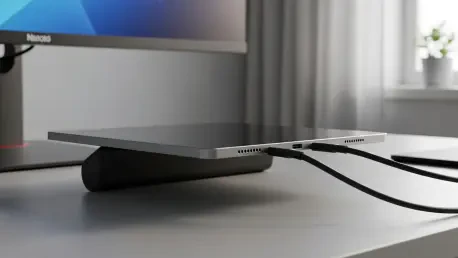
Many tablets struggle with limited connectivity, but the Y700 includes dual USB-C ports for simultaneous charging and wired audio or video output. In what professional or creative scenarios does this dual-port setup offer the most value, and how does the dual-cell battery design affect daily charging habits?
The inclusion of dual USB-C ports is a game-changer for mobile professionals who often have to choose between keeping their device powered and connecting essential peripherals. For a video editor or a streamer, this allows for a direct video output to an external monitor while simultaneously drawing power from a 68W wired source, eliminating the need for bulky, unreliable dongles. The 9,000mAh dual-cell battery design is equally important here, as it allows the device to handle high-amperage charging more efficiently and with less heat buildup than a single large cell. This means you can top up the device quickly during a short break and immediately return to intensive tasks like high-bitrate recording or wired audio monitoring without worrying about the battery draining faster than it charges. It effectively transforms a portable tablet into a stationary workstation hub when the situation demands it.
The Xiaoxin Pro 13 and Pro GT 13 both offer 13-inch, 144Hz displays and JBL-tuned quad speakers for an immersive experience. How do these audiovisual specifications cater to both media consumption and productivity, and what are the practical trade-offs between the 10,200mAh and 12,000mAh battery configurations?
The 13-inch IPS LCD panels, boasting a sharp 3,504 x 2,190px resolution, provide enough screen real estate for comfortable split-screen multitasking, making them excellent tools for document editing or research. When shifting to media consumption, the 144Hz refresh rate ensures smooth motion, while the JBL quad-speaker system with Dolby Atmos creates a spatial audio environment that feels much larger than the tablet itself. The choice between the two models really comes down to how a user prioritizes weight versus endurance, as the Pro GT’s 12,000mAh battery offers significantly longer uptimes for those working away from outlets. While the standard Pro 13 is slightly more portable with its 10,200mAh cell, the Pro GT 13 compensates for its extra bulk with faster 68W charging, compared to the 45W limit on the standard model. This makes the GT variant the clear choice for power users who find themselves in long meetings or on international flights where every milliampere-hour counts.
With the Snapdragon 8 Elite and 8s Gen 4 chipsets powering these different 13-inch models, there is a clear distinction in processing power. How should a user decide between these two tiers of silicon, and can you share any anecdotes regarding how these chips handle multitasking or stylus input?
Choosing between the Snapdragon 8 Elite in the Pro 13 and the 8s Gen 4 in the Pro GT 13 requires an honest assessment of one’s daily workflow and performance needs. The 8 Elite is the undisputed performance king, designed for those who push their devices to the limit with complex 3D rendering or massive spreadsheet calculations. However, the 8s Gen 4 is no slouch; it is optimized to provide a flagship-like feel with better power efficiency, which pairs perfectly with the GT’s larger battery for extreme longevity. When using the Pen Pro 2 stylus, both chips offer the low-latency response required for natural handwriting, though the 8 Elite may feel slightly more instantaneous during very rapid sketching. Ultimately, the 8s Gen 4 is the pragmatic choice for those who value a device that lasts through a full day of heavy use, while the 8 Elite is for the user who demands the absolute fastest response times regardless of the task.
What is your forecast for high-performance Android tablets?
We are entering an era where the hardware gap between premium tablets and high-end ultraportables is nearly closed, suggesting that Android tablets will increasingly move toward specialized, niche roles like professional gaming and portable creative studios. With the introduction of 24GB RAM configurations and ultra-fast storage like UFS 4.1 Pro, these devices are no longer just for media consumption; they are becoming legitimate computational hubs. I expect to see a surge in desktop-class software being ported to Android to take advantage of this burgeoning power. As manufacturers continue to refine dual-port connectivity and advanced cooling solutions, the tablet will likely become the primary device for a new generation of mobile-first professionals who require both extreme portability and uncompromised performance.