



Oscar Vail is a veteran in the tech landscape who thrives at the intersection of raw processing power and elegant hardware engineering. As a specialist in mobile technology and emerging hardware trends, he has witnessed the industry shift from simple communication tools to the hyper-specialized powerhouses that dominate the market today. In this conversation, we explore the intricate balance between aesthetic thinness and thermal stability, the evolution of mobile optics from high-megapixel counts to specialized periscope lenses, and the curious relationship between battery capacity and real-world endurance. Our discussion dives into the physical engineering challenges of ultra-thin handsets, the trade-offs necessitated by the removal of expandable storage, and the impact of software efficiency on battery performance. Additionally, we analyze the current state of mobile imaging and the strategic value of specialized hardware ecosystems in a market increasingly dominated by pre-order incentives and brand-specific features.
The engineering feat of compressing a device down to a 6mm profile and 159g weight while ensuring it survives a drop test is nothing short of remarkable. How do manufacturers navigate the intense thermal pressure of a 68W fast-charging system in such a cramped interior, and what physical sacrifices are made to squeeze a 4,800mAh battery into that frame?
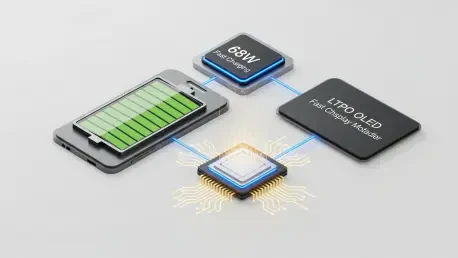
It requires a radical rethink of heat dissipation to keep a device functional under those constraints. In a device like the Motorola Edge 70, you are dealing with a chassis that is only 6mm thick, which leaves almost no room for traditional air pockets or bulky internal cooling vents. To handle a 68W charging cycle—which can juice the phone to 85% in just 30 minutes—engineers must use highly efficient vapor chambers and thin graphite sheets to spread heat across the entire back panel. The sacrifice is often seen in the raw endurance, where the 4,800mAh unit manages a modest 13:36h active use score in testing. You also lose the luxury of space for certain camera hardware; for instance, this specific model lacks a telephoto module entirely to maintain that feather-light 159g feel. It is a delicate dance of shaving off millimeters while ensuring the 1220p+ OLED display doesn’t become a heat trap for the Snapdragon 7 Gen 4 chipset inside.
We are seeing a shift toward faster UFS 3.1 and 4.1 storage while the microSD slot is becoming a relic of the past in the mid-range segment. How does this reliance on non-expandable internal memory impact the long-term viability of a device, especially for those utilizing 4K 60fps video recording capabilities?
The transition is a double-edged sword that prioritizes immediate interface speed over long-term volume flexibility. Newer chipsets like the ones found in the vivo V70 allow for 4K 60fps recording, but these high-bitrate files eat up internal space with terrifying speed compared to standard 1080p footage. While moving from UFS 2.2 to the lightning-fast UFS 3.1 found in the Edge 70 provides a much smoother user experience, the removal of the microSD slot means you are permanently stuck with your initial 512GB configuration. For a power user, that internal storage can begin to feel like a closing room after a year of high-resolution photography, whereas the older Edge 60 offered the safety net of expansion. Ultimately, while the faster storage increases the device’s responsiveness and reduces app load times, it forces a more aggressive and often costly reliance on cloud services for long-term data management.
A curious phenomenon in recent testing shows that massive 6,500mAh batteries are sometimes outperformed by significantly smaller units. What specific display technologies or software tuning contribute to a 5,360mAh battery achieving superior endurance, and how should a consumer look past the raw milliampere-hour rating?
Raw capacity is often a deceptive metric when you consider the efficiency of modern LTPO panels and chipset optimization. The vivo X300, despite having a smaller 5,360mAh battery, managed an incredible 17:31h active use score, which puts many larger-battery phones to absolute shame. This is largely due to the 120Hz LTPO OLED display being able to dynamically scale its refresh rate down to save energy, combined with the power efficiency of the Dimensity 9500 chipset. Compare that to the Poco M8 Pro, which uses a massive 6,500mAh battery to get a 16:11h score; you can see that a bigger tank doesn’t always mean a longer trip if the engine is thirsty. Buyers need to look for that “Active Use Score” rather than the number printed on the box, as a smaller, well-optimized device will feel much better in the hand than a heavy brick that wastes energy through unoptimized background processes.
Mobile photography is bifurcating between massive 200MP periscope sensors and the return of dedicated 3x telephoto lenses in smaller form factors. What are the technical hurdles of cramming a triple-camera array into a compact 6.36-inch body, and how do these different optical paths redefine the user’s creative process?
Fitting a triple-camera array into a compact frame like the 6.36-inch Motorola Edge 60 Neo is a geometric nightmare for hardware designers. You have to balance the sensor size of a 50MP main camera with a 10MP 3x telephoto lens and a 13MP ultra-wide module, all while leaving enough room for a 5,000mAh battery and a charging coil. The 200MP periscope on the vivo X300 Pro offers unparalleled zoom clarity at 3.7x, but it requires a much larger physical footprint and a higher price tag to accommodate that folded optics system. This choice changes how you shoot: a compact 3x telephoto encourages quick, candid portraits and effortless street photography, while the massive periscope sensors turn the phone into a specialized tool for distance and extreme detail. It is a fundamental trade-off between the “carry-anywhere” convenience of a smaller handset and the “studio-in-your-pocket” power of a flagship imaging rig.
Certain flagship manufacturers are choosing to lean into specialized hardware, such as built-in magnets or unique selfie sensors, rather than chasing the highest processing scores. When comparing these specialized handsets to general-purpose powerhouses, where does the real practical value lie for the average user, and how much do pre-order incentives like premium headphones sway the market?
Practical value is increasingly found in the daily ecosystem and the “quality of life” features rather than just raw processing benchmarks. The Google Pixel 10 Pro, for example, uses a Tensor G5 that might lag behind the top-tier Dimensity or Snapdragon chips in gaming, but its built-in magnets and 42MP ultra-wide selfie camera provide a daily utility that many users find more valuable than a slight boost in frame rates. On the other end of the spectrum, the Sony Xperia 1 VIII leans heavily into its audio-visual heritage, offering a free pair of WH-1000XM6 over-ear headphones to entice those who value a complete media experience over a lower price point. These pre-order bundles are essential for niche players because they bridge the value gap for a consumer who might be hesitant to pay flagship prices for a device that doesn’t win the “specs war” on paper. For most, the best value is a phone that integrates seamlessly into their physical life—whether through magnetic accessories or superior ergonomics—rather than one that just wins on a spreadsheet.
What is your forecast for the smartphone market?
I expect we will see a dramatic polarization between ultra-slim “lifestyle” devices and heavy “endurance” monsters that prioritize battery life above all else. The success of phones like the 6mm thick Edge 70 shows there is a massive hunger for devices that don’t feel like a burden in the pocket, even if it means a slight hit to the total active use time. At the same time, the push for 6,500mAh batteries in the mid-range tells us that a significant portion of power users are tired of the daily charge cycle and are willing to carry a heavier device to avoid it. Ultimately, I think we are heading toward a future where “battery efficiency per gram” becomes the new standard metric, as software optimizations finally catch up to the physical limitations of lithium-ion chemistry. We will see more manufacturers focusing on how much work they can get out of every milliampere rather than just trying to fit a bigger battery into the frame.







