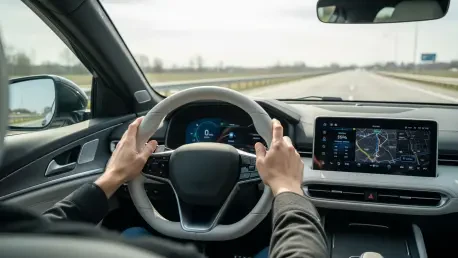

The terrifying sensation of a steering wheel suddenly jerking toward a concrete barrier while a vehicle is traveling at highway speeds remains one of the most significant psychological hurdles for users of modern semi-autonomous driving systems. This visceral fear highlights a fundamental flaw in the way humans interact with high-level driver assistance technology today. As Tesla continues to push its Full Self-Driving (FSD) software to a wider audience, critics and safety experts are raising alarms about the “supervised” model. This approach creates a precarious environment where the car handles most tasks but requires the human to remain perfectly alert for rare, life-threatening glitches.
The current landscape of automotive innovation has reached a crossroads where the convenience of automation clashes with the limitations of human biology. While the promise of a hands-free future remains a powerful marketing tool, the technical reality necessitates a level of vigilance that many drivers find difficult to maintain over long periods. This discrepancy between expectation and operation forms the core of a growing debate regarding the safety of Level 2 autonomous systems that require constant human oversight.
The Lethal Paradox of High-Reliability Automation
When a machine fails constantly, the human operator remains vigilant; when it works perfectly, the operator is unnecessary. The true danger lies in the “almost perfect” performance of Tesla’s Full Self-Driving technology, which lulls drivers into a state of complacency that makes split-second intervention physically and psychologically impossible. Because the system manages complex navigation and traffic flow successfully for 99% of a journey, the brain naturally wanders, drifting away from the high-readiness state required to handle a sudden mechanical or algorithmic error.
The intermittent nature of these failures creates what psychologists call a variable-interval reinforcement schedule, which is notoriously difficult for the human mind to monitor. Instead of being an active participant in the driving task, the person behind the wheel becomes a passive observer of a system that appears flawless. This transition from pilot to passenger-in-waiting is where the most significant risks emerge, as the system provides enough autonomy to be helpful but not enough to be truly self-reliant.
The Evolution of Autonomous Promises and the Reality of Liability
Tesla’s marketing has evolved from earlier claims that drivers would soon be able to sleep in their vehicles to the modern “supervised” model that shifts all legal responsibility to the user. This gap between corporate rhetoric and technical capability creates a societal risk where drivers trust a system that handles most tasks but fails catastrophically during the remaining 1%. The branding itself, using terms like “Full Self-Driving,” continues to suggest a level of capability that the fine print explicitly contradicts, leaving users in a state of cognitive dissonance.
Despite the sophisticated neural networks powering these vehicles in 2026, the legal framework remains firmly rooted in driver accountability. While the software processes millions of data points per second, the manufacturer maintains that the human must always be prepared to take over. This arrangement ensures that the company benefits from the data gathered during autonomous miles while the consumer bears the physical and financial consequences of any system miscalculations.
The Psychological Trap of the Five-Second Window
The “dangerous middle ground” is defined by the human brain’s inability to snap from a state of passive observation to active emergency management. Research into situational awareness suggests humans require five to eight seconds to fully re-engage with a driving environment, yet Tesla’s defensive data often cites disengagements occurring only seconds before impact as proof of driver error. This window of time is often too brief for a person to identify a specific hazard, evaluate the vehicle’s trajectory, and execute a corrective maneuver.
Furthermore, the physical transition of control presents its own set of challenges. When a driver attempts to override an automated system, they must often fight against the steering torque or braking pressure already being applied by the computer. This physical struggle, combined with the mental fog of re-engagement, creates a lag in response that can be the difference between a near-miss and a fatal collision.
Case Studies in Systemic Failure: From Model X to Cybertruck
Mozilla CTO Raffi Krikorian’s harrowing experience with a sudden steering jerk in his Model X illustrates how even experts in self-driving technology cannot overcome the latency of human reaction. While traveling on a familiar route, the vehicle unexpectedly diverted toward a wall, requiring an immediate and forceful physical correction. Krikorian noted that the system’s high reliability was actually its most deceptive feature, as it encouraged him to relax his grip just moments before the failure occurred.
Similarly, the $1 million lawsuit involving Justine Saint Amour’s Cybertruck collision highlights the physical toll of these failures, where a system disengagement moments before impact serves as a desperate reaction rather than a safe transition of control. In this instance, the vehicle crashed into an overpass barrier, resulting in severe spinal injuries and permanent nerve damage. The data logs showed a disengagement four seconds prior to impact, but for the victim, those seconds were spent in a futile attempt to wrestle control from a failing algorithm.
A Framework for Navigating Supervised Autonomy Risks
To mitigate the inherent dangers of FSD, drivers must maintain a “manual-first” mindset, treating the system as a fallible assistant rather than a primary pilot. This involves ignoring marketing narratives of full autonomy, maintaining physical readiness to override steering torque instantly, and understanding that the car’s highest performance levels are often the moments of greatest risk for human distraction. Drivers who chose to engage these systems recognized that the technology functioned best as a secondary layer of safety rather than a replacement for human judgment.
The industry moved toward clearer distinctions between convenience features and safety protocols as more data became available. Manufacturers were urged to implement more robust driver-monitoring systems that go beyond simple steering wheel torque sensors. By prioritizing transparency regarding system limitations, the automotive sector worked to close the gap between machine capability and human expectation. This shift ensured that future developments in automation were paired with a realistic understanding of human psychological constraints, ultimately fostering a safer environment for all road users.