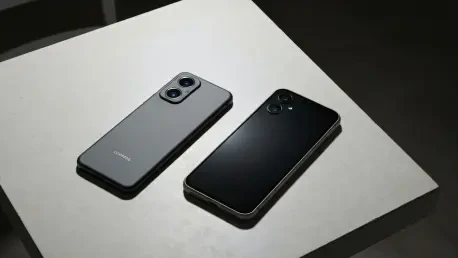

Today we’re sitting down with technology expert Oscar Vail, whose work at the forefront of emerging fields gives him a unique perspective on the smartphone industry’s trajectory. Following recent leaks of Samsung’s next-generation Galaxy S26 lineup, we’re diving deep into what these early mockups reveal about the company’s strategy. Our conversation will explore the surprising return to older design cues, the delicate balance between a device’s thinness and its power, and the immense pressure placed on artificial intelligence to justify the next wave of upgrades when physical changes appear to be more subtle than ever.
The recent leaks of the Galaxy S26 Ultra show a return to a camera island and the adoption of more rounded corners, moving away from the stark minimalism of recent years. From your perspective, what does this design shift signal about Samsung’s broader strategy, and what kind of engineering headaches might a seemingly small change like repositioning the S Pen slot create?
This shift feels like a deliberate course correction, a move away from a minimalist aesthetic that, while clean, may have become too generic across the industry. By reintroducing a structured camera island, Samsung is giving the device a stronger, more recognizable visual anchor—a signature look that stands out. It’s a statement. The uniform rounded corners are about creating a cohesive design language across the entire S26 family, which is incredibly important for brand identity on a crowded store shelf. As for the S Pen slot, moving it even a few millimeters is an absolute hornet’s nest for engineers. You can’t just drill a new hole; that change cascades through the entire internal architecture. The motherboard, the battery placement, the vibration motor, the speakers—everything is packed in a tight, three-dimensional puzzle. Shifting the slot forces a complete internal redesign to maintain balance and ensure no components interfere with one another, all while battling for every last fraction of a millimeter of space.
The article suggests the S26 lineup offers mostly “incremental” design refinements and spec bumps. In your experience, when does this kind of conservative, evolutionary approach actually succeed for a brand, and what specific on-device AI capabilities would have to be truly “game-changing” to compel someone with a Galaxy S25 to make the jump?
A conservative strategy works best when a company is at the absolute peak of its market, where the current product is already perceived as best-in-class. It minimizes risk and avoids alienating a massive, loyal user base that loves the existing formula. However, it’s a dangerous game to play for too long, as it can quickly lead to stagnation. To break through this “incremental” barrier and get S25 owners excited, the on-device AI has to feel less like a feature and more like a fundamental leap in usability. We’re not talking about slightly better photo editing. A “game-changer” would be an AI that proactively manages your day, intelligently summarizing and prioritizing your communications without you even asking. Imagine an AI-powered camera that doesn’t just capture a scene but understands the context to offer creative compositions in real-time, or a device that can generate entire presentations from a few voice notes, all securely on the device itself. It has to save significant time or unlock creative potential that feels impossible on the previous generation.
There are rumors the S26 Ultra will be thinner but feature a more pronounced camera bump, partly to accommodate wider apertures for the cameras. Could you walk us through the technical tug-of-war happening here and how the quest for a thinner profile often impacts other critical elements like the battery or cooling systems?
This is the classic, brutal trade-off in smartphone design. The desire for a thinner, sleeker chassis is constantly at war with the laws of physics. To capture more light and produce better photos, especially in dim conditions, you need wider apertures, and those require physically larger lens elements. When you make the phone’s body thinner, that larger camera module has nowhere to go but out, creating a more prominent bump. It’s an unavoidable compromise. This obsession with thinness inevitably puts immense pressure on other components. The battery is almost always the first victim; a thinner frame means less internal volume, which translates directly to a smaller battery cell or a more complex, expensive L-shaped design. Secondly, the cooling system suffers. A powerful processor generates a lot of heat, and a slim device has less surface area and internal space for heat pipes or vapor chambers to dissipate that thermal energy, potentially leading to performance throttling during intensive tasks like gaming. Samsung is essentially betting that the premium in-hand feel and camera improvements will outweigh potential compromises in battery life and sustained performance.
The leaks suggest the standard Galaxy S26 will get a larger 6.3-inch screen and a slightly chunkier frame. What does this decision tell you about the target customer for the base model, and how does this move align with what we’re seeing in the broader market for non-pro flagship phones?
This move signals that Samsung is fully embracing the reality that the market for truly compact, small-screened flagships is a very small niche. By bumping the display to 6.3 inches, they are directly targeting the mainstream consumer whose primary use for a phone is media consumption—scrolling through Instagram, watching videos, and casual gaming. For those activities, a larger, more immersive screen is simply a better experience. The “chunkier” build is not a design flaw; it’s a very intentional and intelligent consequence. It strongly suggests that Samsung is prioritizing a larger battery to power that bigger display, addressing one of the most significant pain points for the average user. This aligns perfectly with the market trend for non-pro flagships, which is a move away from compromises on fundamentals. Customers in this tier want a reliable, all-day device with a great screen, and they are willing to accept a slightly thicker phone to get it.
What is your forecast for Samsung’s flagship strategy? Given these incremental hardware changes, will a heavy reliance on on-device AI be enough to drive future sales, or will consumers begin demanding more significant hardware and design innovations to justify upgrading?
In the short term, for the next one or two generations, a truly revolutionary suite of on-device AI features could absolutely be enough to drive sales and create a compelling reason to upgrade. If Samsung can successfully market this as a new era of “intelligent phones” that fundamentally change the user experience, it can mask the lack of dramatic hardware changes. However, this is a temporary solution. The tech world moves incredibly fast, and competitors will inevitably catch up on the AI front. Once on-device AI becomes a standard feature across all flagships, the novelty will wear off, and consumers will once again turn their attention to the physical hardware. At that point, a lack of tangible innovation in design, camera systems, or battery technology will become a glaring weakness. To maintain its leadership position and justify premium pricing in the long run, Samsung must walk a tightrope, balancing groundbreaking software intelligence with the meaningful hardware and design evolution that customers can see and feel. AI can be the main attraction for now, but it can’t be the only act on stage forever.