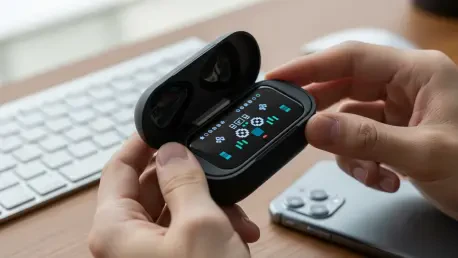

The recent integration of interactive displays into earbud charging cases presents a fascinating, if not perplexing, development in the personal audio sector, pushing the boundaries of what consumers expect from their devices. This review explores this evolution by focusing on the Groov-e Neo Buds and their gaming-centric case to analyze its key features, performance, and the broader impact of such innovations on the user experience. The primary purpose is to provide a thorough understanding of this technology, assess its current capabilities, and question its potential future as either a meaningful feature or a passing gimmick.
The Rise of Multi-Functional Earbud Cases
The wireless earbud charging case has steadily transformed from a simple power bank into a potential smart accessory. This section introduces the core principle of integrating non-audio functionalities, such as interactive displays and embedded games, directly into the case. This trend emerged as manufacturers sought new ways to differentiate their products in a highly competitive market, challenging conventional design and function.
This evolution reflects a strategic pivot in product development, where the accessory itself becomes a key selling point. By embedding features traditionally found on smartphones, companies aim to create a more integrated and engaging ecosystem around their audio products. The underlying goal is to add perceived value beyond core audio performance, transforming a utilitarian object into an interactive gadget that captures consumer attention in a saturated landscape.
A Critical Look at the Groov-e Neo Buds’ Case Features
The Gaming Feature A Missed Opportunity
This review delves into the case’s primary gaming feature, a knock-off of the once-viral sensation “Flappy Bird.” Its intended function as a built-in distraction is profoundly undermined by poor execution. The performance is plagued by significant flaws, including overly simplistic gameplay, the complete absence of iconic sound effects, a broken reward system, and the inability to save high scores.
What could have been a charming and nostalgic feature ultimately becomes a significant piece of missed potential. The lack of challenge, coupled with the technical shortcomings, strips the game of the addictive quality that made its inspiration a global phenomenon. Consequently, the experience feels hollow and underdeveloped, failing to provide the quick, engaging diversion it promises and instead highlighting a lack of polish and attention to detail.
Utility Functions and Display Redundancy
Beyond the game, the case’s display offers access to a flashlight, a timer, and EQ settings. However, a closer look reveals these features to be almost entirely superfluous. In any real-world usage scenario, a smartphone provides these same utilities with vastly superior functionality, a more intuitive interface, and greater reliability, which is a crucial consideration.
The inclusion of these functions on a tiny, secondary screen is a clear example of redundant design. The process of navigating the small display to access a dim flashlight or a basic timer is less efficient than simply using the device already in one’s pocket. This ultimately renders the case’s utility features an unnecessary addition that adds complexity without providing any tangible benefit over existing, more capable solutions.
Smart Cases as a New Industry Trend
Recent developments in the earbud market show a clear shift toward feature-rich accessories, with the charging case becoming a new battleground for innovation. The Groov-e Neo Buds exemplify this emerging trend, where the focus expands beyond core audio performance to include novel interactive elements. This reflects a broader industry push to create a more holistic and engaging user experience.
This movement is driven by the need for brands to stand out. As audio quality at various price points becomes increasingly standardized, manufacturers are exploring unconventional features to capture market share. However, the success of such strategies remains in question, as it hinges on whether these additions offer genuine value or merely serve as fleeting novelties without long-term appeal.
Real-World Applications Novelty Versus Necessity
This section highlights the real-world application of gaming earbud cases, questioning whether there is a genuine need for such a feature. While the initial concept of having a game available without pulling out a phone is amusing, its practical utility is extremely limited. The enjoyment is fleeting, lasting only until the initial curiosity wears off.
The implementation on the Groov-e Neo Buds serves as a key example where the feature provides a moment of novelty but lacks the substance and quality required for regular, enjoyable use. It fails to become a compelling reason to choose this product over its competitors. The feature exists more as a marketing bullet point than a genuinely useful or entertaining function, raising questions about the allocation of development resources.
Challenges and Limitations of Integrated Case Features
This technology faces significant challenges, primarily the risk of being perceived as a gimmick rather than a valuable innovation. Technical hurdles, such as the poor execution and unresponsive controls seen in the Neo Buds’ game, detract immensely from the experience. These flaws can damage consumer trust and make them wary of similar features in the future.
The primary market obstacle is convincing consumers to prioritize these novel features over fundamental aspects like audio quality, battery life, and comfort. When the features themselves are poorly implemented, the challenge becomes nearly insurmountable. For a product’s secondary functions to be a deciding factor, they must be executed flawlessly and offer a clear benefit that justifies any potential compromise in core performance.
The Future of Interactive Earbud Cases
The outlook for interactive earbud cases depends entirely on the quality and utility of their features. While the Groov-e Neo Buds represent a flawed first attempt, the potential for meaningful innovation remains. Future developments could include more polished games, seamless integration with smartphone apps, or genuinely useful display functions that streamline daily tasks.
For this technology to have a long-term impact, however, manufacturers must ensure these additions enhance, rather than detract from, the core user experience. The focus should be on creating features that solve a real problem or provide a high-quality entertainment experience. Without a commitment to excellence in both design and function, the interactive case is destined to be remembered as a curious but ultimately failed experiment.
Conclusion and Final Recommendations
In summary, while the idea of a gaming earbud case was intriguing, the Groov-e Neo Buds failed to deliver a compelling experience. The game proved to be a poorly executed gimmick, and the other display functions were redundant in the face of universally available smartphone utilities. The product’s subpar audio performance and uninspired design were not offset by its novel but hollow case. This review concluded that consumers should prioritize core performance and invest in superior alternatives, like the JLab Go Pods ANC or Earfun Air Pro 3, which proved that excellent audio quality and build are more valuable than a poorly implemented gimmick.