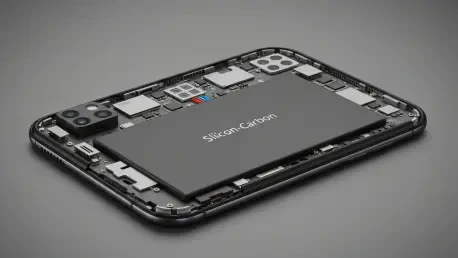

It wasn’t long ago that a phone with a battery over 5,000 mAh felt more like a brick than a modern device. But thanks to advancements like silicon-carbon anode technology, we’re seeing a new breed of smartphone emerge. To unpack this evolution, we’re speaking with technology expert Oscar Vail, whose work at the forefront of consumer electronics gives him a unique perspective on the engineering marvels that are reshaping our expectations. We’ll explore the design choices behind packing unprecedented power into a slim form, the real-world impact of next-generation chipsets, the balance of extreme durability with mainstream appeal, and the market strategy of a device that prioritizes endurance above all else.
The Honor Power2 packs a massive 10,080 mAh silicon-carbon battery into a slim 7.98mm frame. Beyond the new anode tech, what were the biggest engineering hurdles in achieving this power density, and can you walk us through the design process that made this form factor possible?
Absolutely, the silicon-carbon anode is the star, but it’s only part of the story. The real challenge was a complete internal reconfiguration. You can’t just swap in a bigger battery; you have to redesign everything around it. We’re talking about a microscopic, high-stakes game of Tetris with the motherboard, the camera modules, and the antenna placements. Every single millimeter was scrutinized to accommodate that 10,080 mAh cell. The goal was to eliminate any wasted space, making the internal architecture as dense as the battery itself. The result is something that feels almost impossibly sleek in your hand when you know the power it holds, weighing just 216 grams.
As the first phone with MediaTek’s Dimensity 8500 Elite, its “all-big core” design scored over 2.4 million on AnTuTu. Could you detail how this translates to real-world efficiency for the huge battery and what specific optimizations were made to achieve 14 hours of non-stop gaming?
That 2.4 million AnTuTu score is more than just a number for bragging rights; it’s a testament to raw, efficient power. The “all-big core” architecture is a game-changer for battery life. Instead of relying on small, efficient cores for light tasks and power-hungry big cores for heavy lifting, this design uses its powerful Cortex-A725 units more intelligently. For most tasks, they can run at a lower, more efficient clock speed, sipping power instead of guzzling it. To achieve 14 hours of non-stop gaming, the optimizations run deep. It’s a symphony between the hardware and the MagicOS software, ensuring the Mali-G720 GPU only draws the exact power it needs frame by frame. This prevents wasteful energy spikes, stretching every last milliamp of that enormous battery.
The Power2 balances 80W fast charging with a powerful 27W reverse charging feature. What specific thermal management systems are in place to handle this two-way power flow, and could you share some anecdotes where the reverse charging proved to be a game-changer during internal testing?
Managing heat in two directions is a significant thermal engineering feat. Pushing 80 watts into the battery generates one kind of heat signature, while pulling 27 watts out to charge another device creates a completely different one. The system has to be robust enough for both. This involves a multi-layered approach, likely using a combination of vapor chambers and graphite sheets to rapidly dissipate heat away from the battery and chipset, whether it’s charging or discharging. I remember one field test where a photographer’s drone battery died mid-shoot. The Power2 stepped in, and its 27W reverse charging got the drone back in the air fast enough to capture the perfect sunset shot. It completely validated the feature’s purpose—it’s not a gimmick, it’s a genuine tool.
Achieving IP68, IP69, and IP69K ratings is impressive for a non-rugged phone weighing just 216 grams. Can you elaborate on the specific structural reinforcements and sealing techniques used and how you balanced this extreme durability with a mainstream, consumer-friendly design?
Achieving an IP69K rating is the real standout here; it means the device can withstand close-range, high-pressure, high-temperature water jets. For a sleek, mainstream phone, that’s almost unheard of. This isn’t achieved with bulky rubber gaskets. Instead, it requires precision-molded seals and industrial-grade adhesives applied with robotic accuracy around every single opening—from the SIM tray to the speaker grille. The internal frame is also structurally reinforced to prevent flexing under pressure, which could compromise the seals. The key was integrating this protection invisibly. We focused on material science and micro-engineering so the device feels premium and light, not like a piece of industrial equipment.
At a competitive $385 starting price, the Power2 pairs a 50MP OIS main camera with a 5MP ultrawide. What was the strategy behind these specific camera choices, and what market segment is Honor targeting by prioritizing battery and performance over a higher-spec secondary camera?
The strategy here is incredibly focused and smart. At the $385 price point, you simply cannot be the best at everything. Honor made a clear decision to serve the true “power user”—the person whose phone is their primary tool for work, navigation, and entertainment all day long. For this user, a battery that lasts over 20 hours and a top-tier chipset are non-negotiable. The 50MP main camera with OIS is an excellent, reliable shooter for the vast majority of photos people take. By opting for a more basic 5MP ultrawide, they freed up budget to invest in what makes this phone truly special: its unprecedented endurance and flagship-level performance. It’s a direct appeal to the segment of the market that is tired of carrying a power bank.
What is your forecast for the future of smartphone battery technology?
I believe we’re on the cusp of another major leap. While silicon-carbon is the hero of today, increasing density, the next frontier is a two-pronged attack on charging speed and longevity. We’re going to see commercially viable solid-state batteries in the next few years, which will not only be safer but will enable charging speeds that seem like science fiction today—think a full charge in the time it takes to brew a cup of coffee. The focus will also shift to battery health and lifespan. The ultimate goal is a battery that not only lasts for days on a single charge but also retains over 90% of its capacity after a thousand charge cycles, effectively lasting the entire lifetime of the device.