
Joining us is Oscar Vail, a technology expert whose insights cut through the noise of product launches to reveal the deeper trends shaping our future. With a background spanning from robotics to open-source projects, Oscar is uniquely positioned to dissect the complex world of wearable technology. Today, we’ll explore the fascinating strategic battle in the smartwatch market, the device’s transformation into a proactive health guardian, the intricate challenges of medical regulation, and the relentless pursuit of the industry’s next “Holy Grail.”
Reports suggest a fascinating split in the smartwatch market, with some brands leading in units shipped while others capture a larger overall market share. What key factors contribute to this dynamic, and what does it reveal about different brands’ global strategies and target audiences?
It’s a classic tale of two distinct business philosophies playing out on our wrists. On one hand, you have a brand like Apple, which has masterfully cultivated a premium ecosystem. They lead in overall market share, capturing an estimated 23% last year, because they command a higher price point and sell a high-value experience, not just a device. On the other hand, you see a strategy focused on volume. Huawei, for instance, is projected to lead in units shipped for 2025, topping a list that includes Xiaomi, Apple, and Samsung. This indicates a different approach—likely a broader portfolio of devices at various price points, targeting a wider global demographic and prioritizing market penetration over sheer revenue per device. It shows the market is mature enough to support both a high-end, aspirational segment and a high-volume, accessibility-focused one.
The new coronary heart disease risk assessment requires several days of continuous wear to function. Could you walk us through the user experience, from opting into the research project to receiving the results, and explain the significance of this kind of proactive health screening?
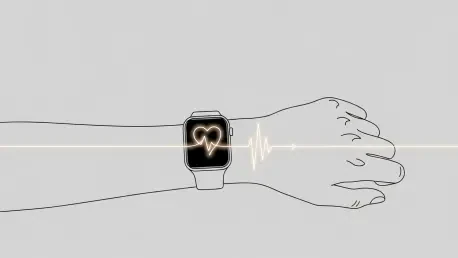
The experience is designed to be almost invisible, which is precisely what makes it so powerful. You begin by actively consenting to join the coronary heart disease research project through the dedicated app on your phone. From that moment, the watch becomes a silent sentinel. You just live your life—working, sleeping, exercising—and for the next three to four days, the device diligently collects your vital signs around the clock. You can almost forget it’s happening. Then, after that period, the app presents you with your risk assessment. This is a monumental shift from reactive to proactive health. We’re moving beyond simple fitness tracking into the realm of preventative screening, where a device you wear every day can offer an early warning about a potential blockage in your heart’s arteries. It transforms the smartwatch from a gadget into a genuine health partner.
Smartwatches are now offering professional-grade cycling data, such as simulated cadence and 3D distance compensation, eliminating the need for separate sensors. How does this integrated technology work, and what specific advantages does it offer cyclists over traditional 2D GPS tracking?
This is where the fusion of multiple sensors creates something greater than the sum of its parts. Traditionally, to get data like cadence, you’d have to physically attach a sensor to your bike’s crank arm. Now, the watch’s sophisticated algorithms can simulate that data in real-time. The more impressive leap, however, is the 3D distance compensation. Instead of just tracking your movement as a flat dot on a map, the watch uses its built-in barometer to measure changes in altitude and combines that with GPS data. This creates a true three-dimensional picture of your ride. Imagine you’re grinding up a steep, one-mile hill at a 45-degree angle. A standard 2D tracker would only register the forward movement, maybe 0.7 miles, completely ignoring the immense effort of your vertical ascent. This integrated 3D tracking provides a far more accurate and professional-level understanding of your actual performance and exertion.
Features like ambulatory blood pressure monitoring and hyperglycemia risk assessment are appearing on some smartwatches but not others. What technical and regulatory hurdles must be overcome to bring these features to a wider audience, especially considering the differences between CE, NMPA, and FDA clearance?
The primary hurdles are less about technical possibility and more about medical validation and regional regulation. Take ambulatory blood pressure monitoring on a device like the Huawei Watch D2; it uses a tiny, inflating micro air-bag on the wristband to take readings, even while you sleep. This is a significant engineering feat. However, to be marketed as a medical tool, it needs approval. Huawei has secured CE MDR clearance in Europe and NMPA in China for features like this, as well as for ECG analysis and hyperglycemia risk assessment. The United States, with its FDA, has a different, often more stringent, set of requirements. Navigating this global patchwork of regulatory bodies is a monumental task for any company. It’s why you see a feature available in one country but absent in another—it’s not that the watch can’t do it, but that it hasn’t yet been legally certified to do so everywhere.
Non-invasive glucose monitoring is often called the “Holy Grail” for smartwatches. Based on the current technological trajectory, what are the primary obstacles to making this a reality, and what impact could its successful implementation have on personal health management for millions?
The term “Holy Grail” is not an exaggeration. The challenge is immense because it requires measuring a specific biomarker in the blood, glucose, without ever breaking the skin. Companies are pouring resources into optical sensors and other technologies to try and achieve this, but accurately and consistently measuring glucose levels through the skin is an incredibly complex biophysical problem. You have to account for skin tone, hydration, and a dozen other variables that can throw off a reading. But the impact of cracking this problem would be world-changing. For millions of people with diabetes, it would mean an end to painful, daily finger pricks. It would provide a continuous, 24-hour map of their body’s response to food and activity, enabling a level of personal health management and disease prevention that we can currently only dream of.
What is your forecast for the future of wearable health technology?
My forecast is a move from passive tracking to active intervention. Right now, our wearables are fantastic at collecting data—steps, heart rate, sleep quality. The next frontier is turning that data into real-time, actionable coaching and, eventually, predictive alerts. We’re already seeing the beginnings of this with features like hyperglycemia risk alerts and heart disease screening. In the near future, your watch won’t just tell you that you slept poorly; it will analyze your vitals and activity from the previous day to suggest concrete actions, like forgoing that late-night coffee or taking a walk after dinner. It will become a deeply personalized health advisor that understands your body’s unique patterns, quietly working in the background to not just monitor your health, but to actively improve it.