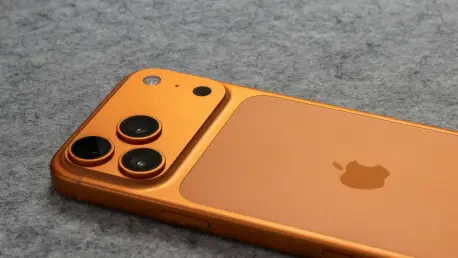

Joining us is Oscar Vail, a technology expert whose insights into emerging fields like robotics and open-source projects give him a unique perspective on the consumer tech landscape. Today, we’re diving deep into Apple’s latest offerings, moving beyond the spec sheets to understand the real-world implications of the new iPhone 17. Our conversation will explore how significant upgrades to the display and performance translate to daily use, dissect the subtle yet important differences in camera and audio hardware, and unravel the surprising nuances of battery life that challenge the idea that newer is always better.
The iPhone 17’s 120Hz LTPO display is a major shift from the iPhone 16’s 60Hz panel. Beyond smoother scrolling, how does this affect features like the Always-On Display, and what’s the practical impact of the iPhone 16 sustaining peak brightness for longer periods?
The move to a 120Hz LTPO panel is genuinely the biggest leap forward for the standard iPhone in years. That silky-smooth scrolling is immediately noticeable, making the entire interface feel more fluid and responsive. But the real game-changer is how the display’s intelligence enables new features. Because it can drop its refresh rate all the way down to 1 Hz, Apple could finally bring the Always-On Display to the standard model, which is a massive quality-of-life improvement. The surprising part of our testing, however, was seeing the iPhone 16 hold its peak brightness for longer. While the iPhone 17 can get just as bright, it throttles down more quickly. This means if you’re outside on a sunny day trying to read a long article, the iPhone 16’s display might actually remain more consistently legible over an extended period.
With its A19 chip and doubled 256GB base storage, the iPhone 17 seems built for longevity. For the average user who mostly browses and uses social media, where would these performance gains be most noticeable, and when does the iPhone 16 still represent a smarter value?
That’s a fantastic point because raw power doesn’t always translate to a better experience for everyone. For that average user, the most noticeable difference won’t be in opening apps—both phones are incredibly fast. Instead, they’ll feel the A19’s efficiency in subtler ways, like improved thermal control during a long video call or faster photo processing when they take a burst of shots. The real benefit is future-proofing; that extra headroom ensures the device will feel snappy for years to come. However, the iPhone 16 is still a powerhouse, and if your usage is truly limited to light tasks and you don’t need 256GB of storage, it represents a much smarter value. Its performance is far from obsolete, and with prices dropping, it’s a compelling choice for those looking to save a few hundred dollars without a significant compromise in the core experience.
The iPhone 17 features a new 48MP ultrawide and an 18MP multi-aspect selfie camera. Given that the real-world image quality gains can be subtle, could you break down a specific scenario where the hardware in the newer model provides a distinct, tangible advantage over the iPhone 16?
This is where you have to look beyond the megapixel count. Let’s imagine you’re out at night with friends in a poorly lit area. With the iPhone 16’s ultrawide, you’d get a usable but probably noisy shot. On the iPhone 17, the new 48MP sensor gives you the option to enable Night Mode for that camera. It takes a moment longer to capture, but the result is a dramatically improved image with better detail and dynamic range. For the selfie camera, the advantage is all about flexibility. The 18MP multi-aspect sensor lets you capture both landscape and portrait shots at full resolution without cropping. So, if you’re trying to fit a large group into a selfie or capture a wide background, the iPhone 17 gives you that extra canvas to work with, which is something the 16’s fixed 12MP shooter simply can’t do.
Interestingly, testing shows the iPhone 16 has objectively louder speakers, while the iPhone 17’s are quieter but more controlled. Could you elaborate on this difference in audio tuning? Please describe a few examples of how this might affect the listening experience for music, podcasts, or movies.
It’s one of those counterintuitive findings where the older model wins on a specific metric. The iPhone 16 registered a “Very Good” –25.5 LUFS in our loudness tests, while the 17 came in at a “Good” –27.5 LUFS. When you listen to a high-energy pop song, the iPhone 16 will sound livelier and fill a room more effectively, giving it more punch. However, when you crank the volume up on a movie with complex sound design—explosions, dialogue, and a musical score all at once—the iPhone 17’s more controlled tuning really shines. It avoids harshness and distortion, sounding more natural and refined at those higher volumes. For podcasts, the difference is negligible, but for music or films, it’s a trade-off: the iPhone 16 offers more raw volume, while the 17 provides a more balanced, arguably higher-fidelity experience when pushed.
Despite a larger battery and more efficient components, the iPhone 17 posted a slightly lower Active Use Score than the iPhone 16. Can you walk us through the factors that contribute to this result and explain how a user’s specific habits might lead to different outcomes on each device?
This result genuinely surprised us. The iPhone 16 clocked in at 15 hours and 42 minutes in our Active Use Score, beating the 17’s 14 hours and 59 minutes. This really highlights that overall scores don’t tell the whole story. The iPhone 16 excelled specifically in web browsing and call times, which weigh heavily in our standardized test. However, the iPhone 17, with its efficient A19 chip and LTPO display, pulled ahead in video playback and gaming. So, a user’s habits are critical here. If your day consists of constant web browsing and calls, you might genuinely get better battery life from the iPhone 16. But if you’re a heavy media consumer who spends hours watching videos or gaming, the iPhone 17’s superior power management in those specific tasks will give you more screen-on time.
What is your forecast for Apple’s standard iPhone line?
I believe Apple is on a clear trajectory to further blur the lines between the standard and Pro models. The introduction of the 120Hz LTPO display in the iPhone 17 was a massive step in that direction, eliminating the most significant experiential gap. Looking ahead, I forecast that features currently exclusive to the Pro line, such as more advanced telephoto lenses or even the titanium frame, will eventually trickle down to the standard iPhone. The goal seems to be creating a more unified lineup where the “Pro” designation is defined by cutting-edge, niche features for creators, rather than fundamental user experience upgrades like a high-refresh-rate screen. The standard iPhone will continue to become a more complete, “pro-enough” package for the vast majority of users.